Loading...
Done
‘‘Air Drive’’ by Photographer Renaud Marion

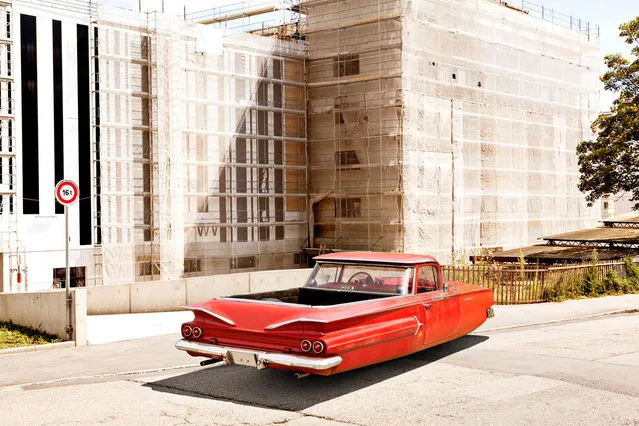
Τhe hovering car without wheels, also called the hovercar, is a constant fixture in science fiction films, video games and comic books, and a long-standing dream for car lovers and technology fans alike. This dream is also shared by French photographer Renaud Marion, who creates images depicting hovering cars in everyday urban settings. In his ongoing photographic project titled ‘‘Air Drive’’, Marion combines retro car designs with futuristic technology, a project driven by his childhood visions of how the world was going to look like in the future. (Photo by Renaud Marion)
Details
13 Jul 2014 10:43:00
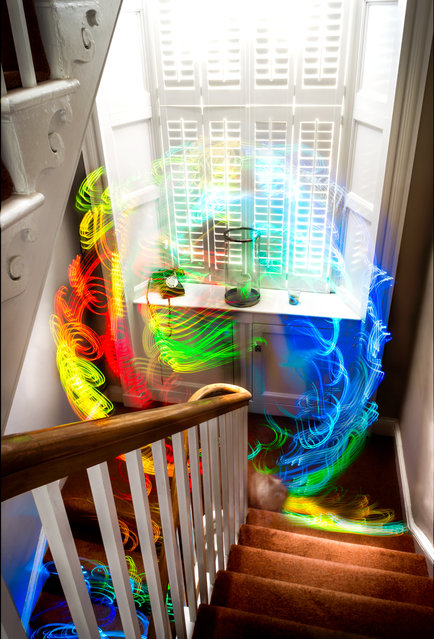
His goal with the project is to make the invisible visible. (Photo by Luis Hernan)

Luis Hernan was always curious about how wireless technologies like radio are transmitted through the air. So after finishing up his studies in architecture, computer science, and design, Hernan decided to research these invisible signals through a PhD at Newcastle University. Hernan set up a system that turned the wireless signals around him into colourful, ghostlike images using long-exposure photography, allowing people to see the strength of the signals around them. (Photo by Luis Hernan)
Details
13 Aug 2014 09:38:00
The known as “callejón de los brujos” has become an alternative for the sick in Venezuela. (Photo by Alvaro Fuente/NurPhoto via Getty Images)

The known as “callejón de los brujos” has become an alternative for the sick in Venezuela. The health crisis that affects hundreds of Venezuelans who face every day the serious shortage of medicines, lack of medical supplies and the high costs of medicines that are unattainable for the population. However, many Venezuelans have resorted to alternative methods to science in recent years. (Photo by Alvaro Fuente/NurPhoto via Getty Images)
Details
25 Dec 2017 05:57:00
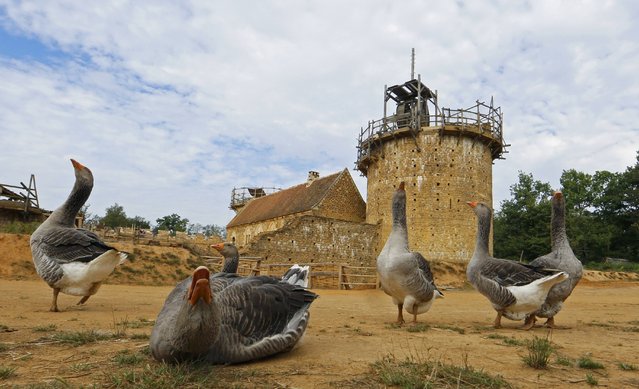
A view of the construction site of the Chateau de Guedelon near Treigny in the Burgundy region of France, September 13, 2016. Blacksmiths, stonemasons and quarry men are hard at work in a Burgundy forest building a 13th-century-style castle using the most basic tools and materials, replicating the methods used hundreds of years ago to better understand them. Forgoing all modern technology, workers use hammers to break stones and forge iron, operate wooden wheels to hoist their materials up to where they are needed, and rely on a quarry for stone, clay and sand as they build up a castle from scratch. Construction on Guedelon Castle in central France began in 1997 after an archaeological survey revealed a medieval fortress hidden inside the walls of nearby Chateau de Saint-Fargeau. Those behind the project hope to answer questions about medieval construction and provide lessons on sustainable building. (Photo by Jacky Naegelen/Reuters)

A view of the construction site of the Chateau de Guedelon near Treigny in the Burgundy region of France, September 13, 2016. Blacksmiths, stonemasons and quarry men are hard at work in a Burgundy forest building a 13th-century-style castle using the most basic tools and materials, replicating the methods used hundreds of years ago to better understand them. (Photo by Jacky Naegelen/Reuters)
Details
15 Sep 2016 09:43:00
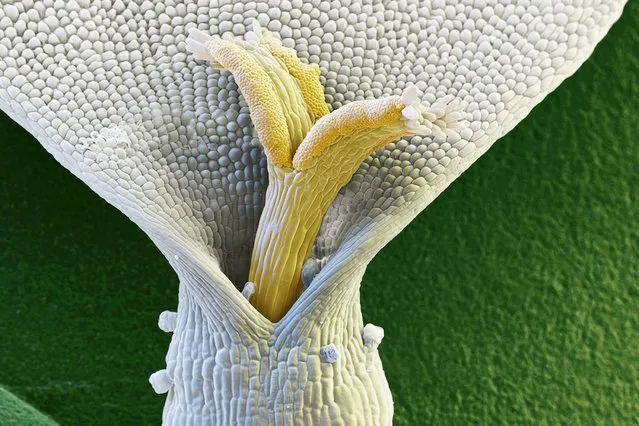
The floret of a Chamomile flower up close and personal. (Photo by Oliver Meckes/Barcroft Media)

These images have been created using a colour scanning electron microscope (SEM) by the award-winning Eye of Science, comprised of snapper Oliver Meckes and biologist Nicole Ottawa. For a decade the pair, based in Reutlingen in the south of Germany, worked with an old SEM they saved from the scrapheap, but for the last five years they have used a £250,000 FEI Quanta Series Field Emission SEM. Oliver said: “Flowers are beautiful in 'normal' view, but when you look closer, some parts get very bizarre and unexpected structures appear – flowers within flowers, worlds within worlds”. Photo: The floret of a Chamomile flower up close and personal. (Photo by Oliver Meckes/Barcroft Media)
Details
26 May 2014 13:51:00
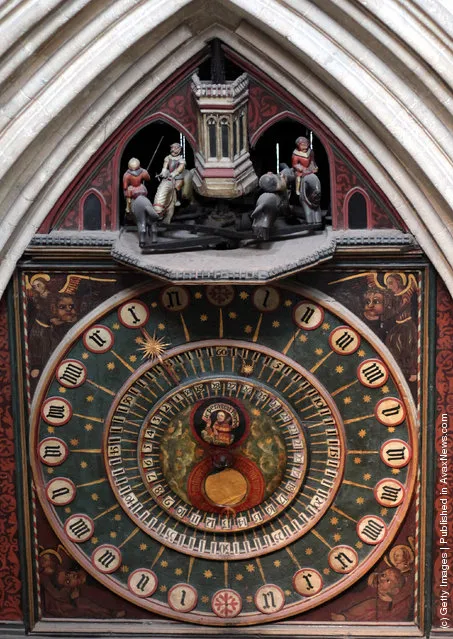
Wells Clock – World's Oldest Mechanical Clock

“Wells Cathedral is a Church of England cathedral in Wells, Somerset, England. Built between 1175 and 1490, Wells Cathedral has been described as “the most poetic of the English Cathedrals”. The Wells clock, an astronomical clock, is located in the north transept. The surviving mechanism, dated to between 1386 and 1392, was replaced in the 19th century, and was eventually moved to the Science Museum in London, where it continues to operate. It is the second-oldest surviving clock in England”. – Wikipedia

Photo: The clock face of world's oldest continually-working mechanical clock is seen as it is hand wound for the very last time on August 21, 2010 in Wells, England. (Photo by Matt Cardy/Getty Images)
Details
10 Aug 2011 11:23:00
Farmer Builds Own Bionic Arms

Sun Jifa, a farmer in China, had his life changed forever when an explosive he planned on using for fishing went off prematurely. He lost his arms and when he couldn’t afford high-end, hospital-made prosthetics he opted for a cheaper set. Finding those to be less than acceptable, Sun started building his own pair of arms, which he currently wears. It’s an incredible story of ingenuity and personal strength.
Details
14 Jun 2013 10:02:00


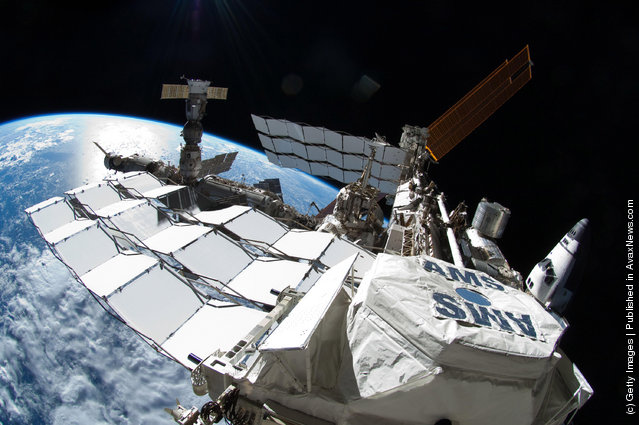
Space shuttle Atlantis (R) remains docked to the International Space Station photographed by NASA astronaut Ronald Garan during a planned six-and-a-half-hour spacewalk July 12, 2011 in space. Space shuttle Atlantis has embarked on a 12-day mission to the International Space Station where it will deliver the Raffaello multi-purpose logistics module packed with supplies and spare parts. This was the final mission of the space shuttle program, which began on April 12, 1981 with the launch of Colombia. (Photo by NASA via Getty Images)
Details
20 Jul 2011 12:23:00