Loading...
Done
Australian actress Elizabeth Debicki pictured as Princess Diana wearing her “Revenge Dress” at Vanity Fair's annual fundraising gala for the Serpentine Gallery while filming hit Netflix TV series “The Crown” in London, United Kingdom on November 1, 2021. The dress, created by Greek fashion designer Christina Stambolian, is one of the most famous dresses the late Princess wore. The form fitting, off-the-shoulder chiffon cocktail dress was worn in June 1994. The same night Diana wore the dress to the Serpentine party, her estranged husband, Prince Charles, confessed on national television that he had been unfaithful to her. (Photo by Splash News and Pictures)

Australian actress Elizabeth Debicki pictured as Princess Diana wearing her “Revenge Dress” at Vanity Fair's annual fundraising gala for the Serpentine Gallery while filming hit Netflix TV series “The Crown” in London, United Kingdom on November 1, 2021. The dress, created by Greek fashion designer Christina Stambolian, is one of the most famous dresses the late Princess wore. The form fitting, off-the-shoulder chiffon cocktail dress was worn in June 1994. The same night Diana wore the dress to the Serpentine party, her estranged husband, Prince Charles, confessed on national television that he had been unfaithful to her. (Photo by Splash News and Pictures)
Details
28 Nov 2021 07:40:00
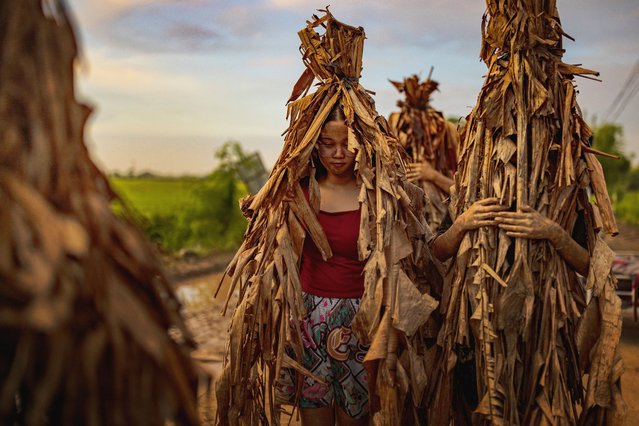
Devotees of the small farming village of Bibiclat celebrate the Feast of Saint John the Baptist while covered in banana leaves and mud on June 24, 2025 in Aliaga, Philippines. Known as the “Taong Putik” (mud people), the ritual happens yearly in this small farming village as their own version of expressing their faith and celebrating the feast of Saint John the Baptist whom the survivors of the Japanese occupation in 1944 in their area prayed to for rain to save their fellow villagers. A marker near the church entrance of the village tells a story of a heavy torrential rain that happened that day that forced the Japanese military to call off the execution of 14 villagers. The Philippines is the only predominantly Catholic country in Southeast Asia after more than 300 years of Spanish rule. (Photo by Ezra Acayan/Getty Images)

Devotees of the small farming village of Bibiclat celebrate the Feast of Saint John the Baptist while covered in banana leaves and mud on June 24, 2025 in Aliaga, Philippines. Known as the “Taong Putik” (mud people), the ritual happens yearly in this small farming village as their own version of expressing their faith and celebrating the feast of Saint John the Baptist whom the survivors of the Japanese occupation in 1944 in their area prayed to for rain to save their fellow villagers. (Photo by Ezra Acayan/Getty Images)
Details
29 Aug 2025 03:18:00
Bristol Museum & Art Gallery representatives on Monday, June 23, 2025 hold an empty frame against Avon Gorge in Bristol, which was painted by JMW Turner in The Rising Squall, Hot Wells, from St Vincent's Rock, Bristol (1792). A fundraising campaign has been launched to bring one of the earliest works by Turner back to the city of Bristol where the artist painted it when he was 17 years old. Bristol Museum & Art Gallery is now keen to acquire the work, which is believed to be the only oil painting Turner made of the city. (Photo by Ben Birchall/PA Images via Getty Images)

Bristol Museum & Art Gallery representatives on Monday, June 23, 2025 hold an empty frame against Avon Gorge in Bristol, which was painted by JMW Turner in The Rising Squall, Hot Wells, from St Vincent's Rock, Bristol (1792). A fundraising campaign has been launched to bring one of the earliest works by Turner back to the city of Bristol where the artist painted it when he was 17 years old. Bristol Museum & Art Gallery is now keen to acquire the work, which is believed to be the only oil painting Turner made of the city. (Photo by Ben Birchall/PA Images via Getty Images)
Details
22 Dec 2025 08:25:00
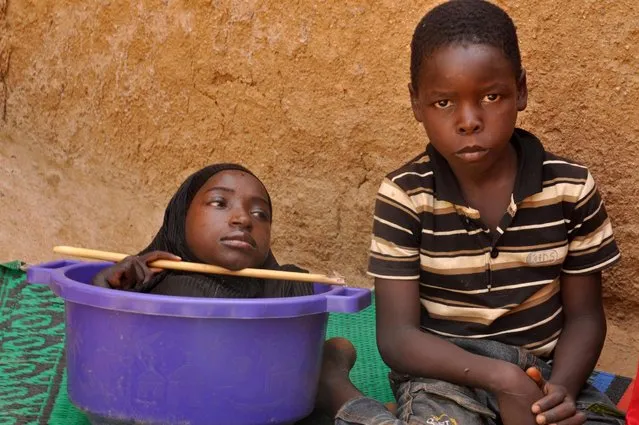
Rahma, 19, pictured with her 10-year old brother Fahad on June 21, 2016 in Kano, Nigeria. A teenage girl born without limbs lives her life in a plastic bowl. Rahma Haruna is a bright, happy girl, despite suffering from a mystery condition that stopped her arms and legs developing properly – leaving her practically limbless and in constant pain. The 19-year- old, from Kano, Nigeria, was born a healthy baby but when she turned six months old her growth came to a sudden halt and she stopped hitting key development milestones. Rahma’s family do their best to provide her with a fulfilling life and transport her around the village in a plastic bowl. Rahma said: “They help me a lot. How do they? They give me anything I need”. Rahma died on 25 December 2016. (Photo by Sani Maikatanga/Barcroft Images)

Rahma, 19 (L), pictured with her 10-year old brother Fahad on June 21, 2016 in Kano, Nigeria. A teenage girl born without limbs lives her life in a plastic bowl. Rahma Haruna is a bright, happy girl, despite suffering from a mystery condition that stopped her arms and legs developing properly – leaving her practically limbless and in constant pain. The 19-year- old, from Kano, Nigeria, was born a healthy baby but when she turned six months old her growth came to a sudden halt and she stopped hitting key development milestones. Rahma’s family do their best to provide her with a fulfilling life and transport her around the village in a plastic bowl. Rahma said: “They help me a lot. How do they? They give me anything I need”. Rahma died on 25 December 2016. (Photo by Sani Maikatanga/Barcroft Images)
Details
30 Dec 2016 10:52:00
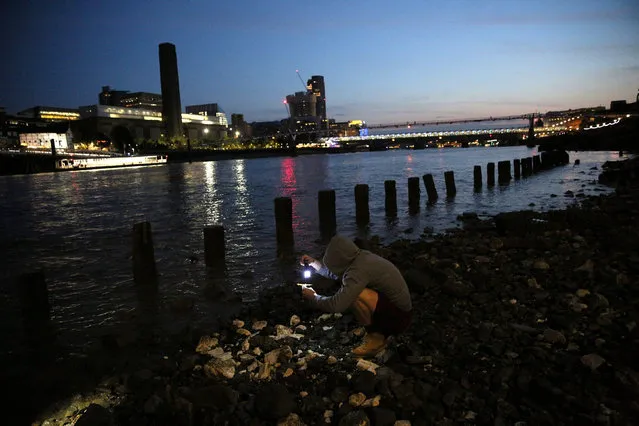
A mudlark uses a torch to look for items on the bank of the River Thames in London, Britain June 06, 2016. Mudlarking is believed to trace its origins to the 18th and 19th century, when scavengers searched the Thames' shores for items to sell. These days, history and archaeology fans are the ones hoping to find old relics such as coins, ceramics, artifacts or everyday items from across centuries. They wait for the low tide and then scour specific areas of exposed shores. "If you're in a field you could be out all day long, with the river you're restricted to about two or three hours," mudlark Nick Stevens said. While many just use the naked eye for their searches, others rely on metal detectors for which a permit from the Port of London Authority is needed. Digging also requires consent. (Photo by Neil Hall/Reuters)

A mudlark uses a torch to look for items on the bank of the River Thames in London, Britain June 06, 2016. Mudlarking is believed to trace its origins to the 18th and 19th century, when scavengers searched the Thames' shores for items to sell. These days, history and archaeology fans are the ones hoping to find old relics such as coins, ceramics, artifacts or everyday items from across centuries. their finds with the Portable Antiquities Scheme. Any item over 300 years old must be recorded. (Photo by Neil Hall/Reuters)
Details
27 Aug 2016 10:43:00
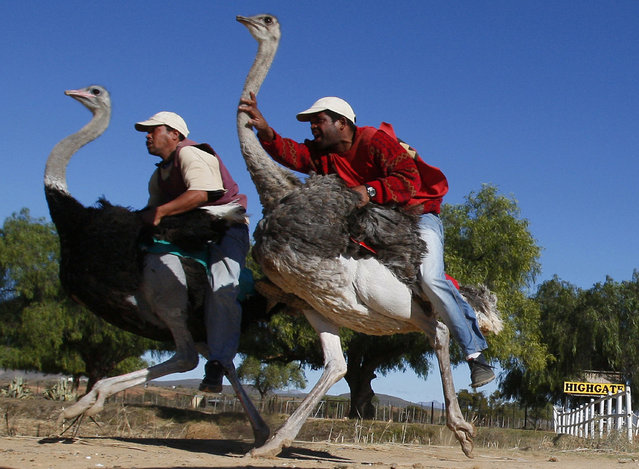
In this Sunday, June 27, 2010 file photo two men compete in an ostrich race at Highgate ostrich farm in Oudtshoorn, South Africa. Clambering onto an ostrich for a ride used to be popular among tourists in a South African town of  Oudtshoorn known of  as the  “ostrich capital of the world”. Not so much anymore. Two major ostrich farms in Oudtshoorn have stopped offering ostrich rides to tourists, responding to concerns about the birds’ welfare. A third farm is sticking with the feature, saying it is regulated and that ostriches do not experience discomfort.. The Highgate farm, however, continues to offer ostrich rides. (Photo by Shuji Kajiyama/AP Photo)

In this Sunday, June 27, 2010 file photo two men compete in an ostrich race at Highgate ostrich farm in Oudtshoorn, South Africa. Clambering onto an ostrich for a ride used to be popular among tourists in a South African town of Oudtshoorn known of as the “ostrich capital of the world”. Not so much anymore. Two major ostrich farms in Oudtshoorn have stopped offering ostrich rides to tourists, responding to concerns about the birds’ welfare. A third farm is sticking with the feature, saying it is regulated and that ostriches do not experience discomfort. The Highgate farm, however, continues to offer ostrich rides. (Photo by Shuji Kajiyama/AP Photo)
Details
20 Jun 2017 07:23:00
Yan Mengjie sits on a boat as she poses for photos near Erhai Lake in Dali Bai Autonomous Prefecture, Yunnan province, China on June 16, 2019. Erhai is one of China's biggest freshwater lakes and a backdrop to the city of Dali, which drew 47 million visitors last year, more than triple the number in 2010. Hotels and homestays have sprung up along a 31-mile (50-km) stretch of lakeside road to accommodate tourists. But officials ordered some hotels demolished after President Xi Jinping during a 2015 visit called for the lake to be protected. (Photo by Tingshu Wang/Reuters)

Yan Mengjie sits on a boat as she poses for photos near Erhai Lake in Dali Bai Autonomous Prefecture, Yunnan province, China on June 16, 2019. Erhai is one of China's biggest freshwater lakes and a backdrop to the city of Dali, which drew 47 million visitors last year, more than triple the number in 2010. Hotels and homestays have sprung up along a 31-mile (50-km) stretch of lakeside road to accommodate tourists. But officials ordered some hotels demolished after President Xi Jinping during a 2015 visit called for the lake to be protected. (Photo by Tingshu Wang/Reuters)
Details
25 Jun 2019 00:01:00
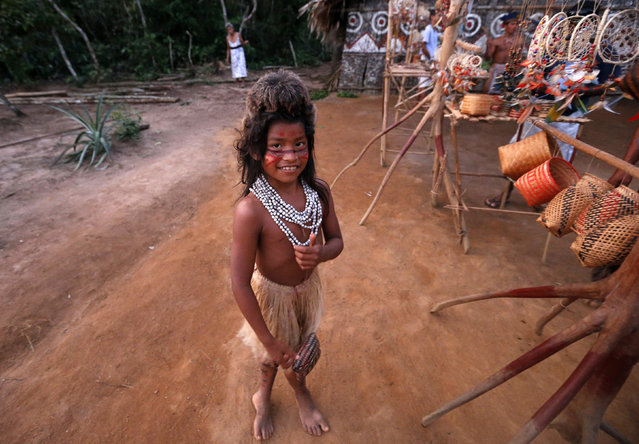
A girl of the Amazonian Tatuyo tribe poses while waiting to sell crafts to tourists in her village in the Rio Negro (Black River) near Manaus city, a World Cup host city, June 23, 2014. Because of their proximity to host city Manaus and their warm welcome, the Tatuyo have enjoyed three weeks of brisk business thanks to the World Cup. Usually, they host between 10 and 30 tourists a day. During the World Cup, this number has rocketed to 250 a day, They have become richer and other communities now come to them to sell them juices and fishes. (Photo by Andres Stapff/Reuters)

A girl of the Amazonian Tatuyo tribe poses while waiting to sell crafts to tourists in her village in the Rio Negro (Black River) near Manaus city, a World Cup host city, June 23, 2014. Because of their proximity to host city Manaus and their warm welcome, the Tatuyo have enjoyed three weeks of brisk business thanks to the World Cup. Usually, they host between 10 and 30 tourists a day. During the World Cup, this number has rocketed to 250 a day, They have become richer and other communities now come to them to sell them juices and fishes. (Photo by Andres Stapff/Reuters)
Details
27 Jun 2014 10:30:00