Loading...
Done
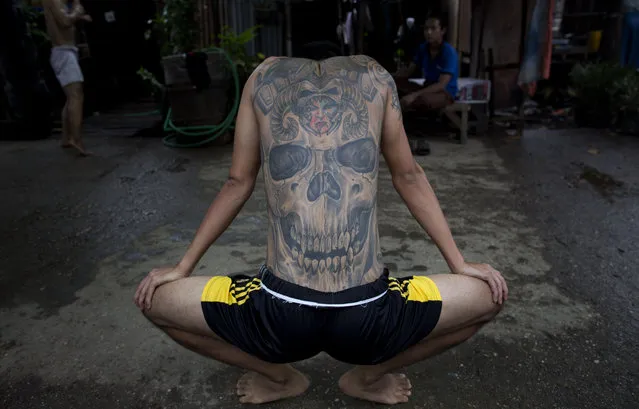
In this Tuesday, July 14, 2015, photo, Phoe Thaw, center, a member of the White New Blood lethwei fighters club, a Myanmar traditional martial-arts club which practices a rough form of kickboxing, stretches during a practice session in their gym on a street in Oakalarpa, north of Yangon, Myanmar. (Photo by Gemunu Amarasinghe/AP Photo)

In this Tuesday, July 14, 2015, photo, Phoe Thaw, center, a member of the White New Blood lethwei fighters club, a Myanmar traditional martial-arts club which practices a rough form of kickboxing, stretches during a practice session in their gym on a street in Oakalarpa, north of Yangon, Myanmar. Three of the club's members competed this summer on a stage a world away from the street gym: a mixed-martial-arts “One Championship” event broadcast globally on cable television networks, where fighters could receive $1,000 for each fight, according to coach Myint Zaw who started the traditional fighters' club 15 years ago. (Photo by Gemunu Amarasinghe/AP Photo)
Details
07 Sep 2015 14:00:00
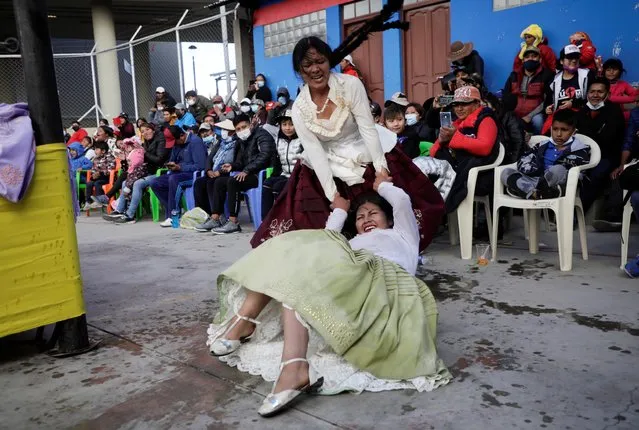
Barbara Quisbert and Susana La Bonita, cholitas wrestlers, fight during their return to the ring after the coronavirus disease (COVID-19) restrictions, in El Alto outskirts of La Paz, November 29, 2020. (Photo by David Mercado/Reuters)

The Fighting Cholitas are a group of female wrestlers who perform in El Alto, Bolivia. Tickets to the exhibitions cost $1. Like the general population of El Alto, which consists almost entirely of Aymara and Quechua residents, the Cholitas are indigenous. They wear braided hair, bowler hats and multilayered skirts in the ring. Here: Barbara Quisbert and Susana La Bonita, cholitas wrestlers, fight during their return to the ring after the coronavirus disease (COVID-19) restrictions, in El Alto outskirts of La Paz, November 29, 2020. (Photo by David Mercado/Reuters)
Details
12 Dec 2020 00:03:00
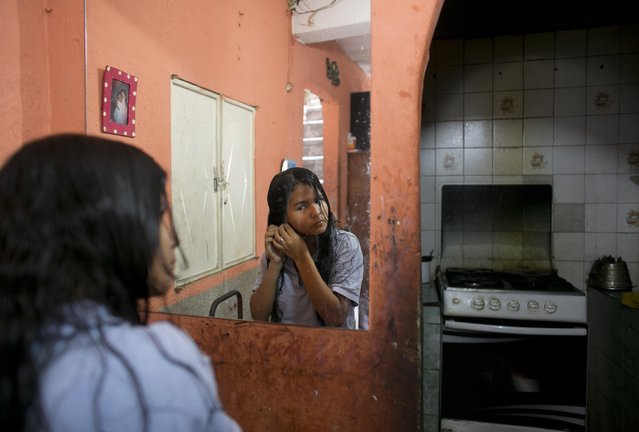
In this June 1, 2016 photo, Maria Arias stands near her kitchen as she puts on earrings while getting ready for school in Caracas, Venezuela. So many students have fainted from hunger at Maria's school that administrators told parents to keep their children home until they could find more food. (Photo by Ariana Cubillos/AP Photo)

In this June 1, 2016 photo, Maria Arias stands near her kitchen as she puts on earrings while getting ready for school in Caracas, Venezuela. So many students have fainted from hunger at Maria's school that administrators told parents to keep their children home until they could find more food. (Photo by Ariana Cubillos/AP Photo)
Details
17 Jun 2016 13:03:00
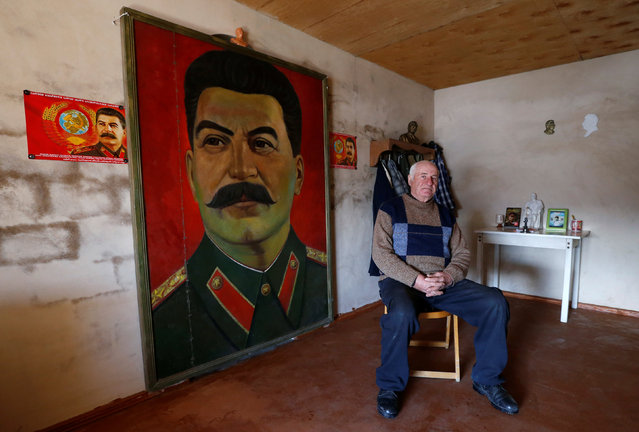
Retired builder Vasili Sidamonidze, 70, poses for a portrait at his home in Gori, Georgia, December 6, 2016. “Unfortunately, Stalin is not popular nowadays. Our people don't respect him. Only we, members of the (Communist) Party, respect him”, Sidamonidze said. “I always try to attend Stalin's birthday anniversaries in Gori. Unfortunately many people don't want to join us even if they live nearby. They look at us from their windows”. Stalin, who was born in Gori in 1878 and died in 1953, is largely reviled today in Georgia, which regained its independence during the 1991 collapse of the Soviet Union. Over the years, his memorials have been dismantled, most recently in 2010 when authorities removed a statue of the dictator from Gori's central square. But Stalin is still revered by a small group of mainly elderly supporters who stress his role in the industrialisation of the Soviet Union and in defeating Nazi Germany in World War Two. Each Dec. 21, a few dozen people mark his birthday by gathering outside a Gori museum dedicated to Stalin, where they make speeches and walk to the square where a 6-meter-high bronze statue of him once stood, calling for it to be reinstated. Opponents say it was a symbol of Moscow's still lingering shadow. In 2008, Russia fought a brief war with Georgia and recognised its breakaway regions of Abkhazia and South Ossetia as independent states. (Photo by David Mdzinarishvili/Reuters)

Retired builder Vasili Sidamonidze, 70, poses for a portrait at his home in Gori, Georgia, December 6, 2016. “Unfortunately, Stalin is not popular nowadays. Our people don't respect him. Only we, members of the (Communist) Party, respect him”, Sidamonidze said. “I always try to attend Stalin's birthday anniversaries in Gori. Unfortunately many people don't want to join us even if they live nearby. They look at us from their windows”. (Photo by David Mdzinarishvili/Reuters)
Details
17 Dec 2016 07:59:00
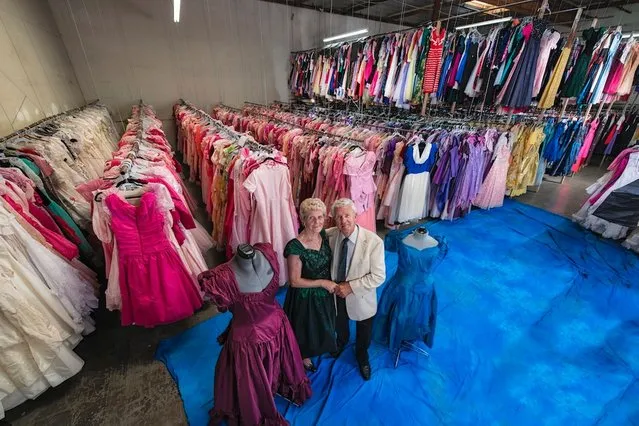
Paul Brockmans Collection Of 55,000 Dresses Bought For His Wife

There are many types of collections. Some are formed by purposefully collecting certain objects, such as stamps or coins. However, some collections are only a byproduct of an obsession, a quirk of mind. For example, Paul Brockmann got into the habit of buying his girlfriend and later his wife a dress every time they went ballroom dancing. It might seem excessive to some, but it was his way of showing his affection. Overtime, this collection grew to be enormous, counting 55,000 dresses in total. Basic math tells us that either they went ballroom dancing three times per day for every day of their lives, or he bought them in huge bundles every time.
Details
28 Mar 2015 10:11:00
Anamorphic Art By Jonty Hurwitz

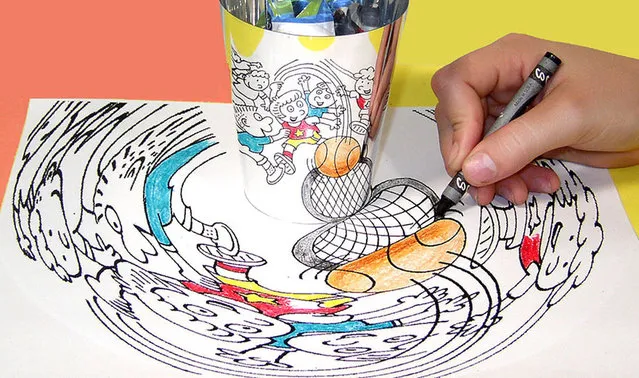
The truth can never be seen right away. Only by looking from a certain angle can we view the true nature of things. At other times, only with the help of some special object can we discern order in chaos. Anamorphosis is a form of art that allows us to see an object only by viewing it from a certain angle or by using cylindrical or conical mirror. Unsurprisingly, the first person in history to ever use this type of technique was the Leonardo Da Vinci. During late Renaissance period this technique was popularized as a children’s toy. Now, however, few people use this form of imagery due to its intricacy. Istvan Orosz, born in 1951, is one of the few people who specialize in anamorphosis. In our opinion, his most stunning piece of art is the one where a shipwreck scene turns into a portrait when viewed through a cylindrical mirror. (Photo by Jonty Hurwitz)
Details
05 Jan 2015 13:07:00
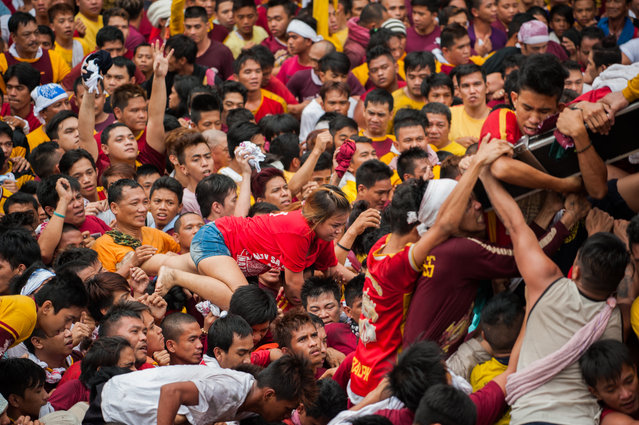
Black Nazarene devotees clamber on top of one another to to touch the cross on January 9, 2015 in Manila, Philippines. The Feast of the Black Nazarene culminates in a day long procession on January 9 as barefoot devotees march to see and touch the image of the Black Nazarene. (Photo by Dondi Tawatao/Getty Images)

Black Nazarene devotees clamber on top of one another to to touch the cross on January 9, 2015 in Manila, Philippines. The Feast of the Black Nazarene culminates in a day long procession on January 9 as barefoot devotees march to see and touch the image of the Black Nazarene. The Black Nazarene is a dark wood sculpture of Jesus brought to the Philippines in 1606 from Spain and considered miraculous by Filipino devotees. The event falls a week ahead of the visit of Pope Francis who will travel to Leyte and Manila during his visit to the Philippines from January 15–19. The visit is expected to attract crowds in the millions as Filipino Catholics flock to catch a glimpse of the leader of the Catholic Church. The Philippines is the only Catholic majority nation in Asia with around 90 percent of the population professing the faith. (Photo by Dondi Tawatao/Getty Images)
Details
11 Jan 2015 13:46:00
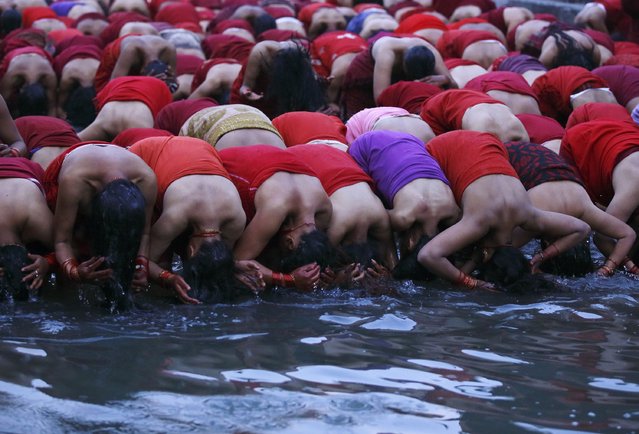
Devotees take a holy bath during the Swasthani Brata Katha festival in Kathmandu January 20, 2015. During the month-long festival, devotees recite one chapter of a Hindu tale daily from the 31-chapter sacred Swasthani Brata Katha book that is dedicated to God Madhavnarayan and Goddess Swasthani, alongside various other gods and goddesses and the miraculous feats performed by them. (Photo by Navesh Chitrakar/Reuters)

Devotees take a holy bath during the Swasthani Brata Katha festival in Kathmandu January 20, 2015. During the month-long festival, devotees recite one chapter of a Hindu tale daily from the 31-chapter sacred Swasthani Brata Katha book that is dedicated to God Madhavnarayan and Goddess Swasthani, alongside various other gods and goddesses and the miraculous feats performed by them. The devotees also go on pilgrimages to various temples, perform religious rituals, take a holy bath in the rivers and fast for a month, especially among women who believe fasting helps in their family's well-being or in getting them a good husband. (Photo by Navesh Chitrakar/Reuters)
Details
21 Jan 2015 13:50:00