A woman walks in front of an art installation made of artificial fruits and vegetables during the “Moscow Autumn” festival in central Moscow, September 14, 2015. (Photo by Maxim Zmeyev/Reuters)
Participants wearing historical attire compete on historical high wheel Penny Farthing bicycles in the traditional 'One Mile Race' at Letna Park in Prague, Czech Republic, November 7, 2015. The meeting of Penny Farthing bicycles is taking place for the 22th time. (Photo by Filip Singer/EPA)
A U.S. soccer fan pretends that Uruguay's soccer striker Luis Suarez is biting him as he takes a selfie next to an Adidas advertisement featuring Suarez near Copacabana beach in Rio de Janeiro, Brazil, Thursday, June 26, 2014. FIFA banned Suarez from all football activities for four months on Thursday for biting an opponent at the World Cup, a punishment that rules him out of the rest of the tournament. (Photo by Matt Dunham/AP Photo)
Ten-year-old Macy Friday, front left, reacts as she looks back at her family after meeting Hillary Clinton, front right, as she campaigns for U.S. Sen. Mark Udall, D-Colo., back, during a stop in the newly-renovated Union Station in Denver on Monday, October 13, 2014. Clinton appeared at an event to raise money for Udall's current re-election campaign and then headed to Las Vegas for another appearance on Monday night. (Photo by David Zalubowski/AP Photo)
A frog sits on a leaf and instead of seeing a reflection of itself in the water below, it sees a snail, attached to the bottom of the leaf, in a fish tank in Vietnam. (Photo by Duong Quoc Dinh/Solent Ne/SIPA Press)
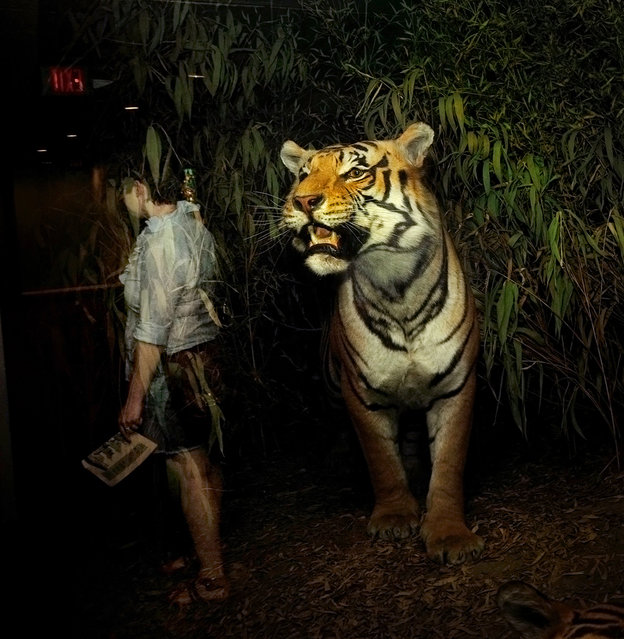
“Natural History” is a series of completely candid single exposure images that merge the living and the dead to create allegorical narratives of our troubled co-existence with nature. Ghost-like reflections of modern visitors viewing wildlife dioramas are juxtaposed against the antique taxidermied subjects housed behind thick glass, their faces molded into permanent expressions of fear, aggression or fleeting passivity. After decades of over-hunting, climate change, poaching and destruction of habitat, many of these long dead diorama specimens now represent endangered or completely extinct species”. – Traer Scott. (Photo by Traer Scott)
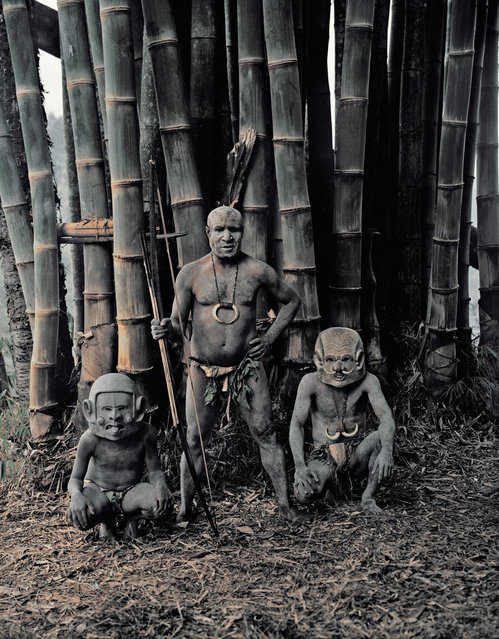
“Asaro from the Eastern Highlands”. The mudmen could not cover their faces with mud because the people of Papua New Guinea thought that the mud from the Asaro river was poisonous. So instead of covering their faces with this alleged poison, they made masks from pebbles that they heated and water from the waterfall, with unusual designs such as long or very short ears either going down to the chin or sticking up at the top, long joined eyebrows attached to the top of the ears, horns and sideways mouths. (Photo and caption by Jimmy Nelson)