Loading...
Done
In this photograph taken on December 8, 2017, Indian child Samarth Bangari, 2, plays with langur monkeys at his home in Allapur in India' s southwest Karnataka state. (Photo by Manjunath Kiran/AFP Photo)

In this photograph taken on December 8, 2017, Indian child Samarth Bangari, 2, plays with langur monkeys at his home in Allapur in India' s southwest Karnataka state, 250 miles from Bangalore. He is still too young to talk, but a 2- year- old Indian boy has become a subject of local intrigue after befriending a gang of langur monkeys. (Photo by Manjunath Kiran/AFP Photo)
Details
25 Dec 2017 06:03:00
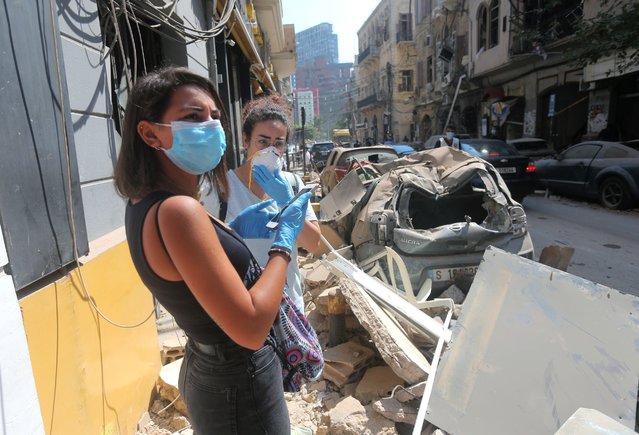
Young Lebanese women wearing protective masks and gloves against the coronavirus pandemic, stand on August 5, 2020 amid the rubble in Beirut's Gimmayzeh commercial district which was heavily damaged by the previous day's powerful explosion that tore through Lebanon's capital, resulting from the ignition of a huge depot of ammonium nitrate at the city's main port. Rescuers searched for survivors in Beirut after a cataclysmic explosion at the port sowed devastation across entire neighbourhoods, killing more than 100 people, wounding thousands and plunging Lebanon deeper into crisis. The blast, which appeared to have been caused by a fire igniting 2,750 tonnes of ammonium nitrate left unsecured in a warehouse, was felt as far away as Cyprus, some 150 miles (240 kilometres) to the northwest. (Photo by AFP Photo/Stringer)

Young Lebanese women wearing protective masks and gloves against the coronavirus pandemic, stand on August 5, 2020 amid the rubble in Beirut's Gimmayzeh commercial district which was heavily damaged by the previous day's powerful explosion that tore through Lebanon's capital, resulting from the ignition of a huge depot of ammonium nitrate at the city's main port. Rescuers searched for survivors in Beirut after a cataclysmic explosion at the port sowed devastation across entire neighbourhoods, killing more than 100 people, wounding thousands and plunging Lebanon deeper into crisis. The blast, which appeared to have been caused by a fire igniting 2,750 tonnes of ammonium nitrate left unsecured in a warehouse, was felt as far away as Cyprus, some 150 miles (240 kilometres) to the northwest. (Photo by AFP Photo/Stringer)
Details
10 Aug 2020 00:05:00
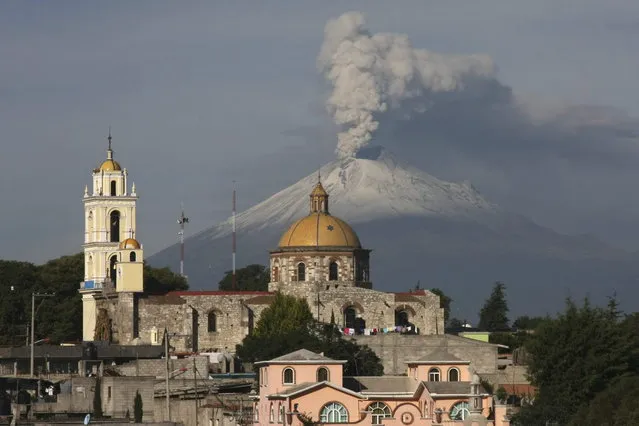
The main church in the town of San Damian Texoloc, Mexico stands in front of the Popocatepetl volcano as is spews ash and vapor early Tuesday, July 9, 2013. Last Saturday, Mexico's National Center for Disaster Prevention raised the volcano alert from Stage 2 Yellow to Stage 3 Yellow, the final step before a Red alert, when possible evacuations could be ordered after the Popocatepetl volcano spit out a cloud of ash and vapor 2 miles (3 kilometers) high over several days of eruptions. (Photo by J. Guadalupe Perez/AP Photo)

The main church in the town of San Damian Texoloc, Mexico stands in front of the Popocatepetl volcano as is spews ash and vapor early Tuesday, July 9, 2013. Last Saturday, Mexico's National Center for Disaster Prevention raised the volcano alert from Stage 2 Yellow to Stage 3 Yellow, the final step before a Red alert, when possible evacuations could be ordered after the Popocatepetl volcano spit out a cloud of ash and vapor 2 miles (3 kilometers) high over several days of eruptions. (Photo by J. Guadalupe Perez/AP Photo)
Details
10 Jul 2013 08:45:00
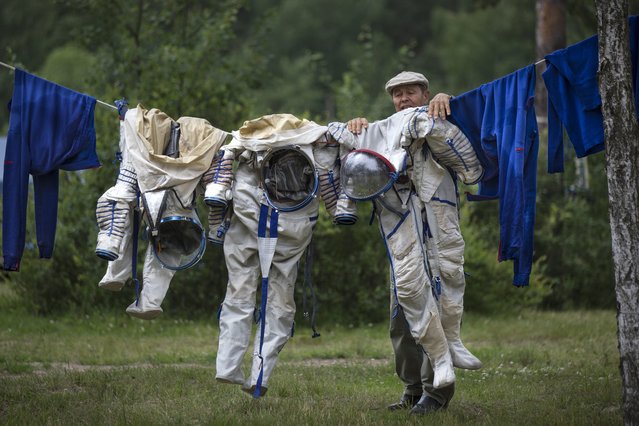
An employe of Russian Space Training Center hangs out to dry space suits of Russian cosmonaut Anatoly Ivanishin, NASA's U.S. flight engineer Kathleen Rubins, and Japanese space agency's flight engineer Takuya Onishi, right, after their undergoing  training near in Noginsk, 60 km (38 miles) east of Moscow, Russia, Wednesday, July 2, 2014. (Photo by Alexander Zemlianichenko/AP Photo)

An employe of Russian Space Training Center hangs out to dry space suits of Russian cosmonaut Anatoly Ivanishin, NASA's U.S. flight engineer Kathleen Rubins, and Japanese space agency's flight engineer Takuya Onishi, right, after their undergoing training near in Noginsk, 60 km (38 miles) east of Moscow, Russia, Wednesday, July 2, 2014. The training was intended to simulate the capsule landing on water. Russian cosmonaut Anatoly Ivanishin, Japanese space agency's flight engineer Takuya Onishi, and NASA's U.S. flight engineer Kathleen Rubins are being trained for a future mission to the International Space Station. (Photo by Alexander Zemlianichenko/AP Photo)
Details
05 Jul 2014 11:47:00


A Haka is performed before the ceremonial departure of the 'vaka' or traditional canoes ahead of their cross-Pacific voyage from Viaduct Harbour on April 13, 2011 in Auckland, New Zealand. Powered by sun and wind only, the 15,000 nautical mile journey to Hawaii via French Polynesia will set off on April 15, aiming to raise awareness of environmental issues such as ocean noise pollution, acidification and anoxic waters, whilst recapturing traditional Pacific voyaging. The votyage is named “Te Mana o Te Moana” meaning “The Spirit of the Sea”. (Photo by Phil Walter/Getty Images)
Details
13 Apr 2011 07:45:00
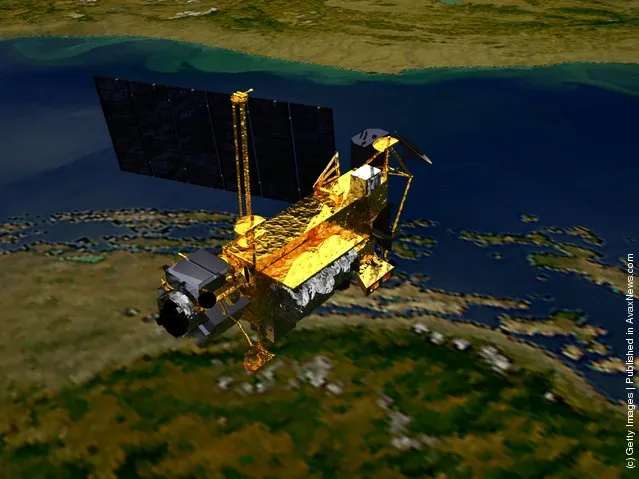
Upper Atmosphere Research Satellite (UARS)

In this artist illustration handout from the National Aeronautics and Space Administration (NASA), the Upper Atmosphere Research Satellite (UARS) is seen. According to NASA, the 12,500 pound satellite will fall from orbit into earth's atmosphere anytime between September 22 through 24. It is estimated that the space craft will break up into about 100 pieces, with an estimated 26 of which could hit the earth over a possible 500 mile debris field. (Illustration by NASA via Getty Images)
Details
21 Sep 2011 10:49:00
Yang Xiaoyun Saved 100 Dogs From Meat Festival

Yulin, a city in southern China, celebrates the summer solstice by throwing a festival that involves the slaughter and consumption of as many as 10,000 dogs. Not everyone in China supports such practices, however; 65-year-old Yang Xiaoyun, a retired teacher who runs an animal shelter in Tianjin, traveled more than 2,400 km (1,500 miles) and spent more than 7,000 yuan ($1,100 or €990) to save 100 dogs from certain death.
Details
25 Jun 2015 07:24:00
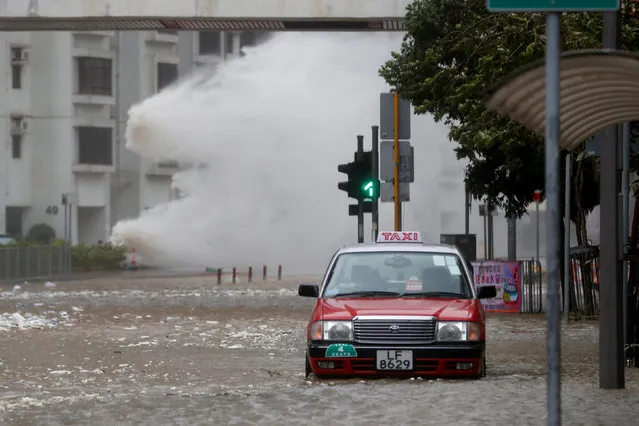
Waves triggered by Typhoon Hato are seen in Hong Kong, China on August 23, 2017. (Photo by Tyrone Siu/Reuters)

Waves triggered by Typhoon Hato are seen in Hong Kong, China on August 23, 2017. A powerful typhoon barreled into Hong Kong on Wednesday, forcing offices and schools to close and leaving flooded streets, shattered windows and hundreds of canceled flights in its wake. Typhoon Hato came within 60 kilometers (37 miles) of Hong Kong, close enough to be considered a direct hit under Hong Kong's storm warning system. It was headed toward the western side of mainland China's Pearl River Delta. (Photo by Tyrone Siu/Reuters)
Details
24 Aug 2017 09:15:00