Loading...
Done
Centre of the Heart Nebula by Ivan Eder (Hungary). Situated 7500 light years away in the ‘W’-shaped constellation of Cassiopeia, the Heart Nebula is a vast region of glowing gas, energized by a cluster of young stars at its centre. The image depicts the central region, where dust clouds are being eroded and moulded into rugged shapes by the searing cosmic radiation. (Photo by Ivan Eder)

The competition, which is run by the Royal Observatory Greenwich in association with BBC Sky at Night Magazine, is now in its sixth year and has received over 2,500 entries. Photo: Centre of the Heart Nebula by Ivan Eder (Hungary). Situated 7500 light years away in the “W”-shaped constellation of Cassiopeia, the Heart Nebula is a vast region of glowing gas, energized by a cluster of young stars at its centre. The image depicts the central region, where dust clouds are being eroded and moulded into rugged shapes by the searing cosmic radiation. (Photo by Ivan Eder)
Details
03 Jul 2014 11:59:00
Filipino children frolic next to ships taking shelter inside a seaport in Navotas city, north of Manila, Philippines, 27 August 2019. According to the latest advisory from Philippine Atmospheric Geophysical and Astronomical Services Administration (PAGASA), Tropical Storm Podul intensified from a tropical depression into a tropical storm on August 27, while moving toward Central Luzon with a maximum winds of 65 kilometers per hour and gustiness of up to 80 km/h. (Photo by Francis R. Malasig/EPA/EFE)

Filipino children frolic next to ships taking shelter inside a seaport in Navotas city, north of Manila, Philippines, 27 August 2019. According to the latest advisory from Philippine Atmospheric Geophysical and Astronomical Services Administration (PAGASA), Tropical Storm Podul intensified from a tropical depression into a tropical storm on August 27, while moving toward Central Luzon with a maximum winds of 65 kilometers per hour and gustiness of up to 80 km/h. (Photo by Francis R. Malasig/EPA/EFE)
Details
14 Jan 2020 00:01:00
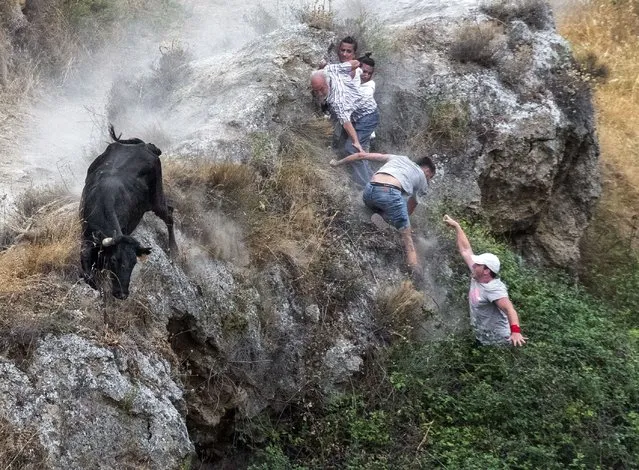
Some runners fall during the “El Pilon” running-the-bulls in the village of Falces, Navarra, northern Spain, 16 August 2022. “El Pilon” running-the-bulls is held on a hill where runners have to avoid the herd of cows on a 800 meter long and narrow slope with the mountain on one side and a steep cliff on the other. (Photo by Peio H/EPA/EFE)

Some runners fall during the “El Pilon” running-the-bulls in the village of Falces, Navarra, northern Spain, 16 August 2022. “El Pilon” running-the-bulls is held on a hill where runners have to avoid the herd of cows on a 800 meter long and narrow slope with the mountain on one side and a steep cliff on the other. (Photo by Peio H/EPA/EFE)
Details
17 Aug 2022 05:17:00
Ja Kang Song, 71, and Ja Hyun Su, 72, dive for shellfish and are the main breadwinners for their families. In South Korea, 45% of the diving women of Jeju are over the age of 70. Routinely diving to depths of 20m and staying under for an average of two to three minutes, the pressure on the body takes its toll and, like many others, burst eardrums have left Ja Hyun Su deaf. Each season, between seven and 10 women die diving the waters around Jeju Island. (Photo by Andy W. Langton/Age International)

Ja Kang Song, 71, and Ja Hyun Su, 72, dive for shellfish and are the main breadwinners for their families. In South Korea, 45% of the diving women of Jeju are over the age of 70. Routinely diving to depths of 20m and staying under for an average of two to three minutes, the pressure on the body takes its toll and, like many others, burst eardrums have left Ja Hyun Su deaf. Each season, between seven and 10 women die diving the waters around Jeju Island. (Photo by Andy W. Langton/Age International)
Details
12 Sep 2016 10:35:00
Sikorsky H-5 helicopters

“Igor Sikorsky (May 25, 1889 – October 26, 1972), born Igor Ivanovich Sikorsky was a Russian American pioneer of aviation in both helicopters and fixed-wing aircraft. He designed and flew the world's first multi-engine fixed-wing aircraft, the Russky Vityaz in 1913, and the first airliner, Ilya Muromets, in 1914. After immigrating to the United States in 1919, Sikorsky founded the Sikorsky Aircraft Corporation in 1923, and developed the first of Pan American Airways' ocean-conquering flying boats in the 1930s. In 1939 Sikorsky designed and flew the Vought-Sikorsky VS-300, the first viable American helicopter, which pioneered the rotor configuration used by most helicopters today. Sikorsky would modify the design into the Sikorsky R-4, which became the world's first mass-produced helicopter in 1942”. – Wikipedia

Photo: Westland Sikorsky H-5's, used by British European Airways Helicopters, which fly between London and Birmingham. The Sikorsky H-5, (aka R-5, S-51, HO3S-1, or Horse) (R-5 until 1948; company designation VS-327) is a helicopter built by Sikorsky Aircraft Corporation, formerly used by the United States Air Force, and its predecessor, the United States Army Air Forces, as well as the United States Navy and United States Coast Guard (with the designations HO2S and HO3S). (Photo by Harrison /Topical Press Agency/Getty Images). 22nd May 1951

Details
06 Sep 2011 10:18:00
A model showcases designs on the catwalk during the Hempel award the 20th China intemational young fashion designers contest at Beijing hotel

A model showcases designs on the catwalk during Eternal Color Xie Ping Collection A/W 2012-2013 of China Fashion Week at Beijing Hotel on March 27, 2012 in Beijing, China. (Photo by Feng Li/Getty Images)
Details
28 Mar 2012 09:57:00
Bike New World Speed Record

Oh, those daredevils! They’re always willing to pull off another incredible stunt to gain fame and glory. Sometimes it’s something incredibly stupid, but sometimes it is simply incredible. The stunt that you can see on this video is of the latter kind. Who would have thought of attaching a jet engine to a bicycle? And who would have dared riding one? Circuit Paul Ricard, that’s who. On November 7 2014 he reached a whooping speed of 333 hm/h (207 mph) on his bicycle. Now that is a tale to tell your grandchildren… if you ever live long enough to see them with a lifestyle such as this.
Details
17 Nov 2014 12:02:00
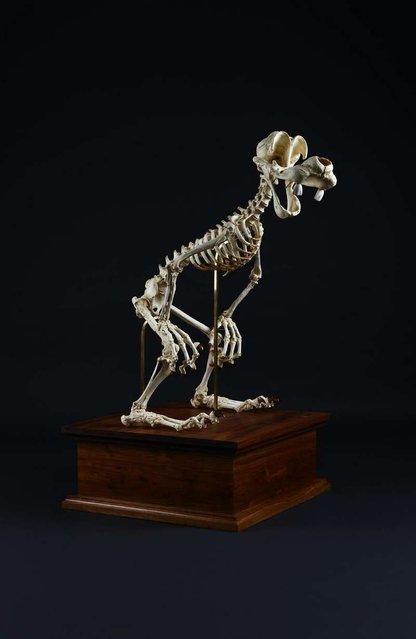
Cartoon Skeletons By Hyungkoo Lee

Korean artist Hyungkoo Lee has created a series (Homo Animatus) of works featuring skeletal representations of familiar cartoon characters. He uses resin, aluminum sticks, stainless steel wires, springs, and oil paint. If you look closely, you will see the bones of our favorite childhood friends like Canis Latrans Animatus (Wile E. Coyote), Geococcyx Animatus (Roadrunner), Lepus Animatus (Bugs Bunny), Felis Catus Animatus (Tom), Mus Animatus (Jerry), Anas Animatus (Donald Duck) and his three nephews, Animatus H, D and L ( Huey, Dewey and Louie)
Details
06 May 2013 12:42:00