Loading...
Done
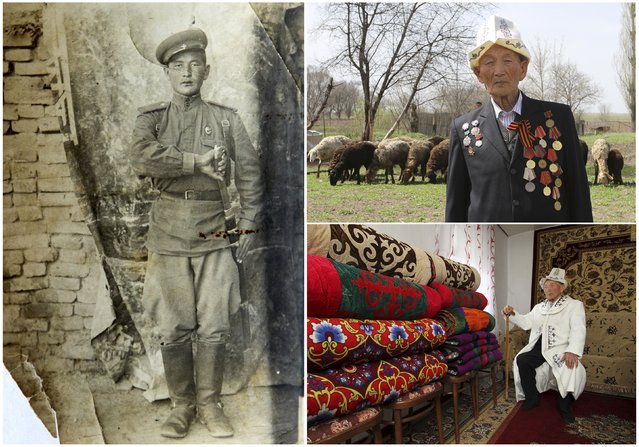
World War Two veteran Abla Begaliyev, 91, is seen in an undated handout picture (L), poses for a picture in Arashan (Top R) and at home in Kyrgyzstan April 14, 2015. Begaliyev served in the border guard cavalry from February 1942 until April 1947. Originally from Kyrgyzstan, he fought on the Ukrainian front and relocated to the border with Afghanistan at the end of World War Two. (Photo by Vladimir Pirogov/Reuters/Family handout (L))

World War Two veteran Abla Begaliyev, 91, is seen in an undated handout picture (L), poses for a picture in Arashan (Top R) and at home in Kyrgyzstan April 14, 2015. Begaliyev served in the border guard cavalry from February 1942 until April 1947. Originally from Kyrgyzstan, he fought on the Ukrainian front and relocated to the border with Afghanistan at the end of World War Two. As the world marks the 70th anniversary of the end of World War Two, Reuters photographers the length and breadth of the former Soviet republics (CCCP) captured portraits of Red Army veterans, mostly now in their 80s and 90s, today and through archive pictures at the time. More than 20 million Soviet citizens were killed in the war. (Photo by Vladimir Pirogov/Reuters/Family handout (L))
Details
08 May 2015 14:22:00


“Sektor gaza” (Russian: Сектор газа) was a Russian rock band formed on 5 December 1987 in the city of Voronezh, Russia. Despite only semi-officially existing (due to obscene lyrics), the group remains popular in Russia today. The group name was taken from an eponymous industrial district of Voronezh (itself named for high levels of environmental contamination). Their music style could be defined as Russian punk, integrated with elements of different musical genres such as rock, rap, and Russian folk. On 4 July 2000, group leader Yuri “Hoy” Klinskih complained of strong pains in his stomach and the left side of his chest. He suffered heart failure shortly thereafter. Klinskikh died in Voronezh (Russia)at the age of 35. He is buried in the Levoberezhniy Cemetery. The group ceased to exist.

About the music video: The First Chechen War, also known as the War in Chechnya, was a conflict between the Russian Federation and the Chechen Republic of Ichkeria, fought from December 1994 to August 1996. After the initial campaign of 1994 – 1995, culminating in the devastating Battle of Grozny, Russian federal forces attempted to seize control of the mountainous area of Chechnya but were set back by Chechen guerrilla warfare and raids on the flatlands in spite of Russia's overwhelming manpower, weaponry, and air support...
Details
24 May 2012 14:38:00
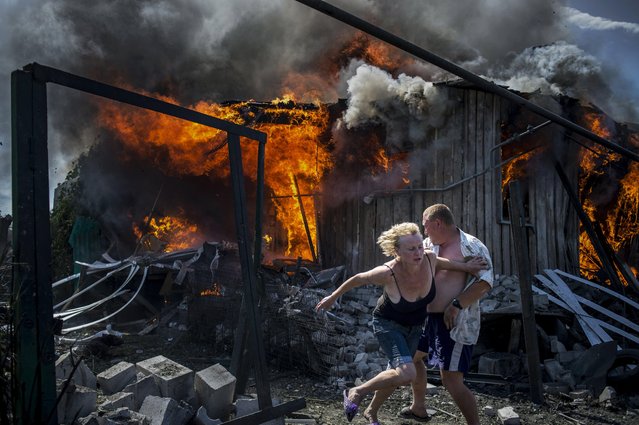
A handout photo made available by the World Press Photo (WPP) organization on 13 February 2017 shows a picture by Rossiya Segodnya photographer Valery Melnikov that won the Long-Term Projects – First Prize award of the 60th annual World Press Photo Contest, it was announced by the WPP Foundation in Amsterdam, The Netherlands on 13 February 2017. Caption: Civilians escape from a fire at a house destroyed by an air attack in the Luhanskaya village. Story: Ordinary people became victims of the conflict between self-proclaimed republics and the official Ukrainian authorities from 2014 onwards in the region of Donbass. Disaster came into their lives unexpectedly. These people were involved in the military confrontation against their will. They experienced the most terrible things: the death of their friends and relatives, destroyed homes and the ruined lives of thousands of people. (Photo by Valery Melnikov/EPA/Rossiya Segodnya/World Press Photo)

A handout photo made available by the World Press Photo (WPP) organization on 13 February 2017 shows a picture by Rossiya Segodnya photographer Valery Melnikov that won the Long-Term Projects – First Prize award of the 60th annual World Press Photo Contest, it was announced by the WPP Foundation in Amsterdam, The Netherlands on 13 February 2017. Caption: Civilians escape from a fire at a house destroyed by an air attack in the Luhanskaya village. (Photo by Valery Melnikov/EPA/Rossiya Segodnya/World Press Photo)
Details
15 Feb 2017 00:06:00
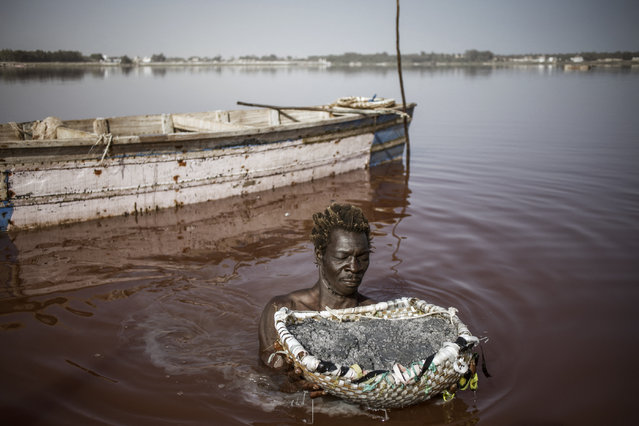
Toure, a Gambian salt harvester, holds a basket filled with  the salt collected from the crust of the bottom of the Lake Retba (Pink Lake) in Senegal on March 16, 2021. Lake Retba, divided from the Atlantic Ocean by a narrow corridor of dunes, owes its name to the pink waters caused by the Dunaliella salina algae and is known for its high salt content, up to 40% in some areas. (Photo by Marco Longari/AFP Photo)

Toure, a Gambian salt harvester, holds a basket filled with the salt collected from the crust of the bottom of the Lake Retba (Pink Lake) in Senegal on March 16, 2021. Lake Retba, divided from the Atlantic Ocean by a narrow corridor of dunes, owes its name to the pink waters caused by the Dunaliella salina algae and is known for its high salt content, up to 40% in some areas. (Photo by Marco Longari/AFP Photo)
Details
24 Mar 2021 10:29:00
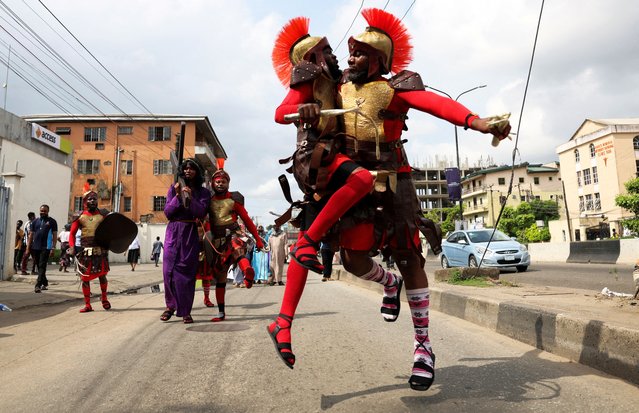
Members of St. Dominic Catholic Church take part in a re-enactment of the crucifixion of Jesus Christ, on Good Friday in Yaba, Lagos, Nigeria, on April 18, 2025. (Photo by Sodiq Adelakun/Reuters)

Members of St. Dominic Catholic Church take part in a re-enactment of the crucifixion of Jesus Christ, on Good Friday in Yaba, Lagos, Nigeria, on April 18, 2025. (Photo by Sodiq Adelakun/Reuters)
Details
09 May 2025 03:45:00
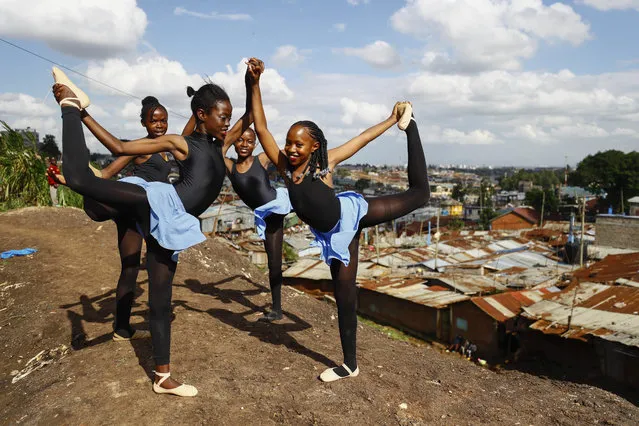
Young dancers practice by the Kenya – Uganda railway line, prior to the start of a Christmas ballet event in Kibera, the Kenyan capital's largest slum, Friday, December 15, 2023. The ballet project is run by Project Elimu, a community-driven nonprofit that offers after-school arts education and a safe space to children in Kibera. (Photo by Brian Inganga/AP Photo)

Young dancers practice by the Kenya – Uganda railway line, prior to the start of a Christmas ballet event in Kibera, the Kenyan capital's largest slum, Friday, December 15, 2023. The ballet project is run by Project Elimu, a community-driven nonprofit that offers after-school arts education and a safe space to children in Kibera. (Photo by Brian Inganga/AP Photo)
Details
25 Dec 2023 19:33:00
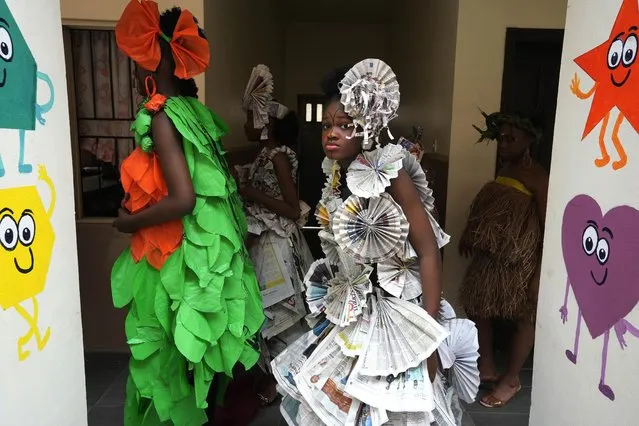
Jalokun Nifemi, wearing an outfit made from recycled newspapers, waits back stage before a “trashion show” in Sangotedo Lagos, Nigeria, Saturday, November 19, 2022. (Photo by Sunday Alamba/AP Photo)

Jalokun Nifemi, wearing an outfit made from recycled newspapers, waits back stage before a “trashion show” in Sangotedo Lagos, Nigeria, Saturday, November 19, 2022. (Photo by Sunday Alamba/AP Photo)
Details
06 Dec 2022 04:55:00
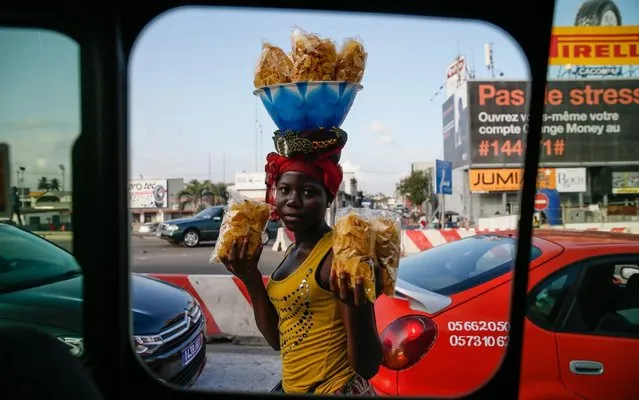
A woman sells chips in Abidjan, Ivory Coast on August 09, 2019. World's number one cacao producer Ivory Coast's capital Abidjan set peace after the 201011 Ivorian crisis. Women in Abidjan work in various jobs to help their families' budget. (Photo by Mahmut Serdar Alakus/Anadolu Agency via Getty Images)

A woman sells chips in Abidjan, Ivory Coast on August 09, 2019. World's number one cacao producer Ivory Coast's capital Abidjan set peace after the 201011 Ivorian crisis. Women in Abidjan work in various jobs to help their families' budget. (Photo by Mahmut Serdar Alakus/Anadolu Agency via Getty Images)
Details
13 Aug 2019 00:05:00