Loading...
Done
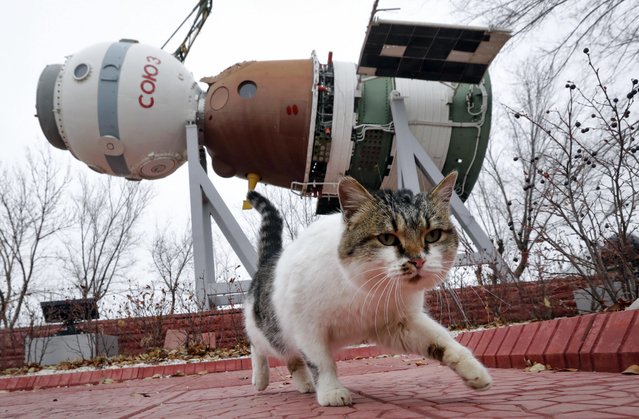
A cat walks past a Soyuz space ship installed at a museum, at the Russian leased Baikonur cosmodrome, Kazakhstan, Tuesday, November 15, 2016. The start of the new Soyuz mission to the International Space Station (ISS) is scheduled on early Friday, Nov. 18 local time. The Russian rocket will carry French astronaut Thomas Pesquet, Russian cosmonaut Oleg Novitsky and U.S. astronaut Peggy Annette Whitson. (Photo by Dmitri Lovetsky/AP Photo)

A cat walks past a Soyuz space ship installed at a museum, at the Russian leased Baikonur cosmodrome, Kazakhstan, Tuesday, November 15, 2016. The start of the new Soyuz mission to the International Space Station (ISS) is scheduled on early Friday, Nov. 18 local time. The Russian rocket will carry French astronaut Thomas Pesquet, Russian cosmonaut Oleg Novitsky and U.S. astronaut Peggy Annette Whitson. (Photo by Dmitri Lovetsky/AP Photo)
Details
16 Nov 2016 11:25:00
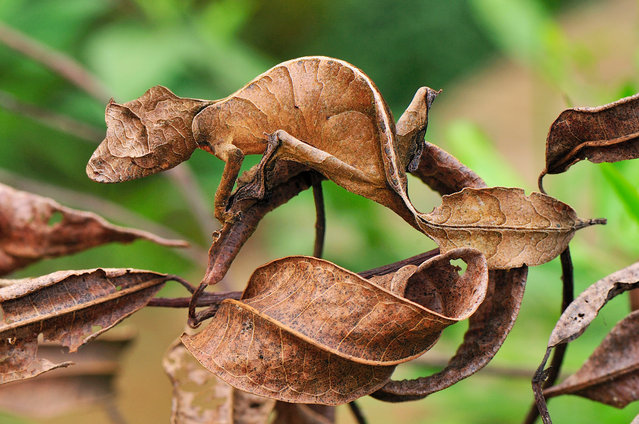
Is it a leaf? Is it tree bark? No, it’s the Satanic leaf-tailed gecko. Cleverly disguised as a rotting leaf, Madagascar’s camouflage king has red eyes, pointy horns and a taste for night hunting: it’s nature’s most devilish deceiver. (Photo by Thomas Marent/ARDEA)

Is it a leaf? Is it tree bark? No, it’s the Satanic leaf-tailed gecko. Cleverly disguised as a rotting leaf, Madagascar’s camouflage king has red eyes, pointy horns and a taste for night hunting: it’s nature’s most devilish deceiver. The twisted body and veiny skin echo the detail of a dry leaf, which ensures the gecko blends in with its forest home. The mottled tail appears to have sections missing, as though it has withered over time. This mini-monster epitomises survival of the fittest, having adapted gradually to become today’s extraordinary leaf impersonator. (Photo by Thomas Marent/ARDEA)
Details
20 Nov 2015 08:03:00
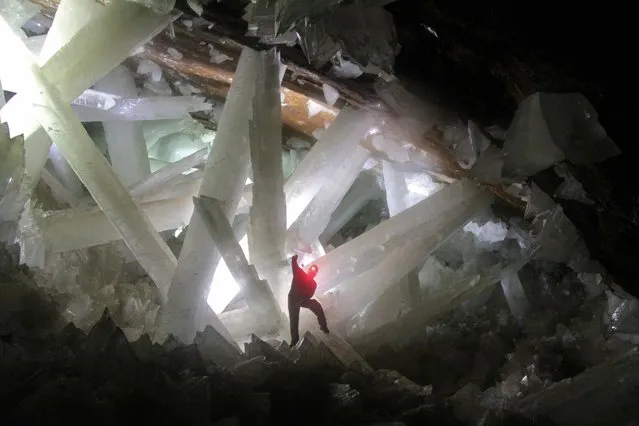
Giant Crystal Cave in Naica, Mexico

Cave of the Crystals or Giant Crystal Cave is a cave connected to the Naica Mine 300 metres (980 ft) below the surface in Naica, Chihuahua, Mexico. The main chamber contains giant selenite crystals (gypsum, CaSO4·2 H2O), some of the largest natural crystals ever found. The cave's largest crystal found to date is 12 m (39 ft) in length, 4 m (13 ft) in diameter and 55 tons in weight. The cave is extremely hot with air temperatures reaching up to 58 °C (136 °F) with 90 to 99 percent humidity. The cave is relatively unexplored due to these factors. Without proper protection people can only endure approximately ten minutes of exposure at a time.
Details
20 May 2014 07:56:00
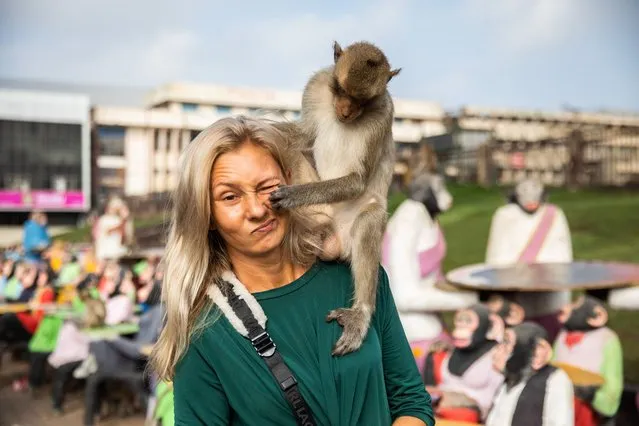
A monkey grabs the face of a tourist during the Lopburi Monkey Festival on November 27, 2022 in Lop Buri, Thailand. Lopburi holds its annual Monkey Festival where local citizens and tourists gather to provide a banquet to the thousands of long-tailed macaques that live in central Lopburi. (Photo by Lauren DeCicca/Getty Images)

A monkey grabs the face of a tourist during the Lopburi Monkey Festival on November 27, 2022 in Lop Buri, Thailand. Lopburi holds its annual Monkey Festival where local citizens and tourists gather to provide a banquet to the thousands of long-tailed macaques that live in central Lopburi. (Photo by Lauren DeCicca/Getty Images)
Details
10 Jan 2024 19:17:00
Wounded women arrive at a hospital for treatment after two blasts, which killed at least five and wounded a dozen, outside the airport in Kabul on August 26, 2021. (Photo by Wakil Kohsar/AFP Photo)

Wounded women arrive at a hospital for treatment after two blasts, which killed at least five and wounded a dozen, outside the airport in Kabul on August 26, 2021. (Photo by Wakil Kohsar/AFP Photo)
Details
27 Aug 2021 08:35:00
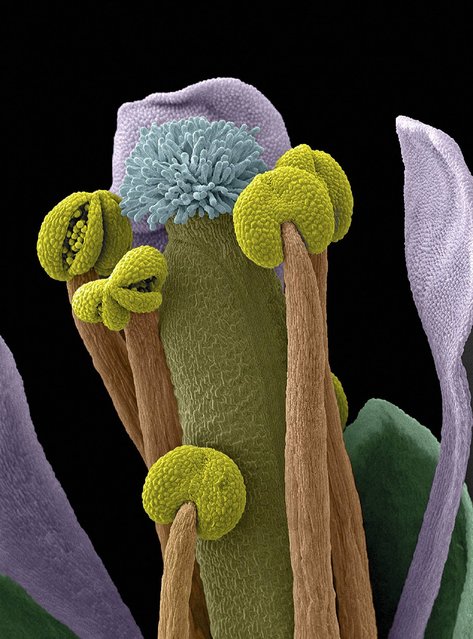
Scanning electron micrograph (SEM) of an Arabidopsis thaliana flower, also commonly known as thale cress. Some of the anthers are open, revealing pollen grains ready for dispersal. Arabidopsis was the first plant to have its entire genome sequenced and is widely used as a model organism in molecular and plant biology. Horizontal width of image is 1200 microns. Magnification 100x. (Photo by Stefan Eberhard/Wellcome Images)

Beautiful, strange and occasionally alarming pictures from the shortlist for this year’s Wellcome image awards – which celebrate the very best in science photography and imaging – from an x-ray of a bat to a micrograph of a kidney stone. The exhibition opens on 12 March at three science centres and the Museum of Science and Industry in Manchester. Photo: Scanning electron micrograph (SEM) of an Arabidopsis thaliana flower, also commonly known as thale cress. Some of the anthers are open, revealing pollen grains ready for dispersal. Arabidopsis was the first plant to have its entire genome sequenced and is widely used as a model organism in molecular and plant biology. Horizontal width of image is 1200 microns. Magnification 100x. (Photo by Stefan Eberhard/Wellcome Images)
Details
11 Mar 2014 05:58:00
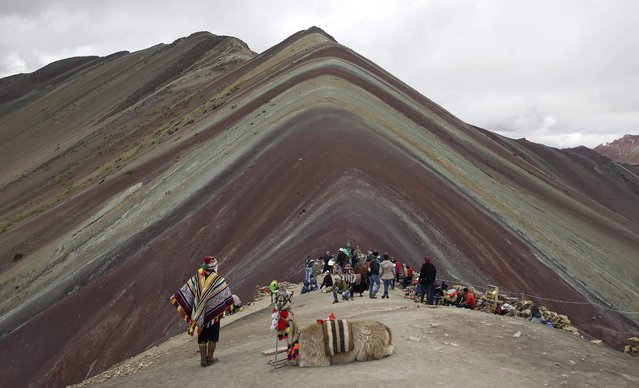
In this March 2, 2018 photo, an Andean man rests with his llama while tourists take in the natural wonder of Rainbow Mountain in Pitumarca, Peru. Tourists gasp for breath as they climb for two hours to the 16,404-foot (5,000-meter) peak in the Peruvian Andes, but stunned by the magical beauty that unfurls before them. (Photo by Martin Mejia/AP Photo)

In this March 2, 2018 photo, an Andean man rests with his llama while tourists take in the natural wonder of Rainbow Mountain in Pitumarca, Peru. Tourists gasp for breath as they climb for two hours to the 16,404-foot (5,000-meter) peak in the Peruvian Andes, but stunned by the magical beauty that unfurls before them. (Photo by Martin Mejia/AP Photo)
Details
07 May 2018 00:01:00
A fellow officer comes to the aid of injured patrolman C.V. Satt, who was pelted with rocks and beer bottles during a clash between police and relief demonstrators in Denver September 23, 1935. (Photo by Henry G. Eisenhand/AP Photo)

A fellow officer comes to the aid of injured patrolman C.V. Satt, who was pelted with rocks and beer bottles during a clash between police and relief demonstrators in Denver September 23, 1935. (Photo by Henry G. Eisenhand/AP Photo)
Details
24 Sep 2015 10:57:00