Loading...
Done
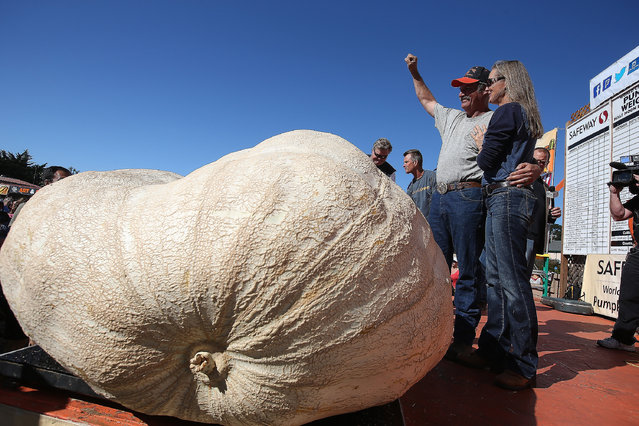
John Hawkley and his wife Patty Hawkley stand next to their 2,058 pound pumpkin and celebrate after winning the 41st Annual Safeway World Championship Pumpkin Weigh-Off on October 13, 2014 in Half Moon Bay, California. John Hawkley of Napa, California won the 41st Annual Safeway World Championship Pumpkin Weigh-Off and broke a state record with his gigantic pumpkin weighing in at 2,085 pounds. Hawkley took home a cash prize of $12,510, or $6.00 a pound. (Photo by Justin Sullivan/Getty Images)

John Hawkley and his wife Patty Hawkley stand next to their 2,058 pound pumpkin and celebrate after winning the 41st Annual Safeway World Championship Pumpkin Weigh-Off on October 13, 2014 in Half Moon Bay, California. John Hawkley of Napa, California won the 41st Annual Safeway World Championship Pumpkin Weigh-Off and broke a state record with his gigantic pumpkin weighing in at 2,085 pounds. Hawkley took home a cash prize of $12,510, or $6.00 a pound. (Photo by Justin Sullivan/Getty Images)
Details
15 Oct 2014 12:27:00
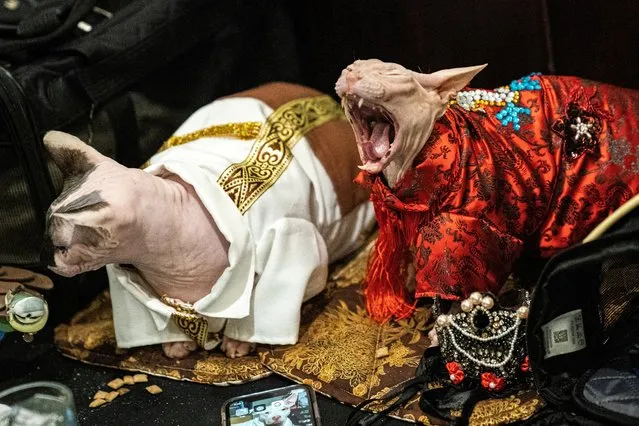
Wasibi, (r), yawns at backstage before the Algonquin Hotel’s Annual Cat Fashion Show in the Manhattan borough of New York City, New York, U.S., August 1, 2019. The theme of this year's show was “It's a Small World”. The cats represented countries including Ireland, Spain, the United Kingdom and the United States. (Photo by Jeenah Moon/Reuters)

Wasibi, (r), yawns at backstage before the Algonquin Hotel’s Annual Cat Fashion Show in the Manhattan borough of New York City, New York, U.S., August 1, 2019. The theme of this year's show was “It's a Small World”. The cats represented countries including Ireland, Spain, the United Kingdom and the United States. (Photo by Jeenah Moon/Reuters)
Details
05 Aug 2019 00:01:00
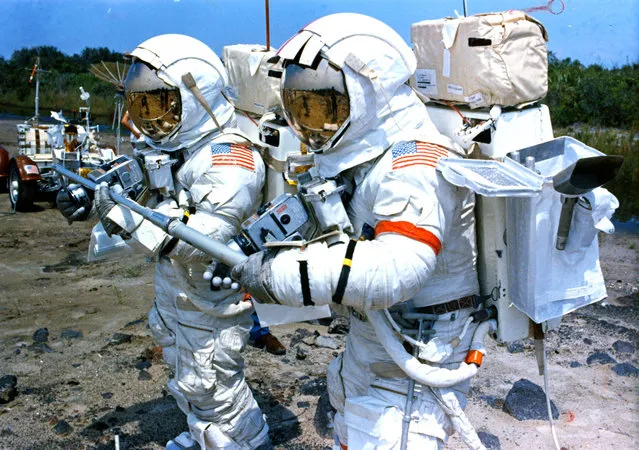
Astronauts Harrison Schmitt (left) and Eugene Andrew Cernan practice taking geological samples at the Kennedy Space Center in Florida, in preparation for NASA's scheduled Apollo 17 lunar landing mission, on August 28, 1972. Schmitt is the Lunar Module Pilot and Cernan is the mission's Commander. They are training for their period of EVA (extravehicular activity) on the Moon. (Photo by Space Frontiers/Getty Images)

Astronauts Harrison Schmitt (left) and Eugene Andrew Cernan practice taking geological samples at the Kennedy Space Center in Florida, in preparation for NASA's scheduled Apollo 17 lunar landing mission, on August 28, 1972. Schmitt is the Lunar Module Pilot and Cernan is the mission's Commander. They are training for their period of EVA (extravehicular activity) on the Moon. (Photo by Space Frontiers/Getty Images)
Details
24 Dec 2022 04:10:00
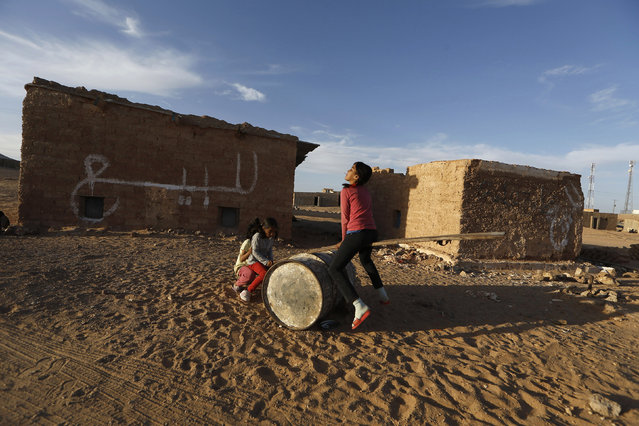
Indigenous Sahrawi girls play on an improvised see-saw at a refugee camp of Boudjdour in Tindouf, southern Algeria March 3, 2016. (Photo by Zohra Bensemra/Reuters)

Indigenous Sahrawi girls play on an improvised see-saw at a refugee camp of Boudjdour in Tindouf, southern Algeria March 3, 2016. UN Secretary General Ban Ki-moon is scheduled to visit the Sahrawi refugees in south-west Algeria's Tindouf region. (Photo by Zohra Bensemra/Reuters)
Details
04 Mar 2016 12:16:00
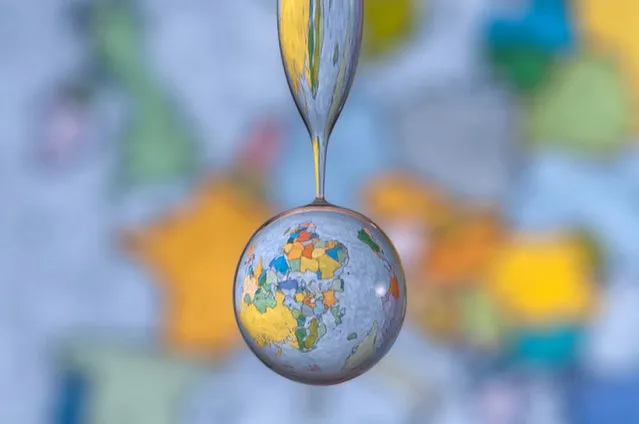
 Refractions In Water Drops By Markus Reugels

German photographer Markus Reugels. Using large satellite photos as a backdrop and a high speed camera he captures the background’s refraction through water drops. The perfectly timed shots result in these spherical representations of the Earth, Moon and Jupiter. See much more of his work here and also here. Thanks Markus for sharing your work with Colossal!
Details
21 Feb 2013 11:00:00
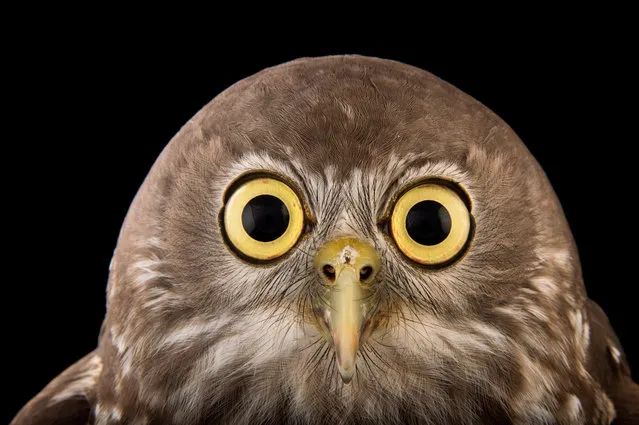
The National Geographic Photo Ark is a travelling exhibition of photographer Joel Sartore’s quest to create a photo archive of biodiversity around the world. So far, Sartore has captured studio portraits of more than 6,000 species – a number that he hopes to double. On 1 July, the ark will open at Melbourne zoo – the first time it has been exhibited in the southern hemisphere. More than 50 portraits will be on display, including many of Australian endangered animals being protected by programs at the zoo itself. These captions have been edited from text supplied by Melbourne zoo. Here: Barking owl. So-named because its call sounds like a barking dog, these birds are native to Australia, Indonesia and Papua New Guinea. In Victoria they are listed as an endangered species, and in 2003 there were estimated to be fewer than 50 breeding pairs. The main threat to the species in Victoria is loss of habitat, especially large trees with hollows in which they can nest and on which many of their prey depend. Apart from a bark, they may utter a chilling scream when they feel threatened. (Photo by Joel Sartore/National Geographic Photo Ark/The Guardian)

The National Geographic Photo Ark is a travelling exhibition of photographer Joel Sartore’s quest to create a photo archive of biodiversity around the world. So far, Sartore has captured studio portraits of more than 6,000 species – a number that he hopes to double. On 1 July, the ark will open at Melbourne zoo – the first time it has been exhibited in the southern hemisphere. More than 50 portraits will be on display, including many of Australian endangered animals being protected by programs at the zoo itself. These captions have been edited from text supplied by Melbourne zoo. Here: Barking owl. (Photo by Joel Sartore/National Geographic Photo Ark/The Guardian)
Details
01 Jul 2017 07:45:00
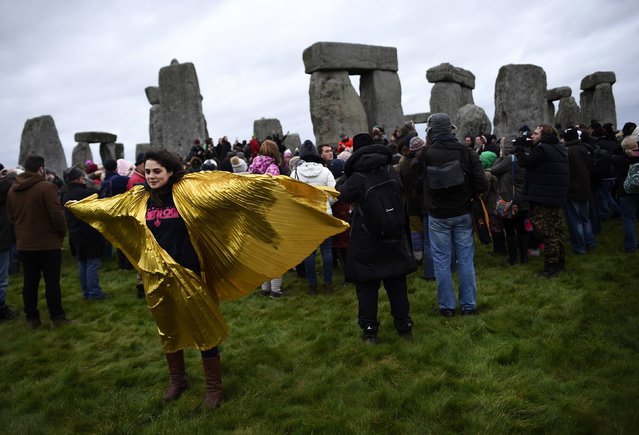
A reveller wearing a golden cape celebrates as the sun rises during the winter solstice at Stonehenge on Salisbury plain in southern England December 22, 2014. The winter solstice is the shortest day of the year, and the longest night of the year. (Photo by Dylan Martinez/Reuters)

A reveller wearing a golden cape celebrates as the sun rises during the winter solstice at Stonehenge on Salisbury plain in southern England December 22, 2014. The winter solstice is the shortest day of the year, and the longest night of the year. (Photo by Dylan Martinez/Reuters)
Details
23 Dec 2014 14:06:00
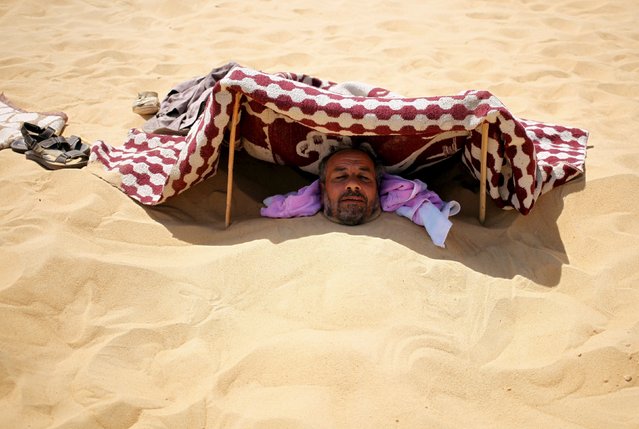
A patient buried in the hot sand looks out from under a shade that protects his face from the sun in Siwa, Egypt, August 12, 2015. (Photo by Asmaa Waguih/Reuters)

A patient buried in the hot sand looks out from under a shade that protects his face from the sun in Siwa, Egypt, August 12, 2015. In the searing heat of summer in western Egypt, at the hottest time of the day, sufferers of rheumatism, joint pain, infertility or impotence lie buried neck-deep in the sand of Siwa near Dakrour Mountain. Locals say taking a sand bath is a natural therapy with powers to cure many medical conditions. (Photo by Asmaa Waguih/Reuters)
Details
28 Aug 2015 12:07:00