Loading...
Done
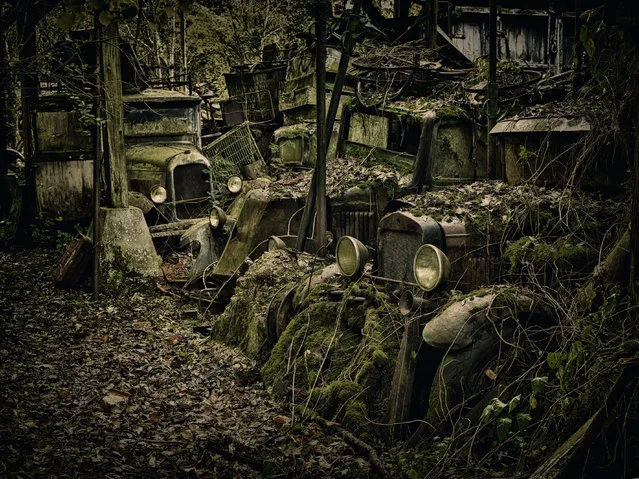
Seemingly camouflaged cars are stacked on top of each other causing them to blend in with the landscape, in 2013, France. (Photo by Dieter Klein/Barcroft Media)

Leaves and forest foliage claim abandoned motors at makeshift car graveyards. German photographer Dieter Klein travels the world to find vintage automobiles left to rust in leafy forests and fields. Here: Seemingly camouflaged cars are stacked on top of each other causing them to blend in with the landscape, in 2013, France. (Photo by Dieter Klein/Barcroft Media)
Details
15 Apr 2015 12:24:00
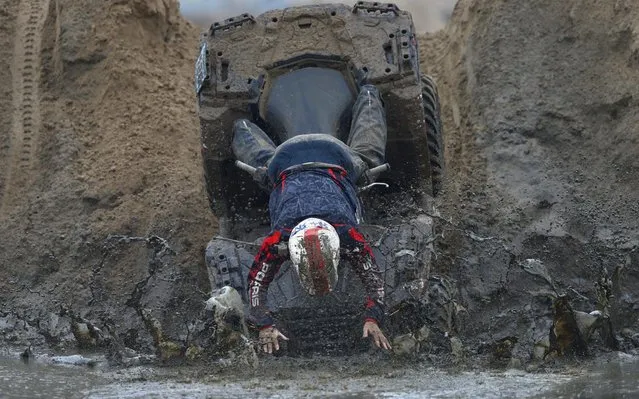
Richard Coleby of Polaris falls over his quad into muddy waters during day one of the HydroGarden Weston Beach Race on October 14, 2017 in Weston-Super-Mare, England. (Photo by Michael Steele/Getty Images)

Richard Coleby of Polaris falls over his quad into muddy waters during day one of the HydroGarden Weston Beach Race on October 14, 2017 in Weston-Super-Mare, England. (Photo by Michael Steele/Getty Images)
Details
17 Oct 2017 06:14:00


Alfred Hitchcock (1899 – 1980) in front of a caricature of his profile at a press reception in London for his new film “Frenzy”. (Photo by Central Press/Getty Images). 24th May 1972
Details
26 Mar 2011 08:46:00


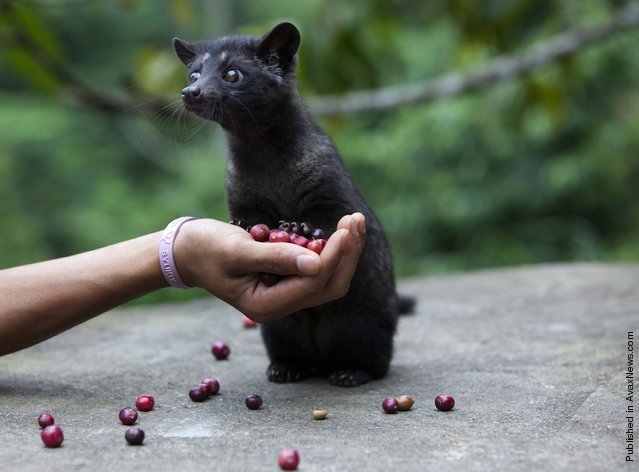
“Kopi luwak (Malay pronunciation), or civet coffee, is one of the world's most expensive and low-production coffee. It is made from the beans of coffee berries which have been eaten by the Asian Palm Civet (Paradoxurus hermaphroditus) and other related civets, then passed through its digestive tract. ...
Details
19 Mar 2011 18:41:00
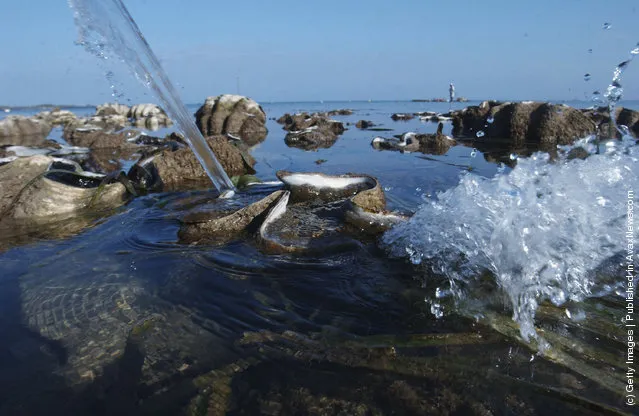
Tridacna Gigas, or Giant Clams

“The giant clam, Tridacna gigas (known as pā’ua in Cook Islands Māori), is the largest living bivalve mollusc. T. gigas is one of the most endangered clam species. It was mentioned as early as 1825 in scientific reports. One of a number of large clam species native to the shallow coral reefs of the South Pacific and Indian oceans, they can weigh more than 200 kilograms (440 lb) measure as much as 120 cm (47 in) across, and have an average lifespan in the wild of 100 years or more”. – Wikipedia

Photo: Tridacna Gigas, or Giant Clams spew water as a traditional fisherman passes by a small sanctuary on January 23, 2004 near Bolinao in the Northern Philippines. The clams, prime builders for coral reefs and providing shelter for spawning fish and other marine life, are exposed by low tides in the sanctuary. Overfishing and pollution throughout the country are not only threatening food security, but are also starting to choke one of the few working clam sanctuaries in the world. (Photo by David Greedy/Getty Images)

Details
01 Oct 2011 13:10:00
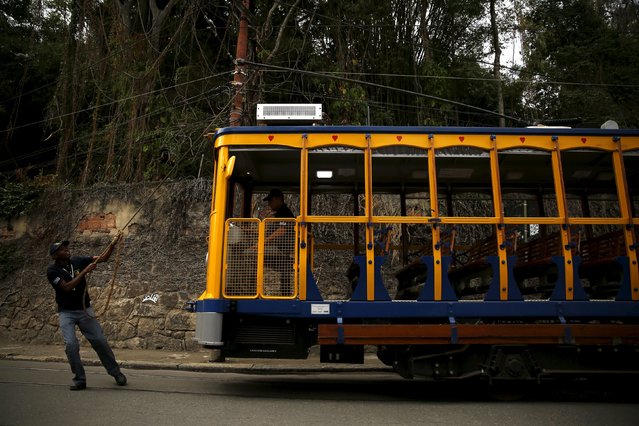
A worker manually changes the direction of the bonde, the typical tram line in Santa Teresa neighborhood, using a rope in Rio de Janeiro, Brazil, September 9, 2015. (Photo by Pilar Olivares/Reuters)

A worker manually changes the direction of the bonde, the typical tram line in Santa Teresa neighborhood, using a rope in Rio de Janeiro, Brazil, September 9, 2015. The Santa Teresa bonde, called “Bondinho” in Portuguese, is running with passengers as a part of a test period, after the service was suspended in 2011 following an accident that killed six people, according to residents. (Photo by Pilar Olivares/Reuters)
Details
11 Sep 2015 12:53:00
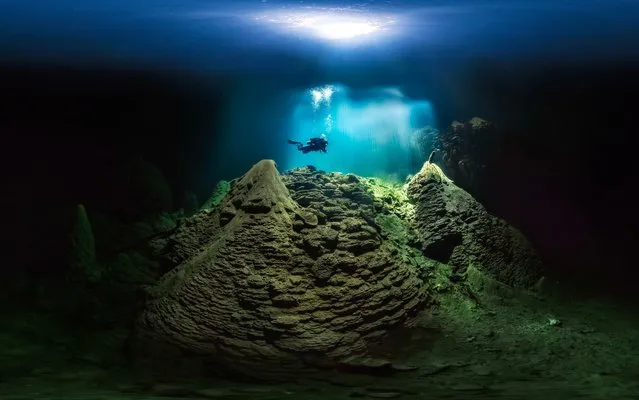
Cave Diver, Anhumas Abyss, Bonito, Brazil: The Anhumas Abyss is an underground cavern with a crystal-clear lake below, more than 260 feet (79 m) deep. A visitor must enter through a narrow opening at the top of the chamber and rappel into the cave. Snorkeling and scuba diving in the lake reveal amazing scenery. Distinctive, conical limestone stalagmites and stalactites occupy the lake and the surrounding area, some reaching 65 feet (20 m) high. “One must rappel about 235 feet (72 m) to get down into this deep lake. The photo was taken at a depth of 50 feet (15 m). It was a challenge to create the image because of the high contrast, plus the diver could not see into the darkness, making communication impossible”. (Photo by Marcio Cabral/Nature’s Best Photography Awards 2017)

Cave Diver, Anhumas Abyss, Bonito, Brazil: The Anhumas Abyss is an underground cavern with a crystal-clear lake below, more than 260 feet (79 m) deep. A visitor must enter through a narrow opening at the top of the chamber and rappel into the cave. Snorkeling and scuba diving in the lake reveal amazing scenery. Distinctive, conical limestone stalagmites and stalactites occupy the lake and the surrounding area, some reaching 65 feet (20 m) high. (Photo by Marcio Cabral/Nature’s Best Photography Awards 2017)
Details
26 Oct 2017 08:10:00
Students of the Krasnoyarsk choreographic college Anastasia Shevtsova (R) and Yulia Lyakhovykh do leg-splits as they study for an exam and a performance by the graduates at the State Theatre of Opera and Ballet, at the college's campus in the Siberian city of Krasnoyarsk, Russia, May 4, 2017. (Photo by Ilya Naymushin/Reuters)

Students of the Krasnoyarsk choreographic college Anastasia Shevtsova (R) and Yulia Lyakhovykh do leg-splits as they study for an exam and a performance by the graduates at the State Theatre of Opera and Ballet, at the college's campus in the Siberian city of Krasnoyarsk, Russia, May 4, 2017. (Photo by Ilya Naymushin/Reuters)
Details
28 Dec 2017 07:48:00