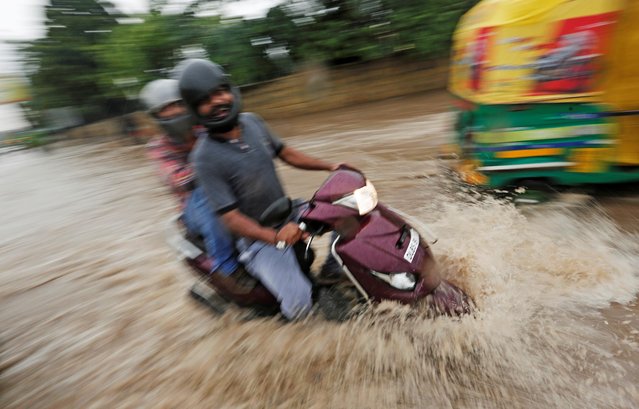
Men rest on a boat in the overflowed Ganges River under the Shastri Bridge in Allahabad on August 17, 2022, as water levels of the Ganges and Yamuna rivers rose following monsoon rainfalls. (Photo by Sanjay Kanojia/AFP Photo)
Model Daisy Lowe has been camouflaged into a wall of daisies by world-leading body paint artist Carolyn Roper, to showcase the Samsung QLED TV's Ambient Mode feature in London, United Kingdom on August 2, 2018. The work took eight hours to complete. (Photo by Matt Alexander/PA Wire)
Relatives of community leader Josemano “Badou” Victorieux, one of the victims of clashes with the Police, cry during his funeral in Port-au-Prince, Haiti, 16 October 2019. The protest movement in Haiti completes a month with no sign of remitting and without the President, Jovenel Moise, yielding to the voices that require him to resign. (Photo by Orlando Barria/EPA/EFE)
Model Helen Kwok displays the nail art completed by a competitor at the Canada Nail Cup in Vancouver, Monday, February 16, 2015. Nail artists competed in multiple categories at the event, which according to organizers is the only nail competition in the country. (Photo by Darryl Dyck/AP Photo/The Canadian Press)
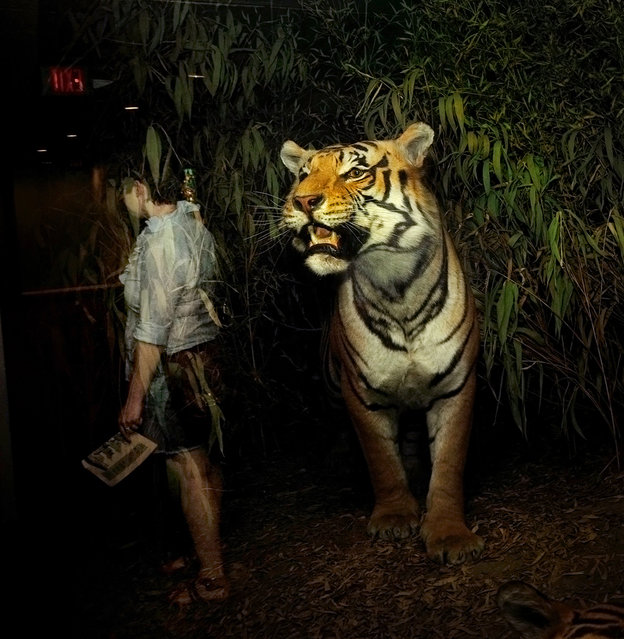
“Natural History” is a series of completely candid single exposure images that merge the living and the dead to create allegorical narratives of our troubled co-existence with nature. Ghost-like reflections of modern visitors viewing wildlife dioramas are juxtaposed against the antique taxidermied subjects housed behind thick glass, their faces molded into permanent expressions of fear, aggression or fleeting passivity. After decades of over-hunting, climate change, poaching and destruction of habitat, many of these long dead diorama specimens now represent endangered or completely extinct species”. – Traer Scott. (Photo by Traer Scott)
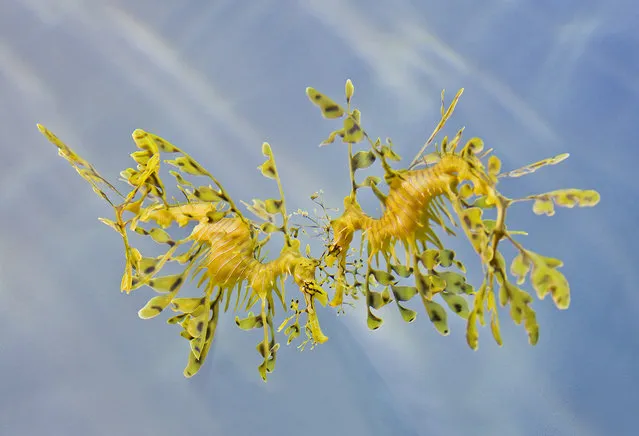
The leafy seadragon or Glauert's seadragon, Phycodurus eques, is a marine fish in the family Syngnathidae, which also includes the seahorses. It is the only member of the genus Phycodurus. It is found along the southern and western coasts of Australia. The name is derived from the appearance, with long leaf-like protrusions coming from all over the body. These protrusions are not used for propulsion; they serve only as camouflage. The leafy seadragon propels itself by means of a pectoral fin on the ridge of its neck and a dorsal fin on its back closer to the tail end. These small fins are almost completely transparent and difficult to see as they undulate minutely to move the creature sedately through the water, completing the illusion of floating seaweed.