Loading...
Done
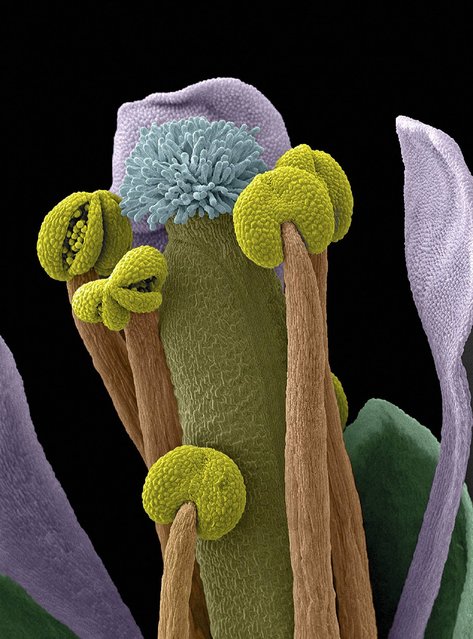
Scanning electron micrograph (SEM) of an Arabidopsis thaliana flower, also commonly known as thale cress. Some of the anthers are open, revealing pollen grains ready for dispersal. Arabidopsis was the first plant to have its entire genome sequenced and is widely used as a model organism in molecular and plant biology. Horizontal width of image is 1200 microns. Magnification 100x. (Photo by Stefan Eberhard/Wellcome Images)

Beautiful, strange and occasionally alarming pictures from the shortlist for this year’s Wellcome image awards – which celebrate the very best in science photography and imaging – from an x-ray of a bat to a micrograph of a kidney stone. The exhibition opens on 12 March at three science centres and the Museum of Science and Industry in Manchester. Photo: Scanning electron micrograph (SEM) of an Arabidopsis thaliana flower, also commonly known as thale cress. Some of the anthers are open, revealing pollen grains ready for dispersal. Arabidopsis was the first plant to have its entire genome sequenced and is widely used as a model organism in molecular and plant biology. Horizontal width of image is 1200 microns. Magnification 100x. (Photo by Stefan Eberhard/Wellcome Images)
Details
11 Mar 2014 05:58:00
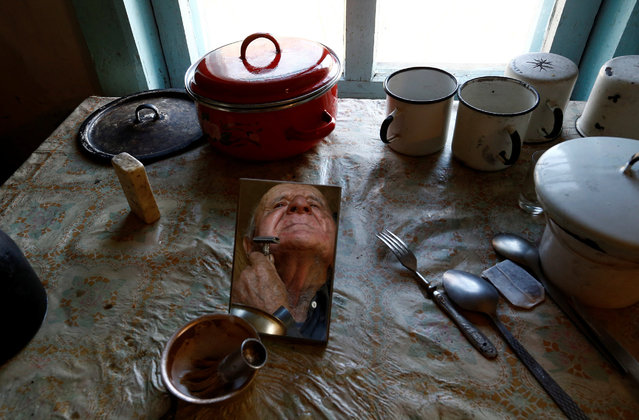
Ivan Shamyanok, 90, shaves in his house in the village of Tulgovichi, near the exclusion zone around the Chernobyl nuclear reactor, Belarus March 15, 2016. “My sister lived here with her husband. They decided to leave and soon enough they were in the ground ... They died from anxiety. I'm not anxious. I sing a little, take a turn in the yard, take things slowly like this and I live”, he said. (Photo by Vasily Fedosenko/Reuters)

Ivan Shamyanok, 90, shaves in his house in the village of Tulgovichi, near the exclusion zone around the Chernobyl nuclear reactor, Belarus March 15, 2016. “My sister lived here with her husband. They decided to leave and soon enough they were in the ground ... They died from anxiety. I'm not anxious. I sing a little, take a turn in the yard, take things slowly like this and I live”, he said. (Photo by Vasily Fedosenko/Reuters)
Details
27 Apr 2016 09:50:00
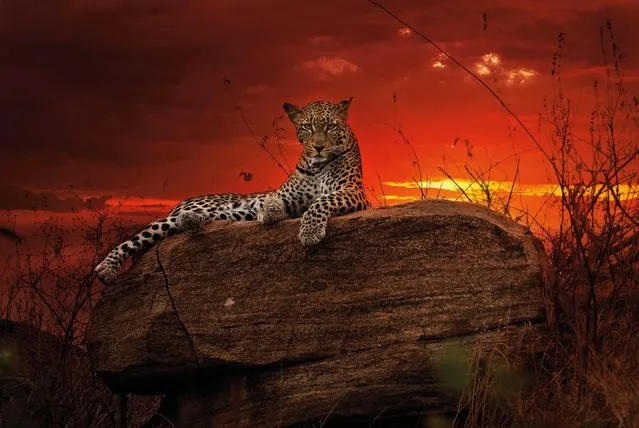
“Wild Africa”. (Photo by Alex Bernasconi)

Award-winning photographer Alex Bernasconi has captured thousands of images – from hiding hippos to wandering zebras – in his travels across Africa. His amazing work features in a new edition of his book Wild Africa. These amazing pictures create a snapshot of the life of some of the planet’s most spectacular animals and natural habitats. Photo: “Wild Africa”. (Photo by Alex Bernasconi)
Details
15 Sep 2013 10:12:00


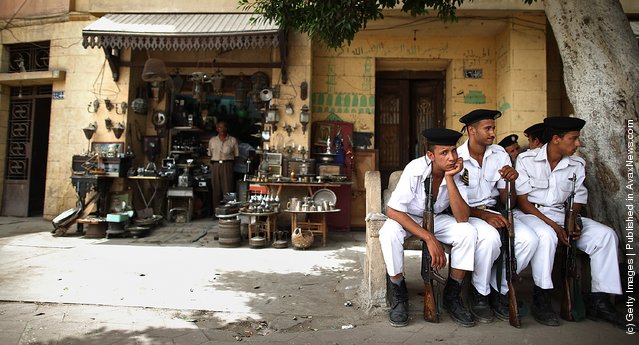
Tourist Police sit in the shade on a road leading to the Coptic Cairo area on May 27, 2011 in Cairo, Egypt. Protests in January and February brought an end to 30 years of autocratic rule by President Hosni Mubarak who will now face trial. Food prices have doubled and youth unemployment stands at 30%. Tourism is yet to return to pre-uprising levels. (Photo by Peter Macdiarmid/Getty Images)
Details
29 May 2011 11:42:00
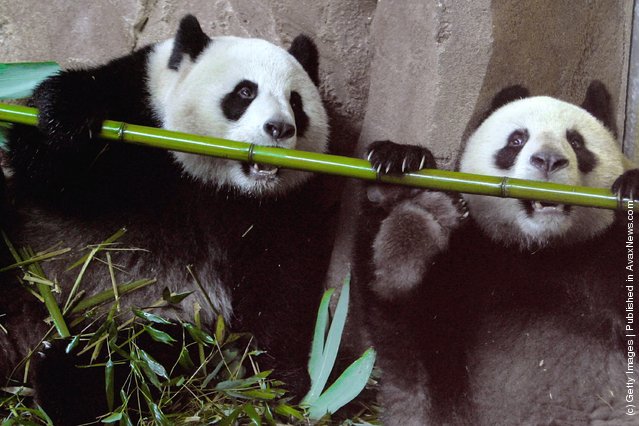
Yuan Zi, a male giant panda and Huan Huan, a female giant panda, share their life inside their enclosure at Zoo Parc De Beauval

Yuan Zi, a male giant panda and Huan Huan, a female giant panda, share their life inside their enclosure at Zoo Parc De Beauval on January 25, 2012 in Beauval, France. A pair of giant pandas which have been loaned to the zoo by China, where they hope the pair will reproduce and help boost the world's dwindling panda population. (Photo by Franck Prevel/Getty Images)
Details
27 Jan 2012 11:42:00
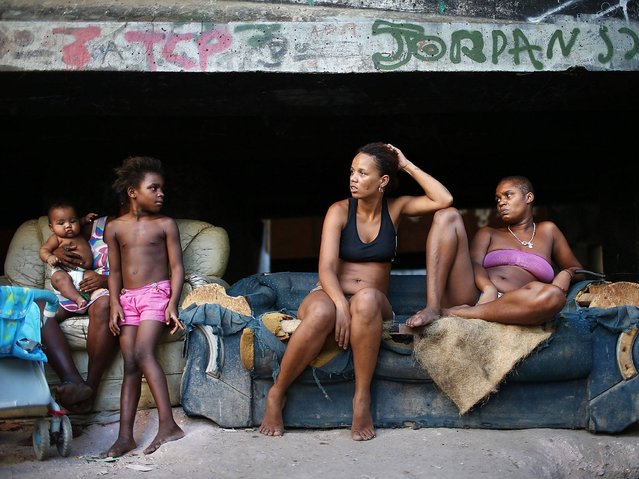
Residents (R to L) Luiza, Janubie, Leiticia and Lucas sit beneath an overpass near their houses in an impoverished area in the unpacified Complexo da Mare slum complex, one of the largest “favela” complexes in Rio de Janeiro. (Photo by Mario Tama/Getty Images)

Residents (R to L) Luiza, Janubie, Leiticia and Lucas sit beneath an overpass near their houses in an impoverished area in the unpacified Complexo da Mare slum complex, one of the largest “favela” complexes in Rio, on March 18, 2014 in Rio de Janeiro, Brazil. (Photo by Mario Tama/Getty Images)
Details
21 Mar 2014 06:07:00
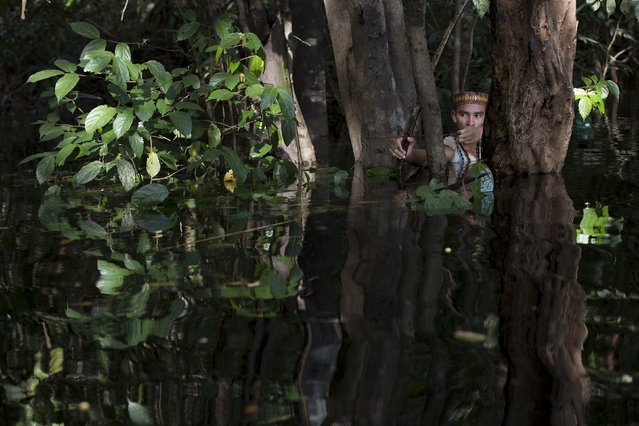
Kambeba Indian, Dream Braga, 18, aims his arrow in a jungle near the village Tres Unidos, Amazon state May 9, 2015. Dream Braga has been shooting fish with a bow and arrow for most of his life. In the Amazonian village where he grew up, that was what kids did for food and fun. (Photo by Bruno Kelly/Reuters)

Kambeba Indian, Dream Braga, 18, aims his arrow in a jungle near the village Tres Unidos, Amazon state May 9, 2015. Dream Braga has been shooting fish with a bow and arrow for most of his life. In the Amazonian village where he grew up, that was what kids did for food and fun. He participated in the Indigenous Archery Project which recruits Amazon native children to compete with modern archery equipment and try for a place on the national team, with the 2016 Olympics in Rio de Janeiro as their ultimate goal. After training with Olympic coaches for three months, he has now been promoted to Brazil's national team. (Photo by Bruno Kelly/Reuters)
Details
17 May 2015 11:19:00
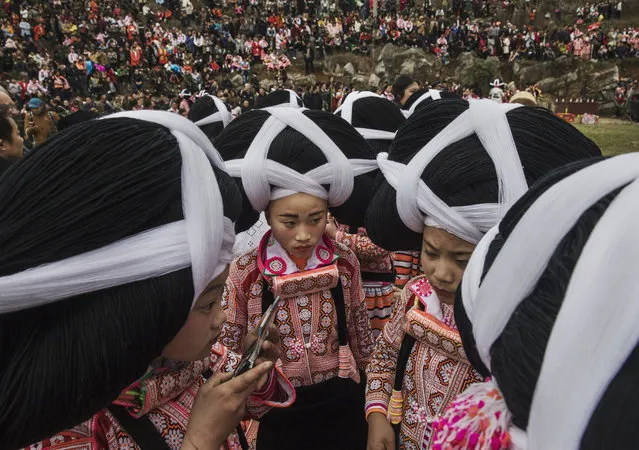
Girls of the Long Horn Miao ethnic minority group wear headdresses as they prepare gather for Tiaohua or Flower Festival as part of the Lunar New Year on February 6, 2017 in Longga village, Guizhou province, southern China. The Long Horn Miao are recognized for their declining practice of wrapping a blend of linen, wool, and the hair of their ancestors around animal horns or a wooden clip to make headdresses. Many young women say they now wear the headdresses only for special occasions and festivals, as the ornaments, which are attached by the horns to their real hair, have proved impractical for modern daily life in a fast changing world. China officially recognizes 56 different ethnic minorities, and statistics show over 7 million Chinese identifying themselves as Miao. But the small Long Horn Miao community counts only around 5000 people living in 12 villages, whose age-old traditions, language, and culture are fading. It is increasingly difficult in a modernizing China, as young people are drawn from remote rural villages to opportunities in bigger cities amongst wide-scale urbanization. Farming and labour remain the mainstays of life for the Long Horn Miao, leaving the area relatively poor in comparison with many parts of China. The government has invested significant amounts into local infrastructure and the tourism industry to try to bolster the local economy. (Photo by Kevin Frayer/Getty Images)

Girls of the Long Horn Miao ethnic minority group wear headdresses as they prepare gather for Tiaohua or Flower Festival as part of the Lunar New Year on February 6, 2017 in Longga village, Guizhou province, southern China. (Photo by Kevin Frayer/Getty Images)
Details
13 Feb 2017 00:01:00