A truck transporting 20 tons of fish lost its load after crashing on a road near Liepen, eastern Germany on April 20, 2018. (Photo by Stefan Sauer/AFP Photo/DPA)
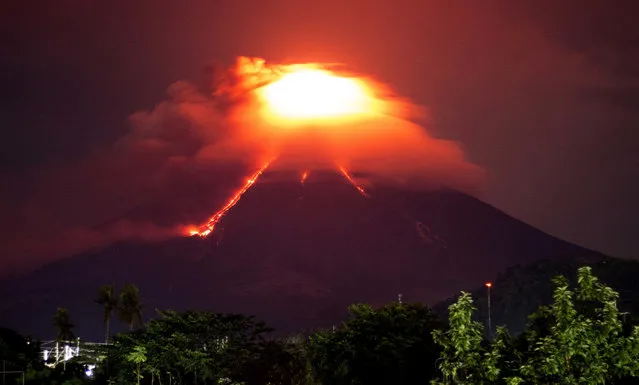
Lava cascades down the slopes of Mayon volcano as seen from Legazpi city, Albay province, around 340 kilometers (210 miles) southeast of Manila, Philippines, Monday, January 15, 2018. More than 9,000 people have evacuated the area around the Philippines' most active volcano as lava flowed down its crater Monday in a gentle eruption that scientists warned could turn explosive. (Photo by Earl Recamunda/AP Photo)
An Oktoberfest visitor swings her dirndl, at the start of Oktoberfest, on Munich's Theresienwiese, in Germany, Saturday, September 20, 2025. (Photo by Karl-Josef Hildenbrand/dpa via AP Photo)
Marry Ousmane, 18, poses outside while wearing her prom dress on May 29, 2020 in the Brooklyn borough in New York City. Marry Ousmane is best friends with Patrice Toussaint and both are seniors at Edward Murrow high school in Brooklyn whose senior prom was canceled due to all schools being closed during the coronavirus pandemic. Toussaint said, “I've been planning for four years. I was going to have a send off party with a barbecue and a red carpet. I was going to have two dresses and wear a crown”. (Photo by Stephanie Keith/Getty Images)
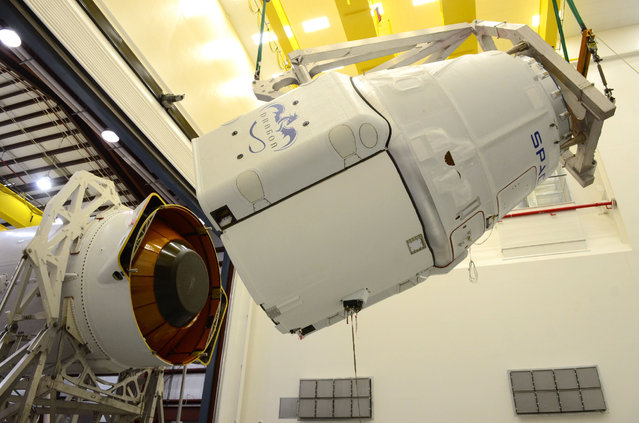
SpaceX’s Dragon spacecraft, March 6, 2014. SpaceX's Falcon 9 rocket and Dragon spacecraft launched from Launch Complex 40 at the Cape Canaveral Air Force Station, Florida, for their third official Commercial Resupply (CRS) mission to the orbiting lab on April 18, 2014. Dragon returned to Earth with a parachute-assisted splashdown off the coast of southern California on May 14, 2014. Dragon is the only operational spacecraft capable of returning a significant amount of supplies back to Earth, including experiments. (Photo by Ron Lin/SpaceX Photos)
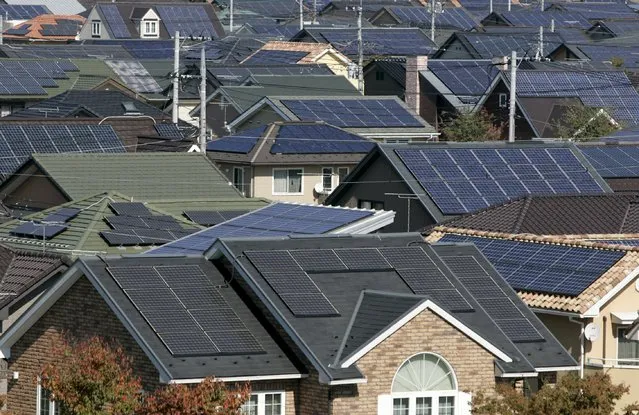
Rooftops of solar powered houses are pictured in Ota, 80 km northwest of Tokyo in this October 28, 2008 file photo. One by one, Japan is turning off the lights at the giant oil-fired power plants that propelled it to the ranks of the world's top industrialised nations. With nuclear power in the doldrums after the Fukushima disaster, it's solar energy that is becoming the alternative. Solar power is set to become profitable in Japan as early as this quarter, according to the Japan Renewable Energy Foundation (JREF), freeing it from the need for government subsidies and making it the last of the G7 economies where the technology has become economically viable. (Photo by Yuriko Nakao/Reuters)