Loading...
Done
Arctic Hare

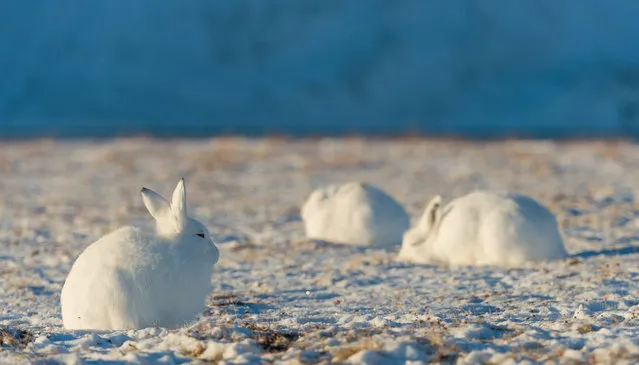
The arctic hare, or polar rabbit, is a species of hare which is adapted largely to polar and mountainous habitats. The arctic hare survives with a thick coat of fur and usually digs holes in the ground or under snow to keep warm and sleep. Arctic hares look like rabbits but have shorter ears, are taller when standing, and, unlike rabbits, can thrive in cold climates. They can travel together with many other hares, sometimes huddling with dozens or more, but are usually found alone, taking, in some cases, more than one partner. The arctic hare can run up to 60 kilometres per hour (40 mph). Its predators include the arctic wolf, arctic fox, and ermine.
Details
17 Mar 2014 13:56:00
Aquarium visitors attend a dinner party in an underwater tunnel in Tianjin, China on September 15, 2016. (Photo by Feature China/Barcroft Images)

Aquarium visitors attend a dinner party in an underwater tunnel in Tianjin, China on September 15, 2016. Tianjin Haichang Polar Ocean World opened in the city of Tianjin, southeast of Beijing, in 2010. It gives visitors a chance to see more than 150 large animals from the Arctic and Antarctic regions, including polar bears. (Photo by Feature China/Barcroft Images)
Details
16 Sep 2016 11:18:00
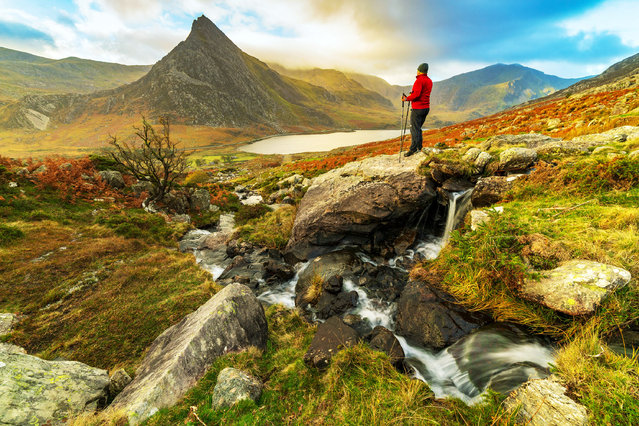
Cooler temperatures begin this week as a polar vortex brings much colder conditions with the chance of snow for Snowdonia, Ogwen Valley, North Wales on 22nd October 2018. The Ogwen Valley and Tryfan Mountain looking splendid in the Autumn sunrise. (Photo by DGDImages/Alamy Live News)

Cooler temperatures begin this week as a polar vortex brings much colder conditions with the chance of snow for Snowdonia, Ogwen Valley, North Wales on 22nd October 2018. The Ogwen Valley and Tryfan Mountain looking splendid in the Autumn sunrise. (Photo by DGDImages/Alamy Live News)
Details
08 Nov 2018 00:01:00
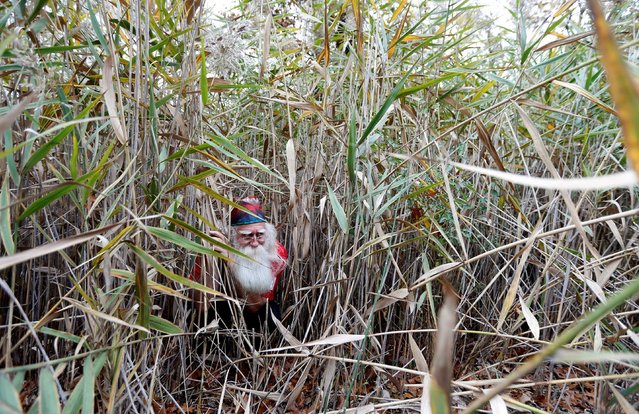
Santa Jerry Julian of Colorado Springs, Colorado hides in the grass following a ride on the Polar Express during a field trip from the Charles W. Howard Santa Claus School in Midland, Michigan, U.S. October 28, 2016. (Photo by Christinne Muschi/Reuters)

Santa Jerry Julian of Colorado Springs, Colorado hides in the grass following a ride on the Polar Express during a field trip from the Charles W. Howard Santa Claus School in Midland, Michigan, U.S. October 28, 2016. (Photo by Christinne Muschi/Reuters)
Details
19 Nov 2016 11:24:00
People pose for a photo with certificates after swimming in the ocean for the 121st annual Coney Island Polar Bear Club's New Year's Day plunge at Coney Island beach in the Brooklyn borough of New York, New York, USA, 01 January 2024. (Photo by Sarah Yenesel/EPA)

People pose for a photo with certificates after swimming in the ocean for the 121st annual Coney Island Polar Bear Club's New Year's Day plunge at Coney Island beach in the Brooklyn borough of New York, New York, USA, 01 January 2024. (Photo by Sarah Yenesel/EPA)
Details
11 Jan 2024 18:21:00
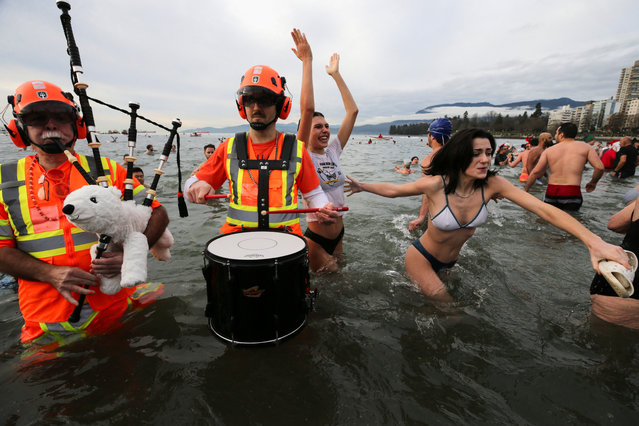
Musicians play as bathers run into the chilly waters of English Bay while celebrating New Year's Day with the Polar Bear Swim in Vancouver, British Columbia, Canada on January 1, 2024. (Photo by Chris Helgren/Reuters)

Musicians play as bathers run into the chilly waters of English Bay while celebrating New Year's Day with the Polar Bear Swim in Vancouver, British Columbia, Canada on January 1, 2024. (Photo by Chris Helgren/Reuters)
Details
19 Apr 2025 00:18:00
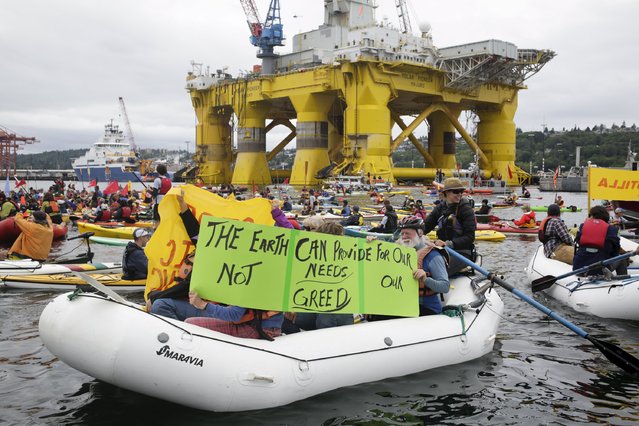
Activists protest the Shell Oil Company's drilling rig Polar Pioneer which is parked at Terminal 5 at the Port of Seattle, Washington May 16, 2015. Hundreds of activists in kayaks and small boats fanned out on a Seattle bay on Saturday to protest plans by Royal Dutch Shell to resume oil exploration in the Arctic and keep two of its drilling rigs stored in the city's port. (Photo by Jason Redmond/Reuters)

Activists protest the Shell Oil Company's drilling rig Polar Pioneer which is parked at Terminal 5 at the Port of Seattle, Washington May 16, 2015. Hundreds of activists in kayaks and small boats fanned out on a Seattle bay on Saturday to protest plans by Royal Dutch Shell to resume oil exploration in the Arctic and keep two of its drilling rigs stored in the city's port. (Photo by Jason Redmond/Reuters)
Details
18 May 2015 12:07:00
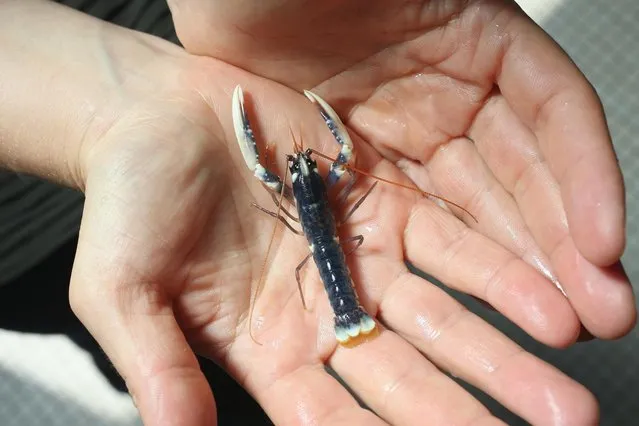
Isabel Schmalenbach, an environmental scientist with the Helgoland Biological Institute (Biologische Anstalt Helgoland), part of the Alfred Wegener Institute for Polar and Marine Research, holds a one-year old baby European lobster (Homarus gammarus) raised at the institute on August 3, 2013 on Helgoland Island, Germany. (Photo by Sean Gallup/Getty Images)

Isabel Schmalenbach, an environmental scientist with the Helgoland Biological Institute (Biologische Anstalt Helgoland), part of the Alfred Wegener Institute for Polar and Marine Research, holds a one-year old baby European lobster (Homarus gammarus) raised at the institute on August 3, 2013 on Helgoland Island, Germany. Later in the day Schmalenbach and her colleagues released a total of 415 one-year old lobsters into the North Sea as part of an effort to repopulate the lobster population around Helgoland (also called Heligoland). In the 19th century local fishermen caught up to 80,000 lobsters a year in the surrounding waters, combined with the heavy allied bombing of the island during and after World War II, as well as other environmental factors, decimated the lobster population. (Photo by Sean Gallup)
Details
05 Aug 2013 08:39:00