Loading...
Done
Rabbit Sport Tournament

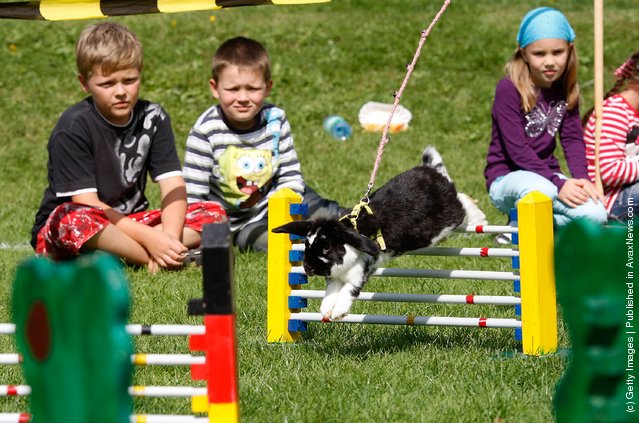
Children watch a rabbit, jumping over a hurdle at an obstacle course the 5th Open Rabbit Sport Tournament (5. offene Kaninchensport Turnier) on August 28, 2011 in Rommerz near Fulda, Germany. Eighty rabbits competed in light-weight, middle-weight and jumping-for-points categories at today's tournament in Rommerz that is based on Kanin Hop, or Rabbit Hopping. Rabbit Hopping is a growing trend among pet rabbit owners in Central Europe and the first European Championships are scheduled to be held later this year in Switzerland. (Photo by Ralph Orlowski/Getty Images)
Details
29 Aug 2011 14:44:00
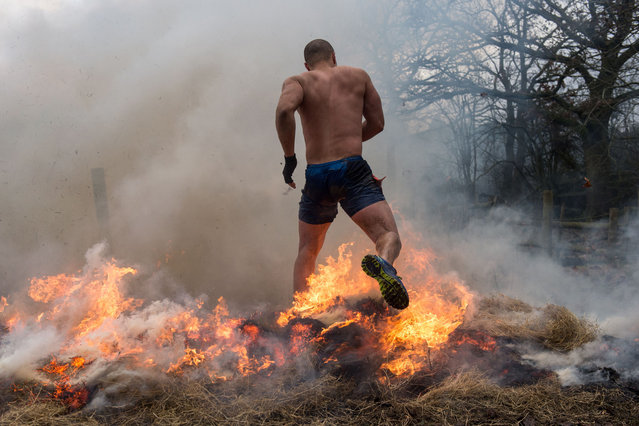
A competitor makes their way through fire as they take part in the Tough Guy endurance event near Wolverhampton, central England, on January 27, 2019. (Photo by Oli Scarff/AFP Photo)

A competitor makes their way through fire as they take part in the Tough Guy endurance event near Wolverhampton, central England, on January 27, 2019. The Tough Guy event challenges hundreds of competitors to run a gruelling course whilst negotiating up to 300 obstacles including water, fire, and tunnels. (Photo by Oli Scarff/AFP Photo)
Details
31 Jan 2019 00:05:00
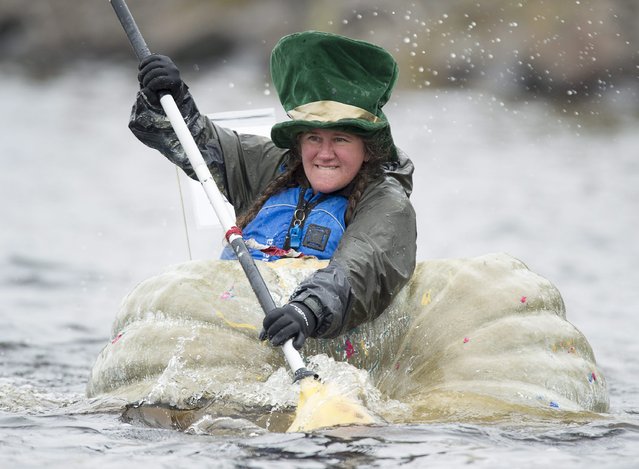
A paddler races in a giant pumpkin during the annual regatta on Lake Pisiquid in Windsor, Nova Scotia, Sunday, October 11, 2015. (Photo by Andrew Vaughan/The Canadian Press via AP Photo)

A paddler races in a giant pumpkin during the annual regatta on Lake Pisiquid in Windsor, Nova Scotia, Sunday, October 11, 2015. Participants hollow out the massive gourds and pilot them across the 500 meter course. (Photo by Andrew Vaughan/The Canadian Press via AP Photo)
Details
14 Oct 2015 08:07:00
Fantastic Illustration by Frank Melech

Frank Melech is a german artist that works with illustration and digital compositing. What we’re bringing you here today is a slice of such work that we thought, besides remarkably talended, highly creative, because Frank Melech starts with a light bulb, a universal symbol of Idea but also a metaphor for an enclosed but transparent world, and inserts in them precisely other worlds and ideas.
Details
23 Jul 2013 16:26:00


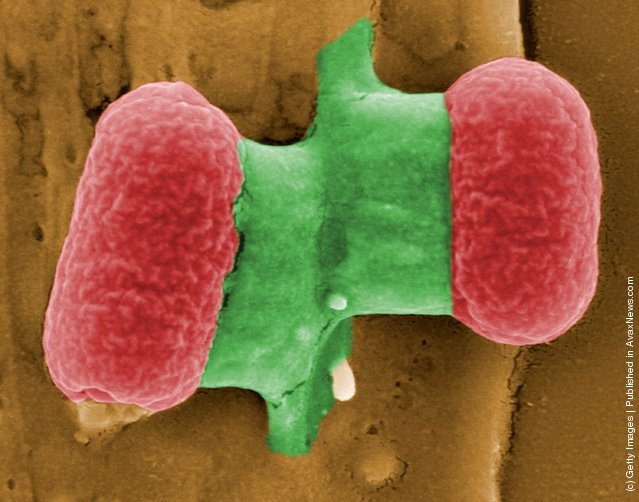
In this handout photo provided by the Helmholtz Center for Research on Infectious Diseases an EHEC bacteria is visible on May 30, 2011 in Berlin, Germany. German health authorities have attributed at least 14 deaths within the last two weeks to an outbreak of enterohemorrhagic E. coli, also known as the EHEC bacteria. (Photo Courtesay Manfred Rohde, Helmholtz-Zentrum fuer Infektionsforschung (HZI)/Getty Images)
Details
31 May 2011 06:43:00
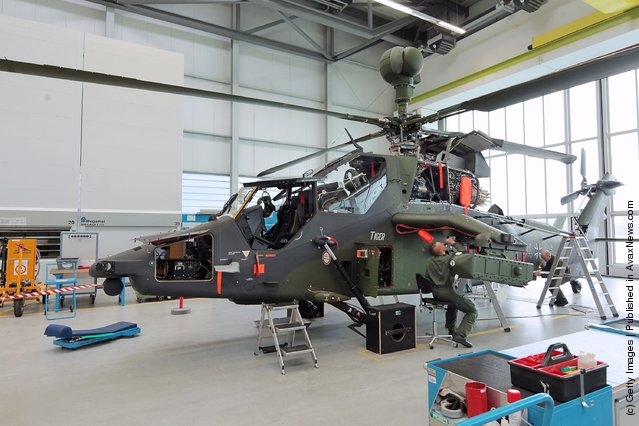
Workers assemble a Eurocopter Tiger military attack helicopter at the Eurocopter plant

Military staff members of the German Bundeswehr check an Eurocopter Tiger military attack helicopter at the Eurocopter plant on March 8, 2012 in Donauworth, Germany. EADS, the parent company of Eurocopter as well as airplane manufacturer Airbus, is scheduled to announce financial results for 2011 today. (Photo by Johannes Simon/Getty Images)
Details
09 Mar 2012 12:34:00
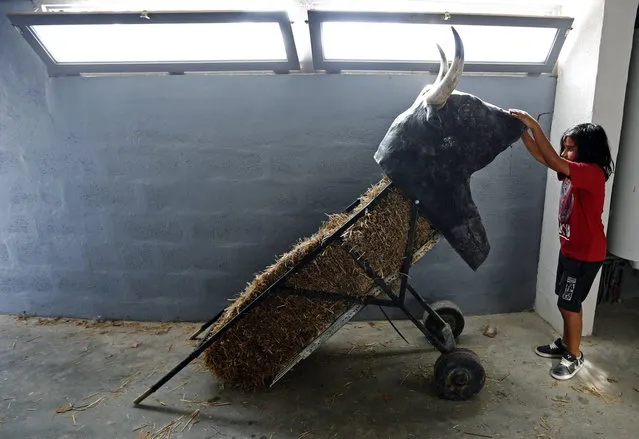
Nino, a ten-year-old toreador apprentice of the French Tauromachy Centre, nicknamed El Nino, touches a practice bull at the bullring of Garons, near Nimes, September 25, 2013. (Photo by Jean-Paul Pelissier/Reuters)

Nino, a ten-year-old toreador apprentice of the French Tauromachy Centre, nicknamed El Nino, touches a practice bull at the bullring of Garons, near Nimes, September 25, 2013. Since 1983, the French Tauromachy Centre in Nimes has trained some 1,000 youths in the art of bullfighting. Twenty of them have gone on to become professional matadors, facing fighting bulls in the arena. Twice a week, students take courses with a matador to learn the movements and gestures of the bullfighter in the ring, but without an animal present. Students train with calves in the surrounding fields during spring, and regularly participate in beginner's bullfights (becerradas) without killing calves. Solal has been taking courses for three years and Nino, for just a year now. Both are normally enrolled in French public schools, but have one thought in mind – bullfighting. They share a passion linked to the city of Nimes, famous for its ferias and bullring. (Photo by Jean-Paul Pelissier/Reuters)
Details
06 Nov 2013 10:12:00
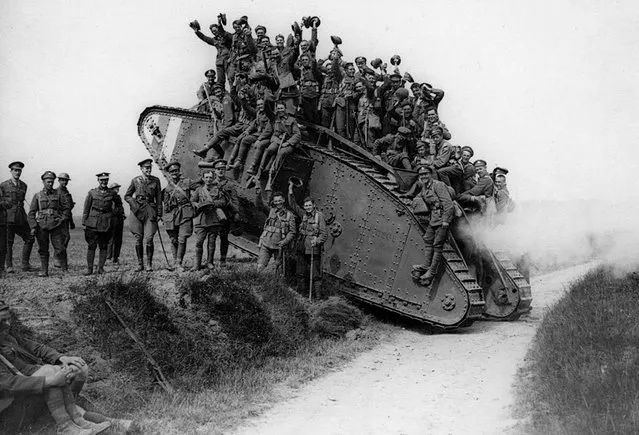
These black-and-white photos are taken from the new book “Armoured Warfare in the First World War 1916 – 1918” by Anthony Tucker-Jones and published by Pen & Sword Military. “Interestingly the British, French and Germans took completely different approaches with varying results”. The British military produced “Little Willie” in Autumn 1915 weighing 18 tonnes, which had a crew of two plus four gunners. “Inspired by a tracked artillery tractor “Little Willie” was referred to as a water tank – hence the name tank – to ensure secrecy”, said Anthony. “This led to the strange looking Mark I with its peculiar rhomboid shape, designed to cross trenches with guns in sponsons on either side. The Germans saw the tank as unchivalrous and were slow to grasp its utility. They favoured the Stormtrooper (specialist soldiers used to infiltrate enemy trenches) and artillery, not the tank”, said Anthony. “However, they didn’t hesitate to make use of captured British tanks. Although the tank helped secure victory and German soldiers dubbed it “Germany’s Downfall” the country was ultimately brought to its knees by the Allies blockade”. Here: British troops hitch a ride on a Mark IV after the massed tank fleet spearheading attack at Cambrai on November 20, 1917. (Photo by Anthony Tucker-Jones/Mediadrumworld.com)

These black-and-white photos are taken from the new book “Armoured Warfare in the First World War 1916 – 1918” by Anthony Tucker-Jones and published by Pen & Sword Military. Here: British troops hitch a ride on a Mark IV after the massed tank fleet spearheading attack at Cambrai on November 20, 1917. (Photo by Anthony Tucker-Jones/Mediadrumworld.com)
Details
23 Feb 2017 00:02:00