Loading...
Done
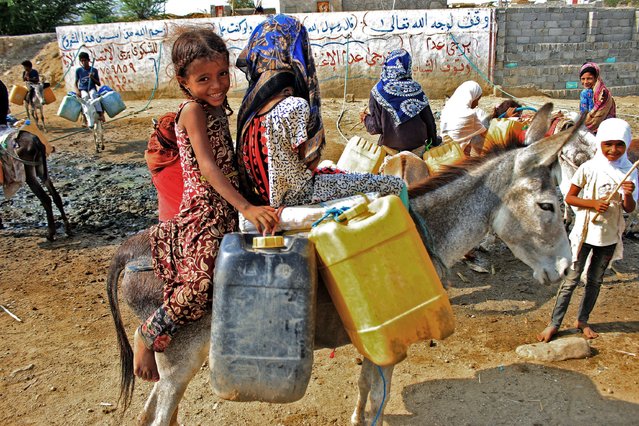
Children riding on donkeys queue to fill their jerrycans with water from a cistern at a make-shift camp for the internally displaced in Yemen's northern Hajjah province on July 12, 2021, amidst an extreme heat wave and severe water shortage. (Photo by Essa Ahmed/AFP Photo)

Children riding on donkeys queue to fill their jerrycans with water from a cistern at a make-shift camp for the internally displaced in Yemen's northern Hajjah province on July 12, 2021, amidst an extreme heat wave and severe water shortage. (Photo by Essa Ahmed/AFP Photo)
Details
13 Aug 2021 09:30:00
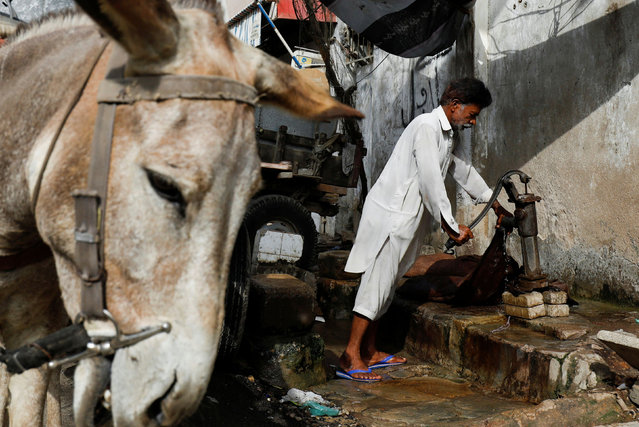
Mohammad Ramzan, 60, a traditional goatskin water carrier also known as a mashki, fills a bag with water from a handpump to deliver to nearby homes during the fasting month of Ramadan, as the outbreak of the coronavirus disease (COVID-19) continues, in Karachi, Pakistan on April 23, 2021. (Photo by Akhtar Soomro/Reuters)

Mohammad Ramzan, 60, a traditional goatskin water carrier also known as a mashki, fills a bag with water from a handpump to deliver to nearby homes during the fasting month of Ramadan, as the outbreak of the coronavirus disease (COVID-19) continues, in Karachi, Pakistan on April 23, 2021. (Photo by Akhtar Soomro/Reuters)
Details
29 May 2021 09:06:00
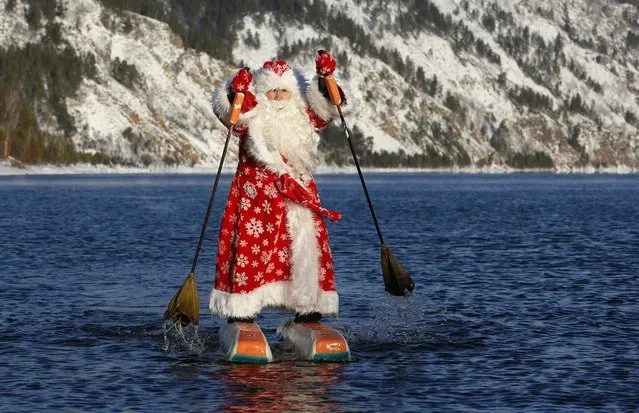
Nikolai Vasilyev, 64, dressed as Father Frost, the Russian equivalent of Santa Claus, water-skis along the Yenisei River outside the Siberian city of Krasnoyarsk, Russia December 19, 2017. Vasilyev, former teacher of the Siberian State Aerospace University, constructed the water skis out of plastic foam and designed the sticks to propel him forward, while travelling on the water surface. (Photo by Ilya Naymushin/Reuters)

Nikolai Vasilyev, 64, dressed as Father Frost, the Russian equivalent of Santa Claus, water-skis along the Yenisei River outside the Siberian city of Krasnoyarsk, Russia December 19, 2017. Vasilyev, former teacher of the Siberian State Aerospace University, constructed the water skis out of plastic foam and designed the sticks to propel him forward, while travelling on the water surface. (Photo by Ilya Naymushin/Reuters)
Details
23 Dec 2017 07:31:00
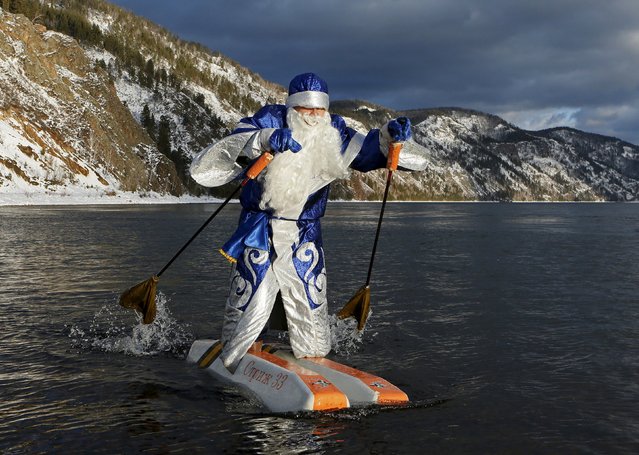
Nikolai Vasilyev, 62, dressed as Father Frost, Russian equivalent of Santa Claus, water-skis along the Yenisei River outside Siberian city of Krasnoyarsk, Russia, December 10, 2015. Vasilyev, a teacher of the Krasnoyarsk Aerospace Academy, constructed the self-made water skis to travel on the water surface. The skis are made of plastic foam and the sticks are designed to propel him forward. (Photo by Ilya Naymushin/Reuters)

Nikolai Vasilyev, 62, dressed as Father Frost, Russian equivalent of Santa Claus, water-skis along the Yenisei River outside Siberian city of Krasnoyarsk, Russia, December 10, 2015. Vasilyev, a teacher of the Krasnoyarsk Aerospace Academy, constructed the self-made water skis to travel on the water surface. The skis are made of plastic foam and the sticks are designed to propel him forward. (Photo by Ilya Naymushin/Reuters)
Details
12 Dec 2015 08:04:00
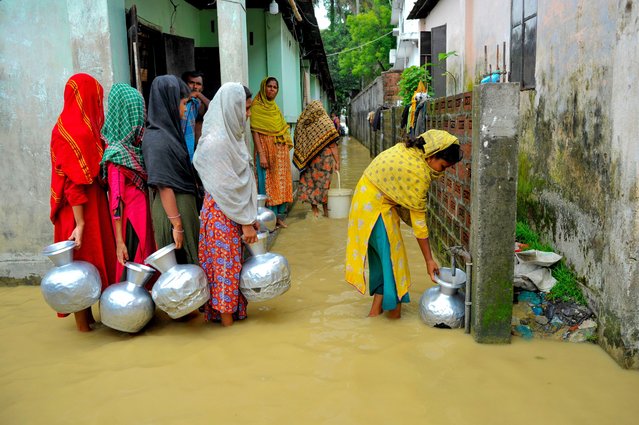
Family members collect clean water from supply pipes in Machimpur, Bangladesh on June 2, 2024, where people have been stranded after heavy flooding. Although the water has receded slowly in the last three days, there is still flood water in the low-lying areas of the city.(Photo by Md Rafayat Haque Khan/ZUMA Press Wir/Rex Features/Shutterstock)

Family members collect clean water from supply pipes in Machimpur, Bangladesh on June 2, 2024, where people have been stranded after heavy flooding. Although the water has receded slowly in the last three days, there is still flood water in the low-lying areas of the city.(Photo by Md Rafayat Haque Khan/ZUMA Press Wir/Rex Features/Shutterstock)
Details
13 Jun 2024 02:47:00
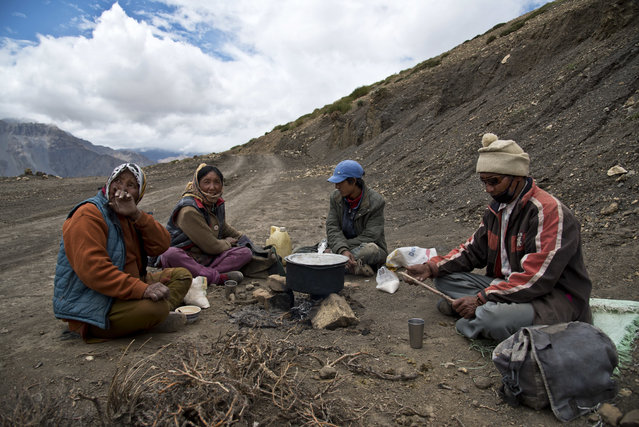
In this August 17, 2016, photo, from left to right, Chhering Chodom, 60, Tashi Yangzom, 50, Lobsang Chhering, 27, and Dorje Tandup, 58, drink milk tea on the side of the road. For centuries, the sleepy valley nestled in the Indian Himalayas remained a hidden Buddhist enclave forbidden to outsiders. Enduring the harsh year-round conditions of the high mountain desert, the people of Spiti Valley lived by a simple communal code – share the Earth's bounty, be hospitable to neighbors, and eschew greed and temptation at all turns. That's all starting to change, for better or worse. Since India began allowing its own citizens as well as outsiders to visit the valley in the early 1990s, tourism and trade have boomed. And the marks of modernization, such as solar panels, asphalt roads and concrete buildings, have begun to appear around some of the villages that dot the remote landscape at altitudes above 4,000 meters (13,000 feet). (Photo by Thomas Cytrynowicz/AP Photo)

In this August 17, 2016, photo, from left to right, Chhering Chodom, 60, Tashi Yangzom, 50, Lobsang Chhering, 27, and Dorje Tandup, 58, drink milk tea on the side of the road. For centuries, the sleepy valley nestled in the Indian Himalayas remained a hidden Buddhist enclave forbidden to outsiders. Enduring the harsh year-round conditions of the high mountain desert, the people of Spiti Valley lived by a simple communal code – share the Earth's bounty, be hospitable to neighbors, and eschew greed and temptation at all turns. That's all starting to change, for better or worse. (Photo by Thomas Cytrynowicz/AP Photo)
Details
15 Sep 2016 09:22:00
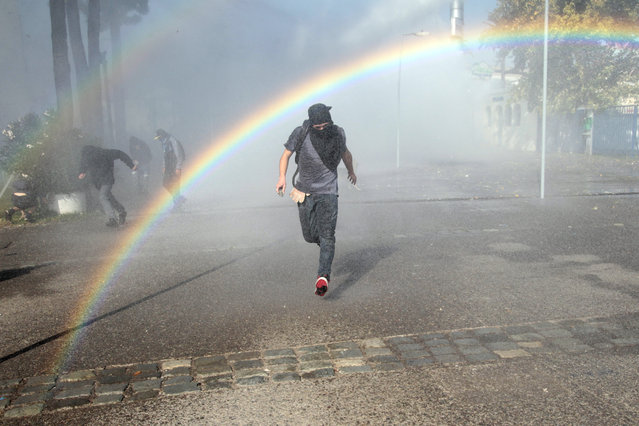
A protester runs from a jet of water shot from a police water cannon in the courtyard of the University of Santiago, during clashes between students and police, in Santiago, Chile, Thursday, May 14, 2015. (Photo by Luis Hidalgo/AP Photo)

A protester runs from a jet of water shot from a police water cannon in the courtyard of the University of Santiago, during clashes between students and police, in Santiago, Chile, Thursday, May 14, 2015. In the capital and other cities across the country, high school and university students marched, for the second time this year, to demand education reform. (Photo by Luis Hidalgo/AP Photo)
Details
15 May 2015 10:49:00
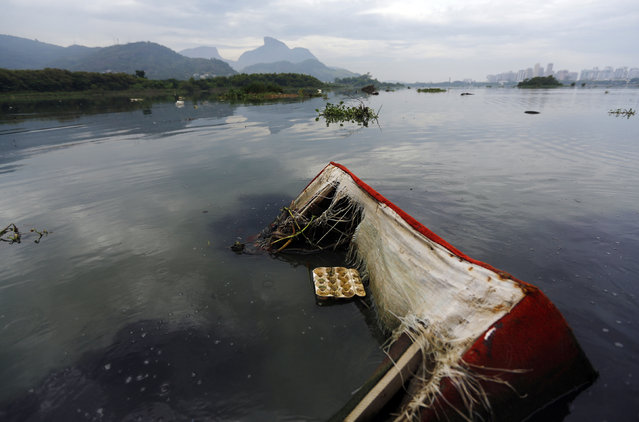
A sofa floats in the polluted waters of Jacarepagua Lagoon, during a press tour in Rio de Janeiro, March 9, 2015. A press tour was organised by biologist Mario Moscatelli, to call attention to pollution on the waters of the lagoons which surround the Rio 2016 Olympic Park. (Photo by Ricardo Moraes/Reuters)

A sofa floats in the polluted waters of Jacarepagua Lagoon, during a press tour in Rio de Janeiro, March 9, 2015. A press tour was organised by biologist Mario Moscatelli, to call attention to pollution on the waters of the lagoons which surround the Rio 2016 Olympic Park. (Photo by Ricardo Moraes/Reuters)
Details
09 Aug 2015 11:04:00