Loading...
Done
Athletes in action during the international parachuting competition Mountain Gravity in Quinto, Switzerland, 27 August 2015. Some 200 participants from all over the world are expected to jump at the event running from 22 to 30 August 2015. (Photo by Samuel Golay/EPA)

Athletes in action during the international parachuting competition Mountain Gravity in Quinto, Switzerland, 27 August 2015. Some 200 participants from all over the world are expected to jump at the event running from 22 to 30 August 2015. (Photo by Samuel Golay/EPA)
Details
28 Aug 2015 12:28:00
A Ukrainian service member shoots from a machine gun at a position on the front line, amid Russia's attack on Ukraine, near the town of New York, Donetsk region, Ukraine on June 9, 2022. (Photo by Gleb Garanich/Reuters)

A Ukrainian service member shoots from a machine gun at a position on the front line, amid Russia's attack on Ukraine, near the town of New York, Donetsk region, Ukraine on June 9, 2022. (Photo by Gleb Garanich/Reuters)
Details
28 Sep 2022 04:59:00
Children of Indian laborers play on make-shift swings in Amritsar, India, May 12, 2015. (Photo by Narinder Nanu/AFP Photo)

Children of Indian laborers play on make-shift swings in Amritsar, India, May 12, 2015. (Photo by Narinder Nanu/AFP Photo)
Details
16 May 2015 12:12:00
A man dressed as a  “Trapajon”, representing entities of nature, poses for a picture after taking part in the Vijanera Festival in Silio, northern Spain, Sunday, Jan. 6, 2013. The Vijanera masquerade, of pre-Roman origin, is the first carnival of the year in Europe symbolizing the triumph of good over evil and involving the participation of crowds of residents wearing different masks, animal skins and brightly colored clothing with its own complex function and symbolism and becoming the living example of the survival of archaic cults to nature. (Photo by Daniel Ochoa de Olza/AP Photo)

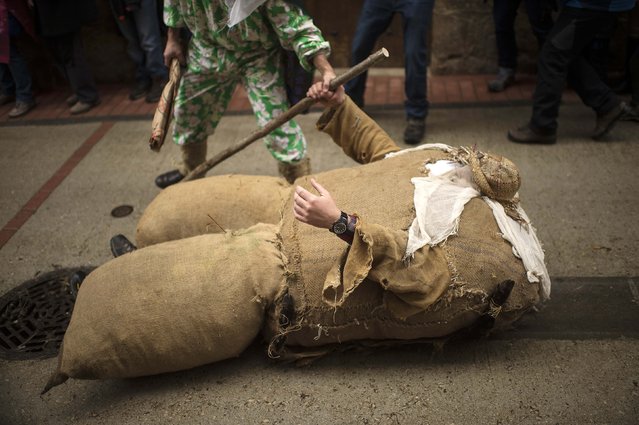
A man dressed as a “Trapajon”, representing entities of nature, poses for a picture after taking part in the Vijanera Festival in Silio, northern Spain, Sunday, Jan. 6, 2013. The Vijanera masquerade, of pre-Roman origin, is the first carnival of the year in Europe symbolizing the triumph of good over evil and involving the participation of crowds of residents wearing different masks, animal skins and brightly colored clothing with its own complex function and symbolism and becoming the living example of the survival of archaic cults to nature. (Photo by Daniel Ochoa de Olza/AP Photo)
Details
19 Jan 2013 13:01:00
An iguana in Bali helped Julij Kopilović, age eight, from Slovenia, earn second runner-up in Amazing Animals. (Photo by Julij Kopilović/National Geographic)

An iguana in Bali helped Julij Kopilović, age eight, from Slovenia, earn second runner-up in Amazing Animals. (Photo by Julij Kopilović/National Geographic)
Details
04 Feb 2016 11:15:00
The Tsaatan people are one of the world’s last groups of nomadic reindeer herders and they live in Khövsgöl Aimag in northern Mongolia. They are originally from across the border in what is now the Tuva republic of Russia. (Photo by Pascal Mannaerts/Rex Feature/Shutterstock)

The Tsaatan people are one of the world’s last groups of nomadic reindeer herders and they live in Khövsgöl Aimag in northern Mongolia. They are originally from across the border in what is now the Tuva republic of Russia. (Photo by Pascal Mannaerts/Rex Feature/Shutterstock)
Details
04 Feb 2016 11:56:00
Saudi children of al-Fefi family walk up the stairs as they make their way to their schools through Fifa Mountain, in Jazan, south of Saudi Arabia, December 15, 2016. (Photo by Mohamed Al Hwaity/Reuters)

Saudi children of al-Fefi family walk up the stairs as they make their way to their schools through Fifa Mountain, in Jazan, south of Saudi Arabia, December 15, 2016. (Photo by Mohamed Al Hwaity/Reuters)
Details
18 Dec 2016 08:36:00
Todeng died in 2009. A young relative of his, Sam, lights him a cigarette and changes his glasses. (Photo by Claudio Sieber Photography/The Guardian)

For the Torajan people of Indonesia, death is part of a spiritual journey: families keep the mummified remains of their deceased relatives in their homes for years – and traditionally invite them to join for lunch on a daily basis – before they are eventually buried. Here: Todeng died in 2009. A young relative of his, Sam, lights him a cigarette and changes his glasses. (Photo by Claudio Sieber Photography/The Guardian)
Details
14 Oct 2017 09:34:00