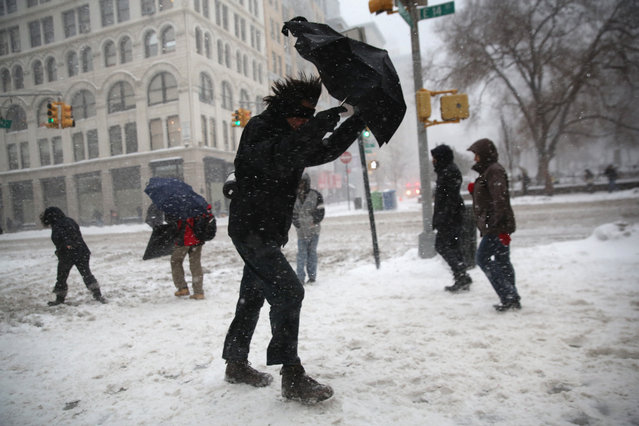
A man braces his umbrella while walking through the snow on February 13, 2014 in New York City. Heavy snow and high winds made for a hard morning commute in the city. (Photo by John Moore/Getty Images)
Hundreds of hardy swimmers across Britain braved jumping into freezing cold waters for a annual Christmas Day dip on December 25, 2017. (Photo by Dave Nelson/The Sun)
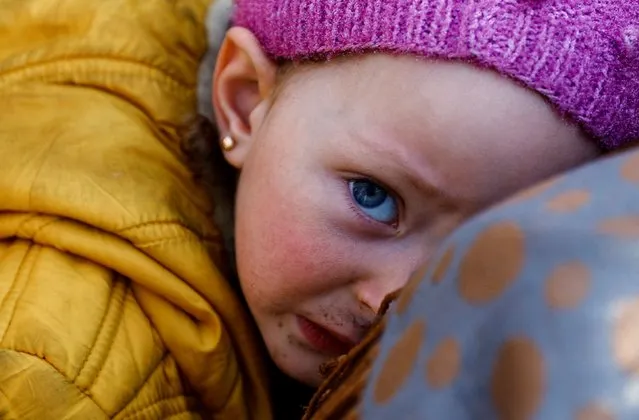
Amar, who is one-and-a-half years old and a Syrian refugee living in Turkey, looks on as the search for survivors continues in the aftermath of a deadly earthquake in Kahramanmaras, Turkey on February 13, 2023. (Photo by Suhaib Salem/Reuters)
Ukrainian refugee circus student Mariia Lysytska stretching in a training room in Budapest, Hungary, Monday, February 13, 2023. More than 100 Ukrainian refugee circus students, between the ages of 5 and 20, found a home with the Capital Circus of Budapest after escaping the embattled cities of Kharkiv and Kyiv amid Russian bombings. (Photo by Denes Erdos/AP Photo)
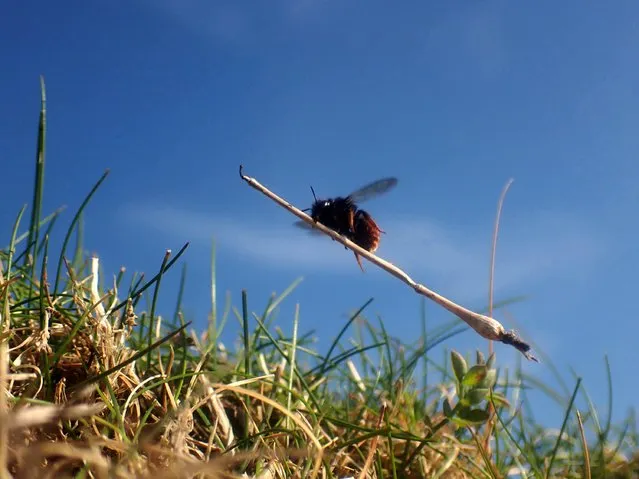
Undated BBC handout photo of a female two-coloured Mason Bee carrying a dried grass stalk back to her snail-shell nest on the British Isles in the latest episode of Sir David Attenborough's Wild Isles series. Issue date: Sunday March 26, 2023. (Photo by John Walters/Silverback Films/BBC/PA Wire)
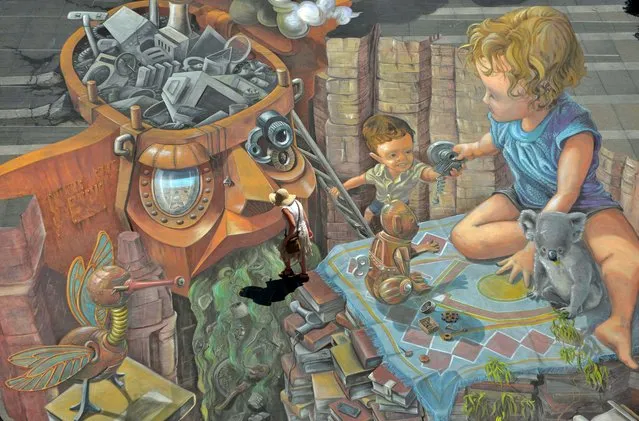
A visitor walks on a giant chalk artwork called “Wasting Time” at the Chalk Urban Arts Festival in Sydney on October 25, 2014. The picture is the biggest 3-D artwork created in Australia by two artists, Leon Keer from Holland and Jenny McCracken from Australia. (Photo by Peter Parks/AFP Photo)
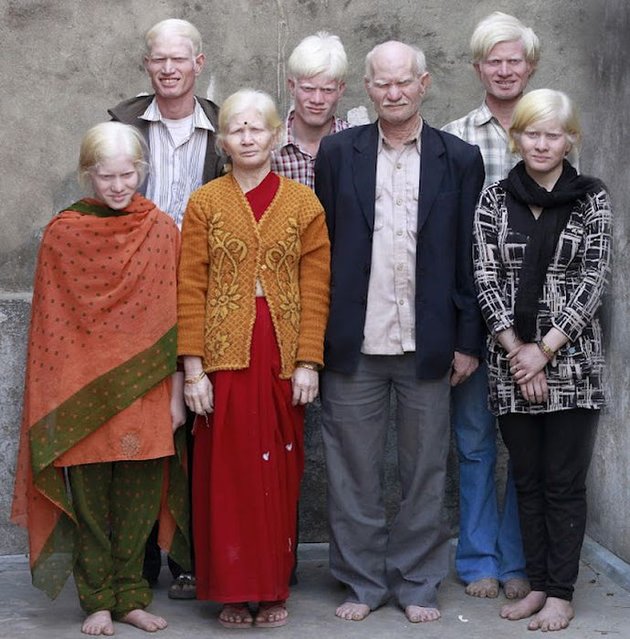
A white-skinned Indian couple are set to enter the record books along with their offspring, after becoming the world's biggest albino family. The ten members of the Pullan family, headed by Rosetauri, 50, and his wife Mani, 45, all have the extremely pale skin and near-white hair of albinos.But despite years of prejudice and suffering the poor vision which is a side effect of the condition, the Pullans and their eight other family members are set to land a Guinness World Record.
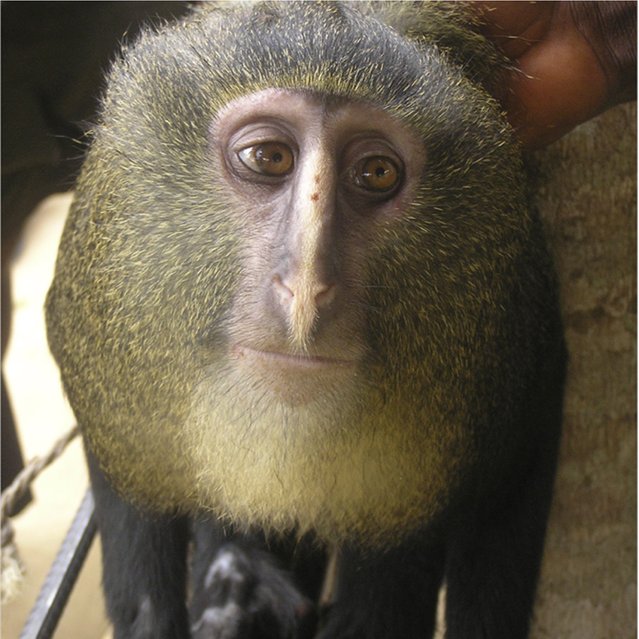
A new species of monkey found in the Democratic Republic of the Congo and identified as Lesula (Cercopithecus lomamiensis) is seen in this undated photograph from an article published September 12, 2012 in the science journal PLOS One. The monkey was first seen in 2007 by researchers John and Terese Hart of the Peabody Museum of Natural History at Yale Research Project. The finding of C. lomamiensis represents only the second new species of African monkey to be discovered in the past 28 years, according to the research article. (Photo by Hart J. A., Detwiler K. M., Gilbert C. C./Reuters)