A combination picture shows Aleppo's Umayyad mosque, Syria, before it was damaged on March 12, 2009 (top) and after it was damaged (bottom) December 13, 2016. (Photo by Omar Sanadiki/Reuters)
JAPAN: A businessman stands at a pond in the Kyu-Shiba-rikyu Garden on a warm and sunny day in Tokyo, Japan, March 18, 2016. (Photo by Thomas Peter/Reuters)
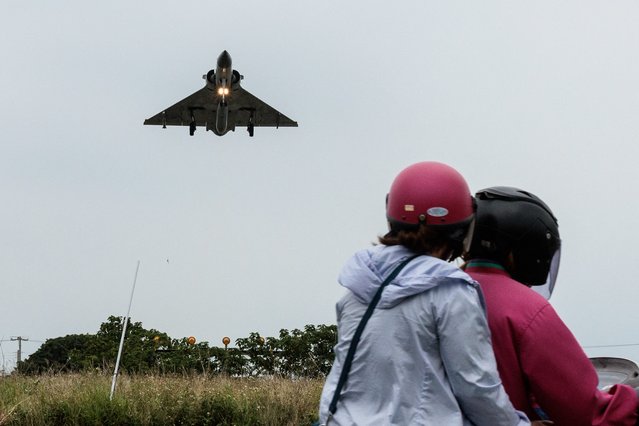
Two people ride a motorcycle as a Taiwanese Air Force Mirage 2000 fighter jet approaches for landing at an air force base in Hsinchu in northern Taiwan on May 23, 2024. China on May 23 encircled Taiwan with naval vessels and military aircraft in war games aimed at punishing the self-ruled island after its new president vowed to defend democracy. (Photo by Yasuyoshi Chiba/AFP Photo)
Actress Kerry Washington, Harvard University's Hasty Pudding Theatricals' Woman of the Year, throws wine in the face of an actor playing Republican presidential candidate Donald Trump, Thursday, January 28, 2016, as she is roasted in Cambridge, Mass. (Photo by Elise Amendola/AP Photo)
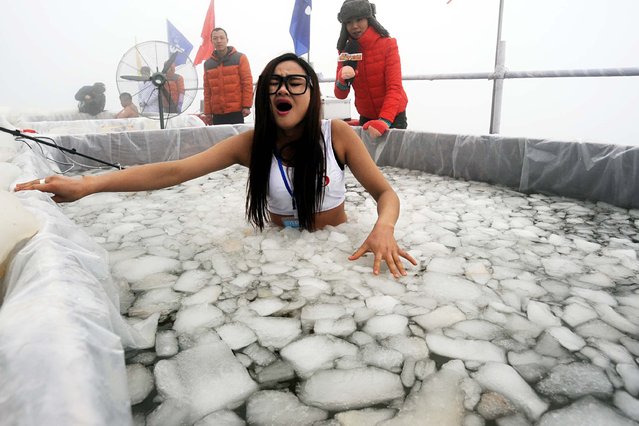
This picture taken on January 25, 2015 shows a participant taking part in an ice water challenge in Zhangjiajie, central China's Hunan province. Participants were required to stay in an ice pond, holding an ice block while eating ice-cream with an electric fan blowing at them. (Photo by AFP Photo/Stringer)
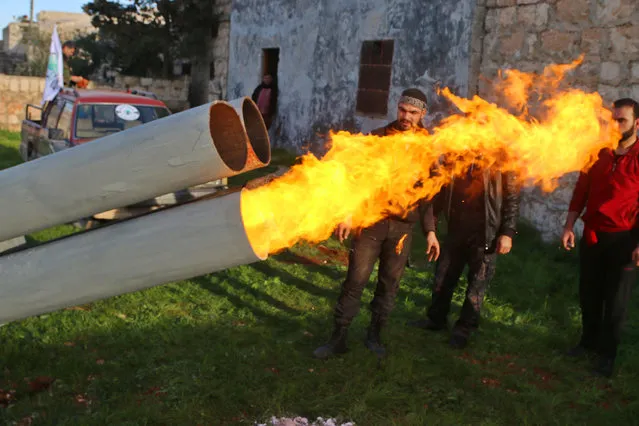
Al-Shamiyah Front fighters inspect a new locally-made cannon named “Borkan” (Volcano) as it was being launched towards forces loyal to Syria's president Bashar Al-Assad located in Aleppo artillery school, March 7, 2015. The “Borkan” is made out of four tubes attached to a loader, which can fire four shells at a time, and have a range of three kilometers (1.86 miles). (Photo by Abdalrhman Ismail/Reuters)
This Thursday, January 22, 2015 photo made with a long exposure shows the glow from a Noctiluca scintillans algal bloom along the seashore in Hong Kong. The luminescence, also called Sea Sparkle, is triggered by farm pollution that can be devastating to marine life and local fisheries, according to University of Georgia oceanographer Samantha Joye. Noctiluca itself does not produce neurotoxins like other similar organisms do. But its role as both prey and predator tends can eventually magnify the accumulation of toxins in the food chain, according to R. Eugene Turner at Louisiana State University. (Photo by Kin Cheung/AP Photo)