Loading...
Done
Frozen Frog By Svein Nordrum

After some days with temperatures below freezing point, I was out skating at some lakes at the outskirts of Oslo in Norway. After a while I noticed something on the ice. To my astonishment it was a dead frozen frog.


Svein Nordrum
Details
04 Feb 2014 11:43:00
A boy shouts after catching a trout during a trout catching contest in Hwacheon, South Korea, Saturday, January 6, 2018. (Photo by Ahn Young-joon/AP Photo)

A boy shouts after catching a trout during a trout catching contest in Hwacheon, South Korea, Saturday, January 6, 2018. The contest is part of an annual ice festival which draws over 1,000,000 visitors every year. (Photo by Ahn Young-joon/AP Photo)
Details
08 Jan 2018 07:12:00
Arctic Hare

The arctic hare, or polar rabbit, is a species of hare which is adapted largely to polar and mountainous habitats. The arctic hare survives with a thick coat of fur and usually digs holes in the ground or under snow to keep warm and sleep. Arctic hares look like rabbits but have shorter ears, are taller when standing, and, unlike rabbits, can thrive in cold climates. They can travel together with many other hares, sometimes huddling with dozens or more, but are usually found alone, taking, in some cases, more than one partner. The arctic hare can run up to 60 kilometres per hour (40 mph). Its predators include the arctic wolf, arctic fox, and ermine.
Details
17 Mar 2014 13:56:00
Goodfellow's Tree-Kangaroo

For some reason, everything that comes from Australia is either very cute or very poisonous; sometimes cute and poisonous at the same time. For example, Slow Loris, which you probably have seen eating a ball of rice on YouTube, is actually a very poisonous creature, despite its extreme cuteness. Goodfellow’s tree-kangaroos, on the other hand, are all cuteness and no poison. Just look at its cute little snout and furry paws, as it gingerly scratches its stomach, while sitting on its hind legs! If you don’t find this creature adorable, nothing will be able to thaw your stone-cold heart.
Details
30 Nov 2014 13:38:00
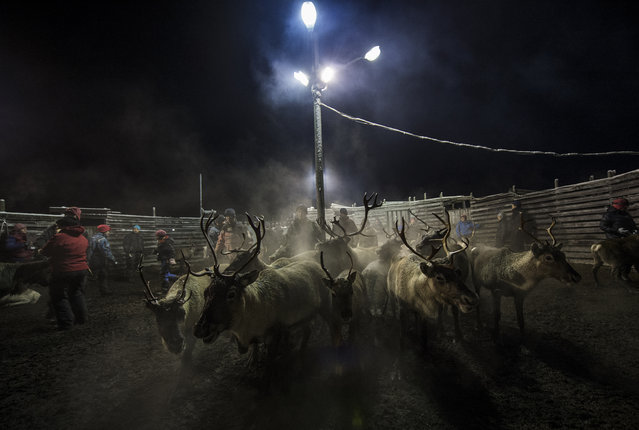
Sami people from the Vilhelmina Norra Sameby, gather their reindeers herd in a corral for selection and calf labelling on October 27, 2016 near the village of Dikanaess, about 800 kilometers north-west of the capital Sweden. (Photo by Jonathan Nackstrand/AFP Photo)

Sami people from the Vilhelmina Norra Sameby, gather their reindeers herd in a corral for selection and calf labelling on October 27, 2016 near the village of Dikanaess, about 800 kilometers north-west of the capital Sweden. Sweden's Sami reindeer herders have more than hungry predators to worry about in the cold night, as the indigenous minority moves its flock to the winter pasture in the Nordic tundra. (Photo by Jonathan Nackstrand/AFP Photo)
Details
23 Nov 2016 12:26:00
Golden-Crowned Kinglet

Golden-crowned Kinglets boldly bear their flashy lemon-yellow crest and a black eyebrow stripe. Taking a good look at them might be rather challenging, since they spend most of their time in the dense fir foliage or spruce. However, if you’re patient enough to find them, listen for their shrill, thin song. Though these “little Kings” are only a tad bit larger than a hummingbird, they can survive easily extreme cold by huddling close together. They breed in montane west and the far north and only visit North America during winter.
Details
21 Jan 2015 13:20:00
Atlantic Puffin Is AKA Puffins Or Puffin Birds

The Atlantic Puffin is definitely a curious-looking bird. The special coloring that this bird develops for the breeding season in the spring is very reminiscent of tropical birds. The bright colors of the beak and the markings around the eyes serve no particular advantage and have evolved as a result of sexual selection. However, Puffins don’t look that pretty all year round. They shed all these festive colors in partial moult after the breeding season is over. They lose the ornaments around their eyes, their face becomes darker, and their beak becomes very different. The natural habitat of these birds is the cold waters of the North Atlantic Ocean.
Details
12 Nov 2014 13:40:00
“Lofoten Glow”. I was desperately searching a good sunrise spot this particular morning. Normally Storvatnet Lake is completely covered in snow, so you can only imagine my surprise when I saw these crazy ice formations almost being shot out of the frozen lake. I put my crampons on and took a big risk walking out. Photo location: Storvatnet, Lofoten Islands in Northern Norway. (Photo and caption by Stian Klo/National Geographic Photo Contest)

“Lofoten Glow”. I was desperately searching a good sunrise spot this particular morning. Normally Storvatnet Lake is completely covered in snow, so you can only imagine my surprise when I saw these crazy ice formations almost being shot out of the frozen lake. I put my crampons on and took a big risk walking out. I could hear the ice cracking underneath my feet, and when you’re all alone in a fjord/canyon like this – the cracks are echoed and sound really frightening. Was it worth it? I sure think so! Photo location: Storvatnet, Lofoten Islands in Northern Norway. (Photo and caption by Stian Klo/National Geographic Photo Contest)
Details
08 Apr 2014 09:40:00