Loading...
Done
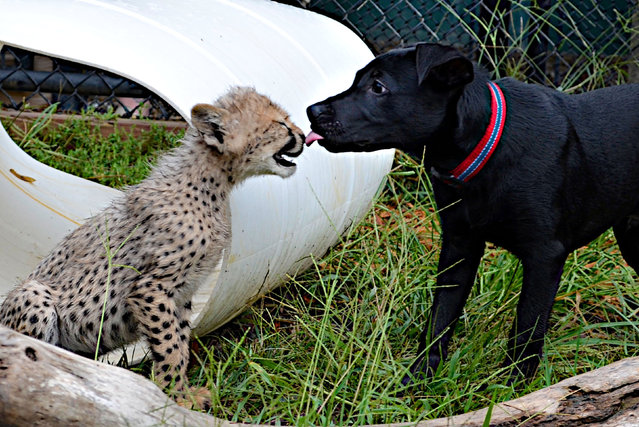
These stunning images could be mistaken for a cheetah ravenously chasing down a dog, but in fact, the pair are best of friends. Savanah, the one-and-a-half-year-old cheetah and Max, who is just a few weeks younger, were put together when Savanah was just 10-weeks-old. (Photo by Caters News Agency)

These stunning images could be mistaken for a cheetah ravenously chasing down a dog, but in fact, the pair are best of friends. Savanah, the one-and-a-half-year-old cheetah and Max, who is just a few weeks younger, were put together when Savanah was just 10-weeks-old. Ever since, their friendship has amazed visitors at Cincinatti Zoo, who are delighted but confused as to why the spotted beast hasnt eaten the dashing hound. So, when it snowed, Savanah and Max just like young children were very excitable and wasted no time playing in the snow. (Photo by Caters News Agency)
Details
21 Dec 2013 13:56:00
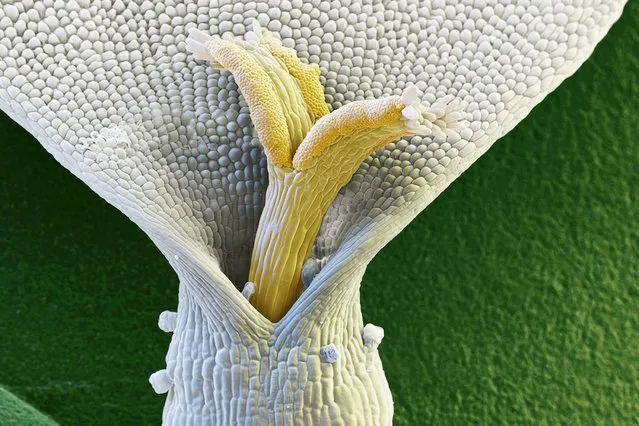
The floret of a Chamomile flower up close and personal. (Photo by Oliver Meckes/Barcroft Media)

These images have been created using a colour scanning electron microscope (SEM) by the award-winning Eye of Science, comprised of snapper Oliver Meckes and biologist Nicole Ottawa. For a decade the pair, based in Reutlingen in the south of Germany, worked with an old SEM they saved from the scrapheap, but for the last five years they have used a £250,000 FEI Quanta Series Field Emission SEM. Oliver said: “Flowers are beautiful in 'normal' view, but when you look closer, some parts get very bizarre and unexpected structures appear – flowers within flowers, worlds within worlds”. Photo: The floret of a Chamomile flower up close and personal. (Photo by Oliver Meckes/Barcroft Media)
Details
26 May 2014 13:51:00
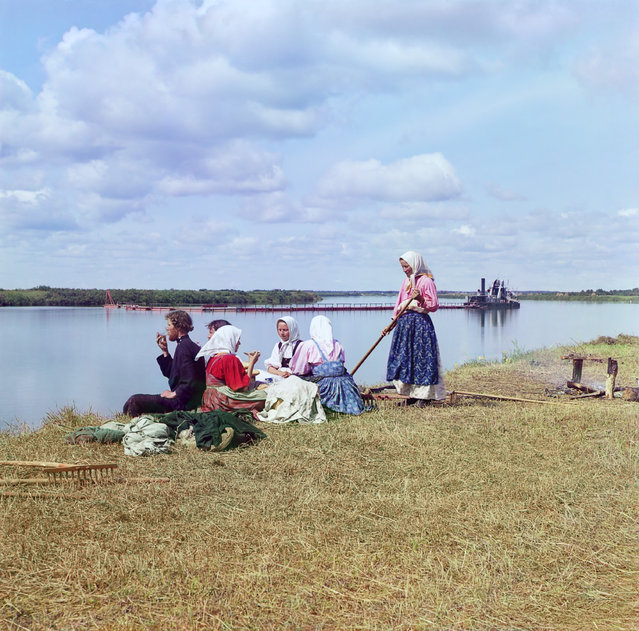
Photos by Sergey Prokudin-Gorsky. Dinner during haying. Russian Empire, Novgorod province, county Cherepovets, 1909

“Sergey Mikhaylovich Prokudin-Gorsky (August 30 1863 Russian Empire – September 27, 1944 Paris, France) was a Russian chemist and photographer. He is best known for his pioneering work in color photography of early 20th-century Russia”. – Wikipedia

Photo: Dinner during haying. Russian Empire, Novgorod province, county Cherepovets, 1909. (Photos by Sergey Prokudin-Gorsky via US Library of Congress and Prokudin-Gorsky.org)

P.S. All pictures are presented in high resolution. To see Hi-Res images – just TWICE click on any picture. In other words, click small picture – opens the BIG picture. Click BIG picture – opens VERY BIG picture (if available; this principle works anywhere on the site AvaxNews). Enjoy.
Details
24 Jul 2012 12:03:00
Aerial Views by  Ken Hong Leung

H. Leung has been acclaimed since 1952 for his brilliant artistic style. A master of oil on canvas, he achieves a haunting quality in his works that absorbs the viewer’s emotions like an irresistible melody. His brush, like a wand, seems to weave a sense of enchantment. In his landscapes and waterside villages, visions of Shangri-La come to mind, superbly mixed with subtle orchestrations of peacefulness and drama.

Technique is both a creative and expressive force in the art of H. Leung. Distinctively semi-abstract, his images allow the viewer’s eye to supply what is merely suggested. This very involving result adds power not only to the impact of his designs, it increases the joy that owning his works provides.
Details
26 Aug 2012 12:10:00
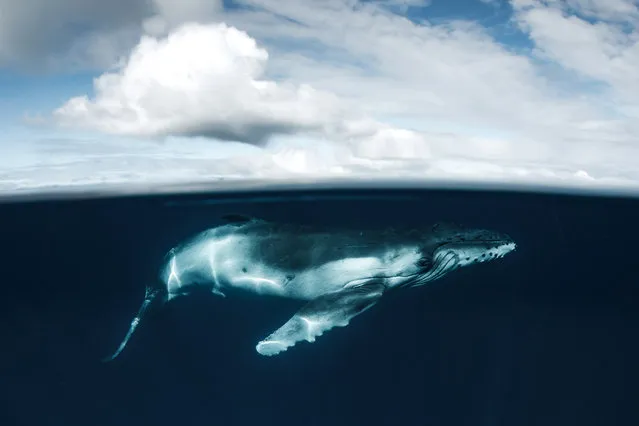
The images were taken off the coast of Tonga in the South Pacific. Photographer Grant Thomas said: “Through my images I aim to show off the amazing life we have on our planet in hope of inspiring more people to experience it for themselves and, most importantly, care for it. There is nothing to be afraid of with the humpback whales, as these animals are some of the most majestic and peaceful creatures in the sea. They will often be very curious of people in the water and will even seek out interactions with us”. (Photo by Grant Thomas/Caters News Agency)

The images were taken off the coast of Tonga in the South Pacific. Photographer Grant Thomas said: “Through my images I aim to show off the amazing life we have on our planet in hope of inspiring more people to experience it for themselves and, most importantly, care for it”. (Photo by Grant Thomas/Caters News Agency)
Details
28 Nov 2019 00:03:00


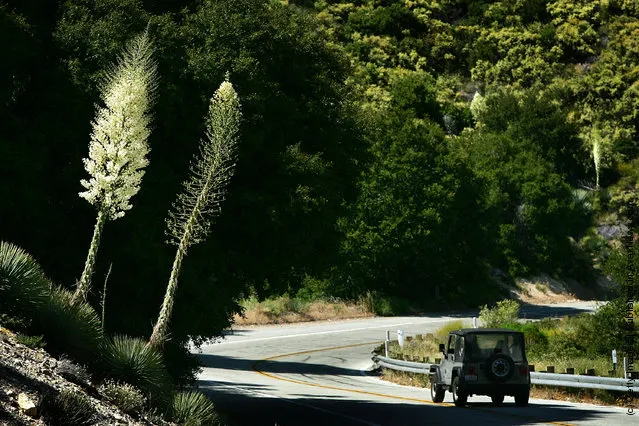
“Yucca is a genus of perennial shrubs and trees in the agave family, Agavaceae. Its 40-50 species are notable for their rosettes of evergreen, tough, sword-shaped leaves and large terminal panicles of white or whitish flowers. They are native to the hot and dry (arid) parts of North America, Central America, South America, and the Caribbean. Early reports of the species were confused with the cassava (Manihot esculenta). Consequently, Linnaeus mistakenly derived the generic name from the Carib word for the latter, yuca. It is also colloquially known in the midwest United States as “Ghosts in the graveyard”, as it is commonly found growing in rural graveyards and when in bloom the flowers appear as an apparition floating.” – Wikipedia

Photo: A yucca standing among flowers bursts forth a very large stalk of flowers as a heavy wildflower bloom on June 21, 2005 in the Angeles National Forest northwest of La Canada, California. (Photo by David McNew/Getty Images)
Details
29 Mar 2011 07:31:00
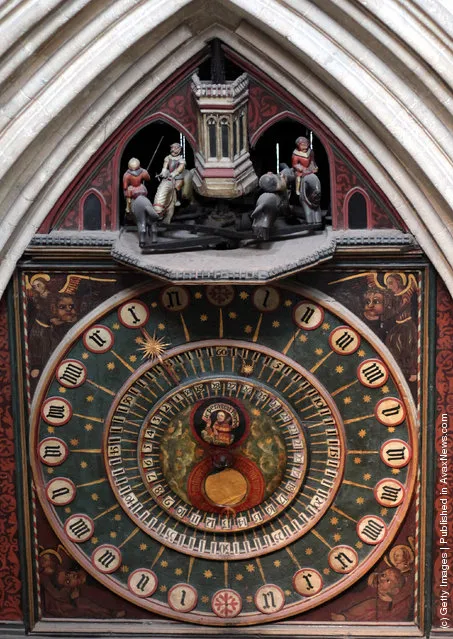
Wells Clock – World's Oldest Mechanical Clock

“Wells Cathedral is a Church of England cathedral in Wells, Somerset, England. Built between 1175 and 1490, Wells Cathedral has been described as “the most poetic of the English Cathedrals”. The Wells clock, an astronomical clock, is located in the north transept. The surviving mechanism, dated to between 1386 and 1392, was replaced in the 19th century, and was eventually moved to the Science Museum in London, where it continues to operate. It is the second-oldest surviving clock in England”. – Wikipedia

Photo: The clock face of world's oldest continually-working mechanical clock is seen as it is hand wound for the very last time on August 21, 2010 in Wells, England. (Photo by Matt Cardy/Getty Images)
Details
10 Aug 2011 11:23:00
Pedra da Gavea highline, 850 meters above the city, 100 meters direct exposure, March 24, 2013. Brian Mosbaugh on the line. Carefully tiptoeing almost 3000 metres above Rio de Janeiro on a thin wire got a bit too much for this adrenaline junkie – so he decided to have a LIE DOWN. Fearless Brian Mosbaugh is so used to the perilous heights he decided he deserved a short break and proceeded to kick back and relax over the famous Brazilian city. (Photo by Scott Rogers/Caters)

Pedra da Gavea highline, 850 meters above the city, 100 meters direct exposure, March 24, 2013. Brian Mosbaugh on the line. Carefully tiptoeing almost 3000 metres above Rio de Janeiro on a thin wire got a bit too much for this adrenaline junkie – so he decided to have a LIE DOWN. Fearless Brian Mosbaugh is so used to the perilous heights he decided he deserved a short break and proceeded to kick back and relax over the famous Brazilian city. (Photo by Scott Rogers/Caters)

P.S. All pictures are presented in high resolution. To see Hi-Res images – just TWICE click on any picture. In other words, click small picture – opens the BIG picture. Click BIG picture – opens VERY BIG picture (if available; this principle works anywhere on the site AvaxNews).
Details
30 Mar 2013 12:00:00