Loading...
Done
Parade participants during the traditional “Masopust Carnival” festival on February 13, 2018 in Roztoky near Prague, Czech Republic. Known as Masopust (literally, “giving up meat”), the festival was traditionally the last chance to eat and drink in excess before the austerity of Lent. (Photo by Margot Buff/RFE/RL)

Parade participants during the traditional “Masopust Carnival” festival on February 13, 2018 in Roztoky near Prague, Czech Republic. Known as Masopust (literally, “giving up meat”), the festival was traditionally the last chance to eat and drink in excess before the austerity of Lent. (Photo by Margot Buff/RFE/RL)
Details
14 Feb 2018 08:44:00
Revellers celebrate “Ash Monday” by participating in a colourful “flour war”, a traditional festivity marking the end of the carnival season and the start of the 40-day Lent period until the Orthodox Easter, in Galaxidi, Greece February 19, 2018. (Photo by Alkis Konstantinidis/Reuters)

Revellers celebrate “Ash Monday” by participating in a colourful “flour war”, a traditional festivity marking the end of the carnival season and the start of the 40-day Lent period until the Orthodox Easter, in Galaxidi, Greece February 19, 2018. (Photo by Alkis Konstantinidis/Reuters)
Details
21 Feb 2018 00:02:00
A reveller of a street party known as blocos, dances during a protest against restrictions by city officials in Rio de Janeiro, Brazil, Wednesday, April 13, 2022. City Hall has banned the street parties during Carnival celebrations, which were delayed by almost two months due to the pandemic. (Photo by Silvia Izquierdo/AP Photo)

A reveller of a street party known as blocos, dances during a protest against restrictions by city officials in Rio de Janeiro, Brazil, Wednesday, April 13, 2022. City Hall has banned the street parties during Carnival celebrations, which were delayed by almost two months due to the pandemic. (Photo by Silvia Izquierdo/AP Photo)
Details
15 Apr 2022 06:22:00
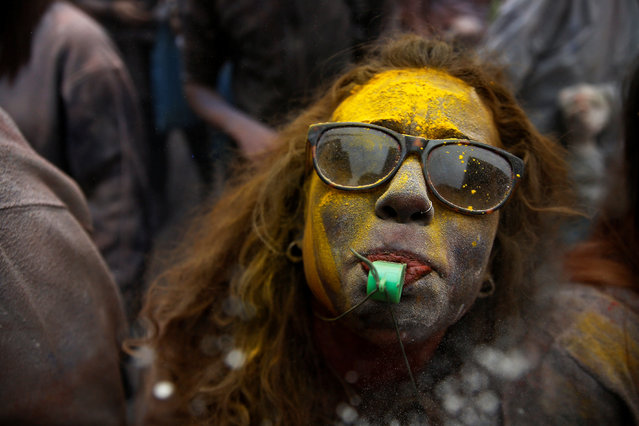
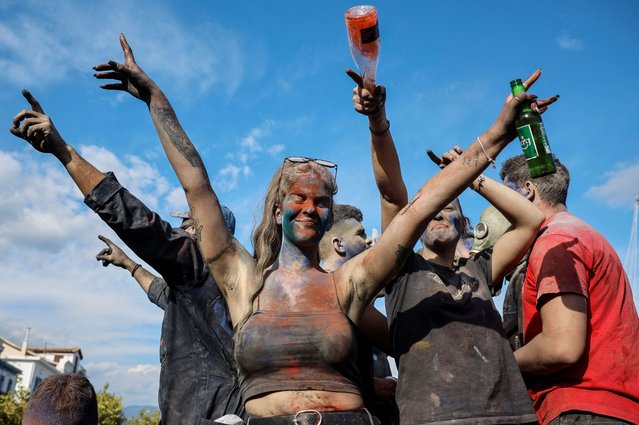
Revellers participate in a colourful “flour war”, celebrating the “Ash Monday” or “Clean Monday”, a traditional festivity marking the end of the carnival season and the start of the 40-day Lent period until the Orthodox Easter, in the town of Galaxidi, Greece, on March 18, 2024. (Photo by Louisa Gouliamaki/Reuters)

Revellers participate in a colourful “flour war”, celebrating the “Ash Monday” or “Clean Monday”, a traditional festivity marking the end of the carnival season and the start of the 40-day Lent period until the Orthodox Easter, in the town of Galaxidi, Greece, on March 18, 2024. (Photo by Louisa Gouliamaki/Reuters)
Details
12 Jun 2025 03:41:00
CGAP Photo Contest – South Asia Regional Winner: Bricks Worker, Bangladesh. A private enterprise worker is working at a brick field. These small businesses are creating new job opportunities for many poor people. (Photo by Moksumul Haque)

The shoemaker in Turkey, the potato seller in Vietnam, and the weaver in Bolivia are among the billions of low-income entrepreneurs who make the world go round. They are also the type of people who can benefit significantly from microfinance. Every year, the Consultative Group To Assist The Poor (or CGAP) hosts a photo contest asking entrants to submit photos based around the idea of microfinance.The purpose of the contest is to give amateur and professional photographers a chance to show the different ways that poor households manage their financial lives and make their lives better through financial inclusion. Photo: South Asia Regional Winner – “Bricks Worker”, Bangladesh. A private enterprise worker is working at a brick field. These small businesses are creating new job opportunities for many poor people. (Photo by Moksumul Haque)
Details
14 Aug 2014 10:58:00
A reveler wearing sheepfur costume is seen in front of a bonfire on which they burn a coffin symbolizing winter during the closing ceremony of the traditional carnival parade in Mohacs, 189 kms south of Budapest, Hungary, 07 February 2016. (Photo by Tamas Soki/EPA)

A reveler wearing sheepfur costume is seen in front of a bonfire on which they burn a coffin symbolizing winter during the closing ceremony of the traditional carnival parade in Mohacs, 189 kms south of Budapest, Hungary, 07 February 2016. The carnival parade of people, the so-called busos, dressed in such costumes and frightening wooden masks, using various noisy wooden rattlers is traditionally held on the seventh weekend before Easter to drive away winter, and is a revival of a legend, which says that ethnic Croats ambushed the Osmanli Turkish troops, who escaped in panic seeing the terrifying figures during the Turkish occupation of Hungary. (Photo by Tamas Soki/EPA)
Details
09 Feb 2016 14:02:00
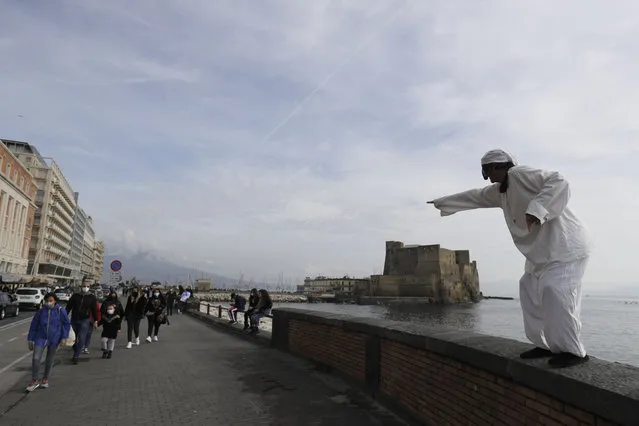
A man wearing the traditional Carnival Neapolitan mask of Pulcinella performs on Via Caracciolo avenue in Naples, Italy, Saturday, November 14, 2020. The regions of Campania and Tuscany were designated red zone on Friday, signaling the dire condition of a hospitals struggling with a surge of new admissions. (Photo by Gregorio Borgia/AP Photo)

A man wearing the traditional Carnival Neapolitan mask of Pulcinella performs on Via Caracciolo avenue in Naples, Italy, Saturday, November 14, 2020. The regions of Campania and Tuscany were designated red zone on Friday, signaling the dire condition of a hospitals struggling with a surge of new admissions. (Photo by Gregorio Borgia/AP Photo)
Details
16 Nov 2020 00:07:00
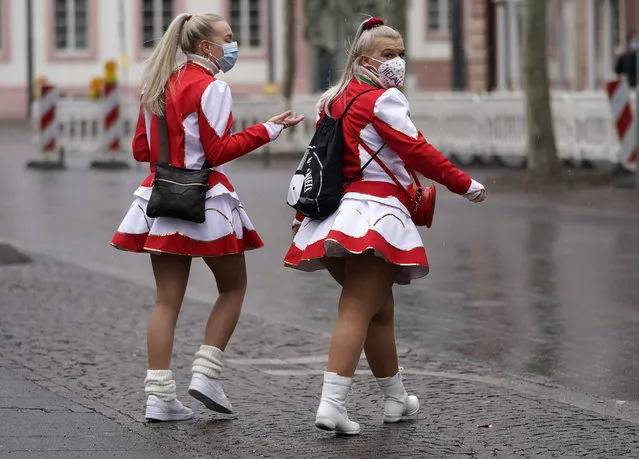
Two costumed reveler seen at the City center where normally thousands of revelers dressed in carnival costumes would celebrate the Rose Monday parade on the streets in Mainz, Germany, 15 February 2021. The Rose Monday Parade has been cancelled due to the coronavirus Covid-19 pandemic. (Photo by Ronald Wittek/EPA/EFE)

Two costumed reveler seen at the City center where normally thousands of revelers dressed in carnival costumes would celebrate the Rose Monday parade on the streets in Mainz, Germany, 15 February 2021. The Rose Monday Parade has been cancelled due to the coronavirus Covid-19 pandemic. (Photo by Ronald Wittek/EPA/EFE)
Details
16 Feb 2021 10:06:00