Loading...
Done
A person carries a fan in Westminster, London, Britain, 12 July 2022. Britain has been issued with an amber weather warning for the weekend as experts predict that temperatures could rise to the high thirties and Sunday could be the hottest day on record for the UK. (Photo by Tolga Akmen/EPA/EFE/Rex Features/Shutterstock)

A person carries a fan in Westminster, London, Britain, 12 July 2022. Britain has been issued with an amber weather warning for the weekend as experts predict that temperatures could rise to the high thirties and Sunday could be the hottest day on record for the UK. (Photo by Tolga Akmen/EPA/EFE/Rex Features/Shutterstock)
Details
14 Jul 2022 04:51:00
Underwater photographer of the year 2020 and wide angle category winner: Frozen Mobile Home by Greg Lecoeur (France) in the Antarctic peninsula, Antarctica. Crabeater seals swim around an iceberg. These massive and mysterious habitats are dynamic kingdoms that support marine life. As they swing and rotate slowly through polar currents, icebergs fertilise the oceans by carrying nutrients from land that spark blooms of phytoplankton, fundamental to the carbon cycle. (Photo by Greg Lecoeur/Underwater Photographer of the Year 2020)

Underwater photographer of the year 2020 and wide angle category winner: Frozen Mobile Home by Greg Lecoeur (France) in the Antarctic peninsula, Antarctica. Crabeater seals swim around an iceberg. These massive and mysterious habitats are dynamic kingdoms that support marine life. As they swing and rotate slowly through polar currents, icebergs fertilise the oceans by carrying nutrients from land that spark blooms of phytoplankton, fundamental to the carbon cycle. (Photo by Greg Lecoeur/Underwater Photographer of the Year 2020)
Details
28 Feb 2020 00:05:00
Emilia Pechinkova, a 24-years-old Bulgarian Pomak (Bulgarian speaking Muslims) bride poses for a photograph following the “gelina” or face painting ceremony carried out by female guests and relatives in preparation for her three-day wedding ceremony in the village of Draginovo, 100 kms southeast of Sofia on April 22, 2016. Bulgaria's Muslim population is one of the highest in the European Union. (Photo by Nikolay Doychinov/AFP Photo)

Emilia Pechinkova, a 24-years-old Bulgarian Pomak (Bulgarian speaking Muslims) bride poses for a photograph following the “gelina” or face painting ceremony carried out by female guests and relatives in preparation for her three-day wedding ceremony in the village of Draginovo, 100 kms southeast of Sofia on April 22, 2016. Bulgaria's Muslim population is one of the highest in the European Union. During the Communist regime religious rituals were not tolerated, and Muslims were forced to abandon wearing their traditional wedding outfits. Recently, more young Pomak women want to include traditional wedding customs that were forbidden during the regime, regardless of their secular lifestyles and the high cost of such a wedding. (Photo by Nikolay Doychinov/AFP Photo)
Details
25 Apr 2016 09:55:00
A Harley Davidson biker is dressed as Santa Claus as he takes part in a charity ride in Zurich, Switzerland December 6, 2015. (Photo by Arnd Wiegmann/Reuters)

A Harley Davidson biker is dressed as Santa Claus as he takes part in a charity ride in Zurich, Switzerland December 6, 2015. (Photo by Arnd Wiegmann/Reuters)
Details
08 Dec 2015 08:03:00
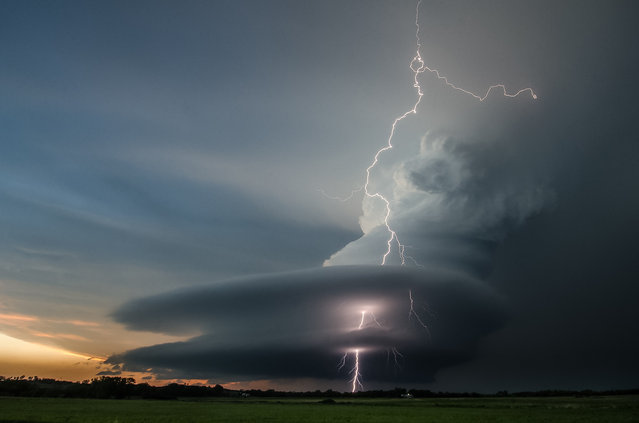
“Strike Through The Mothership”. Every May for the last 3 years I have driven down to Tornado Alley to capture some amazing storms. This supercell held so much promise to drop a tornado but one small shift in the atmosphere and all that it produced was an extreme lightning show. Photo location: Broken Bow, Nebraska. (Photo and caption by Vanessa Neufeld/National Geographic Photo Contest)

“Strike Through The Mothership”. Every May for the last 3 years I have driven down to Tornado Alley to capture some amazing storms. This supercell held so much promise to drop a tornado but one small shift in the atmosphere and all that it produced was an extreme lightning show. Photo location: Broken Bow, Nebraska. (Photo and caption by Vanessa Neufeld/National Geographic Photo Contest)
Details
06 May 2014 09:37:00
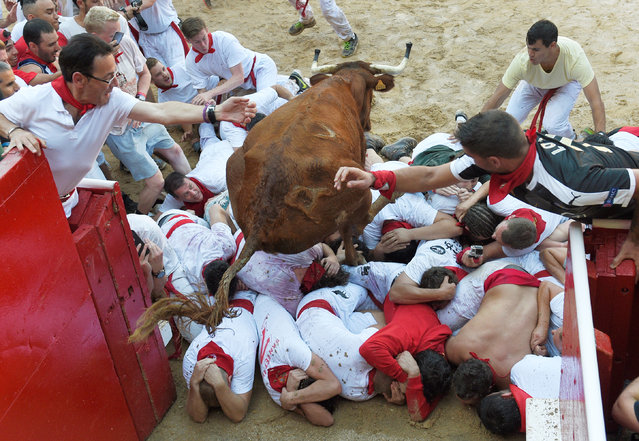
A wild cow jumps over revelers in the bullring after the first running of the bulls at the San Fermin festival in Pamplona, northern Spain, July 7, 2016. (Photo by Eloy Alonso/Reuters)

A wild cow jumps over revelers in the bullring after the first running of the bulls at the San Fermin festival in Pamplona, northern Spain, July 7, 2016. (Photo by Eloy Alonso/Reuters)
Details
09 Jul 2016 09:59:00
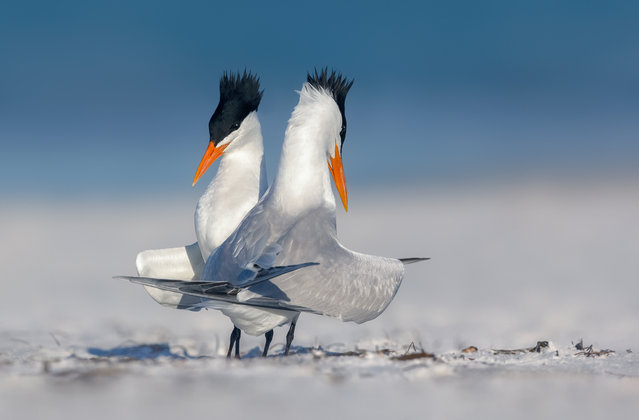
Behaviour winner: Courting Royals: two royal terns in courtship display by Kristian Bell. Another beautiful morning on a beautiful beach on the Gulf Coast of Florida seemed to prompt these two royal terns to commence an intricate courtship dance. The photograph was taken with a Canon 300mm lens and 2x extender. (Photo by Kristian Bell/Deakin University/Royal Society Publishing Photography Competition 2018)

Behaviour winner; Courting Royals: two royal terns in courtship display by Kristian Bell. Another beautiful morning on a beautiful beach on the Gulf Coast of Florida seemed to prompt these two royal terns to commence an intricate courtship dance. The photograph was taken with a Canon 300mm lens and 2x extender. (Photo by Kristian Bell/Deakin University/Royal Society Publishing Photography Competition 2018)
Details
06 Dec 2018 00:05:00
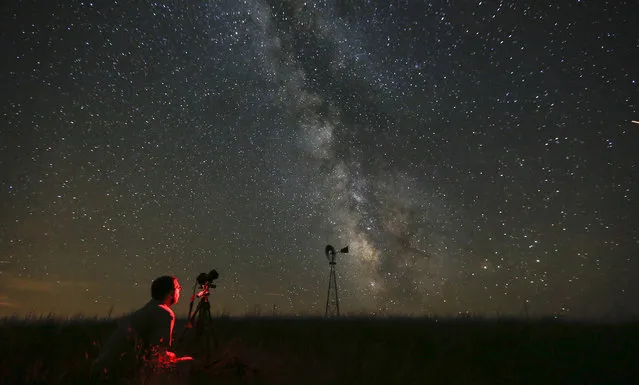
In this Wednesday, July 23, 2014 file photo, Omaha photographer Lane Hickenbottom photographs the night sky in a pasture near Callaway, Neb. With no moon in the sky, the Milky Way was visible to the naked eye. More than one-third of the world’s population can no longer see the Milky Way because of man-made lights, according to a scientific paper by Light Pollution Science and Technology Institute's Fabio Falchi and his team members, published on Friday, June 10, 2016. (Photo by Travis Heying/The Wichita Eagle via AP Photo)

In this Wednesday, July 23, 2014 file photo, Omaha photographer Lane Hickenbottom photographs the night sky in a pasture near Callaway, Neb. With no moon in the sky, the Milky Way was visible to the naked eye. More than one-third of the world’s population can no longer see the Milky Way because of man-made lights, according to a scientific paper by Light Pollution Science and Technology Institute's Fabio Falchi and his team members, published on Friday, June 10, 2016. (Photo by Travis Heying/The Wichita Eagle via AP Photo)
Details
11 Jun 2016 12:37:00