Loading...
Done


“The Trabant is a car that was produced by former East German auto maker VEB Sachsenring Automobilwerke Zwickau in Zwickau, Sachsen. It was the most common vehicle in East Germany, and was also exported to countries both inside and outside the communist bloc. The main selling points was that it had room for four adults and luggage in a compact, light and durable shell and that it was fast (when introduced) and durable. With its mediocre performance, smoky two-stroke engine, and production shortages, the Trabant is often cited as an example of the disadvantages of centralized planning; on the other hand, it is regarded with derisive affection as a symbol of the failed former East Germany and of the fall of communism (in former West Germany, as many East Germans streamed into West Berlin and West Germany in their Trabants after the opening of the Berlin Wall in 1989). It was in production without any significant changes for nearly 30 years with 3,096,099 Trabants produced in total”. – Wikipedia

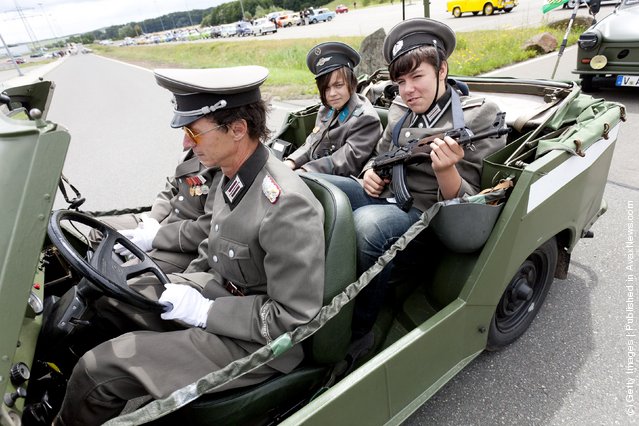
Photo: Enthusiasts weared in uniforms of the former eastern german army trive in a military Trabant car as fans and owners of East German-era Trabant cars gather at the 2011 International Trabantfahrer Treffen (International Trabant Drivers Meeting) on June 26, 2011 in Zwickau, Germany. The Trabant, also known as the Trabi, was among the main cars produced in communist East Germany and built by VEB Sachsenring Automobilwerke in Zwickau for 30 years until 1989. Today the car has cult status for many followers and one company, IndiKar, is even seeking to revive the brand in a modern, electric version. (Photo by Carsten Koall/Getty Images)
Details
27 Jun 2011 12:21:00


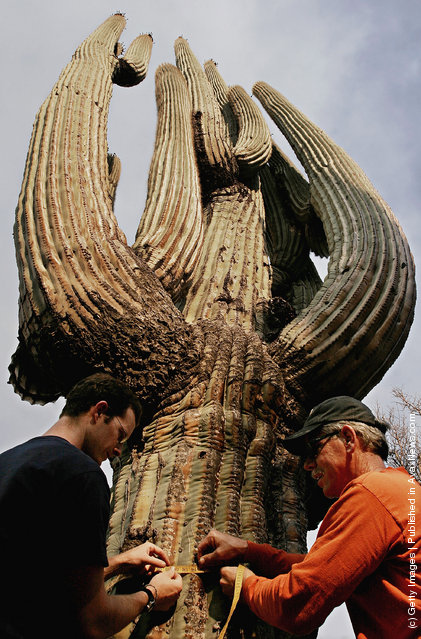
“The saguaro (scientific name Carnegiea gigantea) is a large, tree-sized cactus species in the monotypic genus Carnegiea. It is native to the Sonoran Desert in the U.S. state of Arizona, the Mexican state of Sonora, a small part of Baja California in the San Felipe Desert and an extremely small area of California, U.S. The saguaro blossom is the State Wildflower of Arizona”. – Wikipedia

Photo: Daniel Appel (L), a firefighter with Engine 84 from the Lassen National Forest in California and Mike Hallen, (R), Arizona representative of the National Register of Big Trees, measure the circumference of this Saguaro cactus called the "Grand One," in the Tonto National Forest on July 1, 2005 35 miles north of Phoenix, near Carefree, Arizona. The cactus, estimated to be more than 200 years old, measures a circumference of 7 feet, 10 inches (2.4 meters) and stands 46 feet high (14 meters). The cactus was burned in the Cave Creek Complex fire and may not survive. It was once the largest Saguaro in the world, two others have been found recently that have tied it's measurements. The fire has burned more than 214,000 acres of the Sonoran desert. (Photo by Jeff Topping/Getty Images)
Details
26 Jul 2011 12:27:00
Sikorsky H-5 helicopters

“Igor Sikorsky (May 25, 1889 – October 26, 1972), born Igor Ivanovich Sikorsky was a Russian American pioneer of aviation in both helicopters and fixed-wing aircraft. He designed and flew the world's first multi-engine fixed-wing aircraft, the Russky Vityaz in 1913, and the first airliner, Ilya Muromets, in 1914. After immigrating to the United States in 1919, Sikorsky founded the Sikorsky Aircraft Corporation in 1923, and developed the first of Pan American Airways' ocean-conquering flying boats in the 1930s. In 1939 Sikorsky designed and flew the Vought-Sikorsky VS-300, the first viable American helicopter, which pioneered the rotor configuration used by most helicopters today. Sikorsky would modify the design into the Sikorsky R-4, which became the world's first mass-produced helicopter in 1942”. – Wikipedia

Photo: Westland Sikorsky H-5's, used by British European Airways Helicopters, which fly between London and Birmingham. The Sikorsky H-5, (aka R-5, S-51, HO3S-1, or Horse) (R-5 until 1948; company designation VS-327) is a helicopter built by Sikorsky Aircraft Corporation, formerly used by the United States Air Force, and its predecessor, the United States Army Air Forces, as well as the United States Navy and United States Coast Guard (with the designations HO2S and HO3S). (Photo by Harrison /Topical Press Agency/Getty Images). 22nd May 1951
Details
06 Sep 2011 10:18:00
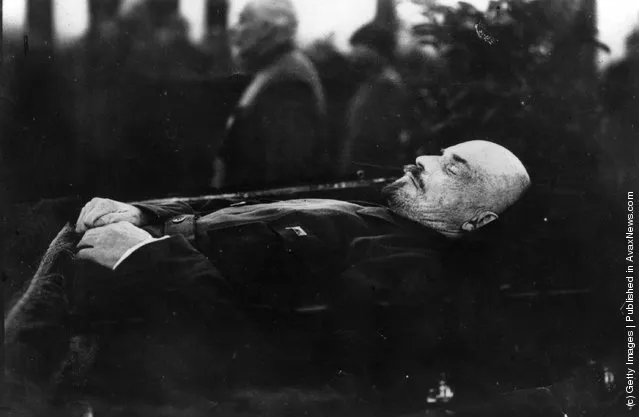
1924:  Vladimir Ilyich Lenin lying in state in the Kremlin

Photo: Vladimir Ilyich Lenin (1870 – 1924) lying in state in the Kremlin. (Photo by Hulton Archive/Getty Images). 1924

Important! For the same article in Russian language click here.

Something quite intriguing is happening within Russian-speaking internet during the last few – should you type a fully academic inquiry (at least, according to Russian academic requirements) in national search engines for "Lenin's mausoleum" – the first thing you get (even in top 10 searches) is website pages talking about black magic and occult. Website authors view this construction differently, but unconditionally agree on one thing: the mausoleum of the "leader of the world proletariat” – the essence of a magical artifact, a sort of “energy vampire”. It was built with a certain purpose: to drain the energy out of miserable Soviet citizens on one hand; and to poison the anthroposphere of one-sixth part of the earth with its vibes (the exact territory that was occupied by the former Soviet Union), depriving the Russian people of will to resist on the other hand. Complete nonsense? No doubt. Nevertheless, an intriguing one. Well, probably because some oddities do exist in mausoleum's history. These oddities are the thing we are going to discuss this time. First, let me refresh you memory on the subject.
Details
16 Oct 2011 11:27:00
Tengger tribe people make their way to the summit of Mount Bromo volcano to make offerings in Probolinggo, East Java province on July 7, 2020, as part of the Yadnya Kasada Festival. During the annual Yadnya Kasada festival, the Tenggerese climb Mount Bromo, an active volcano, and seek the blessing from the main deity by presenting offerings of rice, fruit, livestock and other items. (Photo by Juni Kriswanto/AFP Photo)

Tengger tribe people make their way to the summit of Mount Bromo volcano to make offerings in Probolinggo, East Java province on July 7, 2020, as part of the Yadnya Kasada Festival. During the annual Yadnya Kasada festival, the Tenggerese climb Mount Bromo, an active volcano, and seek the blessing from the main deity by presenting offerings of rice, fruit, livestock and other items. (Photo by Juni Kriswanto/AFP Photo)
Details
15 Jul 2020 00:05:00
Drag performer Maxi Shield chats to her online audience on May 18, 2020 in Sydney, Australia. Drag performer Maxi Shield started hosting a live instagram chat show “Maxi's Couch Potato” as a way to keep performing and connected with fans on social media after perfomance venues were closed due to the COVID-19 outbreak. (Photo by Don Arnold/Getty Images)

Drag performer Maxi Shield chats to her online audience on May 18, 2020 in Sydney, Australia. Drag performer Maxi Shield started hosting a live instagram chat show “Maxi's Couch Potato” as a way to keep performing and connected with fans on social media after perfomance venues were closed due to the COVID-19 outbreak. (Photo by Don Arnold/Getty Images)
Details
20 May 2020 00:07:00
A couple share a kiss at the “Purple Rain” installation at the Lycée Jacques-Decour on August 02, 2020 in Paris, France. Part of Festival Paris l'Eté, the installation by Pierre Ardouvin is a tribute to the song by Prince and allows visitors to role play while equipped with umbrellas and accompanied by the song. (Photo by Kiran Ridley/Getty Images)

A couple share a kiss at the “Purple Rain” installation at the Lycée Jacques-Decour on August 02, 2020 in Paris, France. Part of Festival Paris l'Eté, the installation by Pierre Ardouvin is a tribute to the song by Prince and allows visitors to role play while equipped with umbrellas and accompanied by the song. (Photo by Kiran Ridley/Getty Images)
Details
06 Aug 2020 00:01:00
A fisherman throws his net beside a half-submerged M/V Palawan Pearl after it collided with a Cyprus-flagged BKM 104 dredger in Manila bay, Philippines on Thursday, July 8, 2021. A Philippine cargo vessel and a Cyprus-flagged dredger collided in a Manila Bay anchorage area early Thursday, resulting in no injuries but causing the cargo vessel to list and lie half-submerged in the busy waters. (Photo by Aaron Favila/AP Photo)

A fisherman throws his net beside a half-submerged M/V Palawan Pearl after it collided with a Cyprus-flagged BKM 104 dredger in Manila bay, Philippines on Thursday, July 8, 2021. A Philippine cargo vessel and a Cyprus-flagged dredger collided in a Manila Bay anchorage area early Thursday, resulting in no injuries but causing the cargo vessel to list and lie half-submerged in the busy waters. (Photo by Aaron Favila/AP Photo)
Details
25 Sep 2021 07:51:00