Loading...
Done
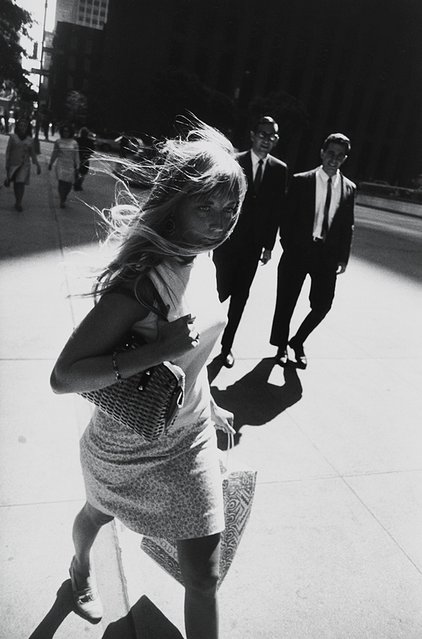
New York, 1965. (Photo by Garry Winogrand/The Estate of Garry Winogrand, courtesy Fraenkel Gallery, San Francisco)

A retrospective of Garry Winogrand's photography is on display at the Metropolitan Museum of Art in New York. It is the first in 25 years of his work. The show was organized by the San Francisco Museum of Art, and the National Gallery in Washington, DC. Photo: New York, 1965. (Photo by Garry Winogrand/The Estate of Garry Winogrand, courtesy Fraenkel Gallery, San Francisco)
Details
17 Jul 2014 11:56:00
Bailey the Staffordshire bull terrier, holding a red rose. (Photo by Helen Yates/Barcroft Media)

“Like most Brits, Emmie Stevens is dog mad. But the 25-year-old has taken it to the next level, spending £30,000 on her nine pets. Emmie’s dogs enjoy regular manicures and fur dyes and have their own walk in wardrobe to store their £15,000 clothing collection”. – Daily Record. Photo: Bailey the Staffordshire bull terrier, holding a red rose. (Photo by Helen Yates/Barcroft Media)
Details
09 Mar 2014 04:45:00
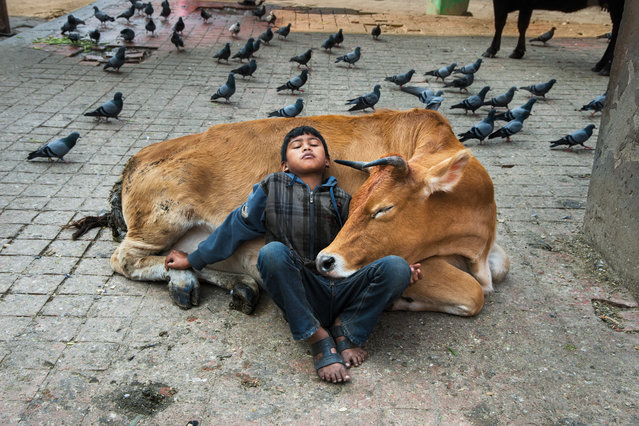
A boy rests against a cow, Kathmandu, Nepal, 2013. “Cows have been designated the national animal in Nepal. They roam freely, and are considered sacred by the 80% of Nepalis who are Hindu”. (Photo by Steve McCurry/The Guardian)

The legendary US photographer’s favourite shots of creatures and how they interact with humans feature in “Animals”, his latest book. Here: A boy rests against a cow, Kathmandu, Nepal, 2013. “Cows have been designated the national animal in Nepal. They roam freely, and are considered sacred by the 80% of Nepalis who are Hindu”. (Photo by Steve McCurry/The Guardian)
Details
07 Nov 2019 00:01:00
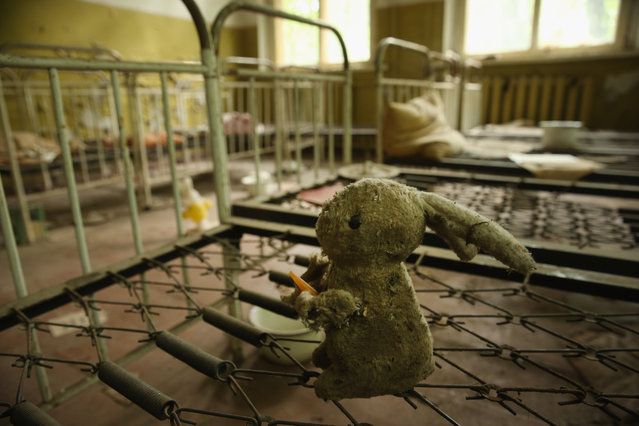
A stuffed rabbit doll sits among children's beds standing in the abandoned kindergarten of Kopachi village located inside the Chernobyl Exclusion Zone on September 29, 2015 near Chornobyl, Ukraine. Kopachi, a village that before 1986 had a population of 1,114, lies only a few kilometers south of the former Chernobyl nuclear power plant, where in 1986 workers inadvertantly caused reactor number four to explode, creating the worst nuclear accident in history. Radiation fallout was so high that authorities bulldozed and buried all of Kopachi's structures except for the kindergarten. (Photo by Sean Gallup/Getty Images)

A stuffed rabbit doll sits among children's beds standing in the abandoned kindergarten of Kopachi village located inside the Chernobyl Exclusion Zone on September 29, 2015 near Chornobyl, Ukraine. Kopachi, a village that before 1986 had a population of 1,114, lies only a few kilometers south of the former Chernobyl nuclear power plant, where in 1986 workers inadvertantly caused reactor number four to explode, creating the worst nuclear accident in history. (Photo by Sean Gallup/Getty Images)
Details
27 Apr 2016 09:28:00
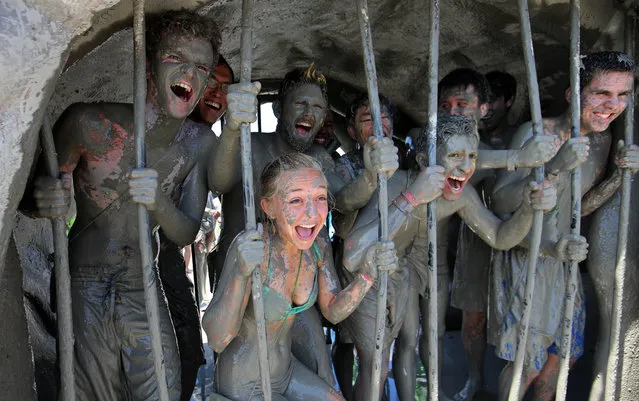
Mud-covered tourists pretend to be trapped inside a mud prison at the Daecheon Beach Mud Plaza in the city of Boryeong on South Korea's west coast, July 17, as they take part in the Boryeong Mud Festival, which opened that day and runs through July 26. Boryeong mud is rich in natural mineral component and is considered to prevent skin aging. (Photo by EPA/Yonhap)

Mud-covered tourists pretend to be trapped inside a mud prison at the Daecheon Beach Mud Plaza in the city of Boryeong on South Korea's west coast, July 17, as they take part in the Boryeong Mud Festival, which opened that day and runs through July 26. Boryeong mud is rich in natural mineral component and is considered to prevent skin aging. (Photo by EPA/Yonhap)
Details
18 Jul 2015 13:33:00
Revellers, dressed as “Zarramaches”, pose inside the city hall during celebrations to mark Saint Blaise's festivity in Casavieja, Spain February 3, 2017. (Photo by Sergio Perez/Reuters)

Revellers, dressed as “Zarramaches”, pose inside the city hall during celebrations to mark Saint Blaise's festivity in Casavieja, Spain February 3, 2017. (Photo by Sergio Perez/Reuters)
Details
06 Feb 2017 01:04:00
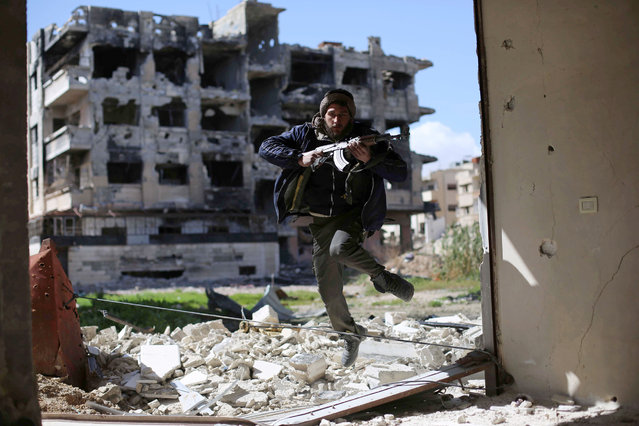
A fighter belonging to Jaish al-Islam (Islam Army) runs to take cover near the frontline on March 14, 2016 in the neighbourhood of Jobar, on the eastern outskirts of the capital Damascus. (Photo by Amer Almohibany/AFP Photo)

A fighter belonging to Jaish al-Islam (Islam Army) runs to take cover near the frontline on March 14, 2016 in the neighbourhood of Jobar, on the eastern outskirts of the capital Damascus. (Photo by Amer Almohibany/AFP Photo)
Details
25 Mar 2016 13:28:00
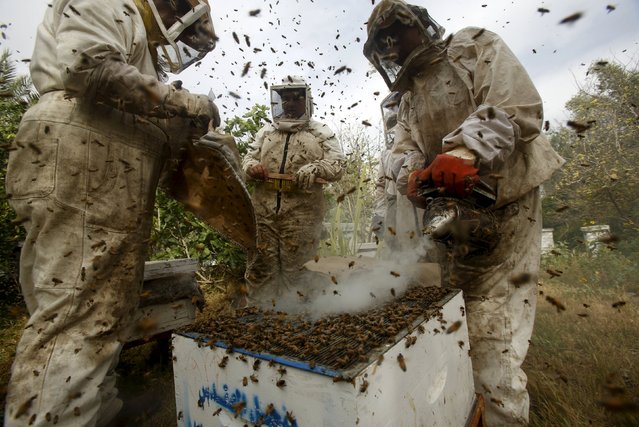
A Palestinian beekeeper uses smoke to calm bees in the process of collecting honey at a farm in Rafah, in the southern Gaza Strip April 11, 2016. (Photo by Suhaib Salem/Reuters)

A Palestinian beekeeper uses smoke to calm bees in the process of collecting honey at a farm in Rafah, in the southern Gaza Strip April 11, 2016. Rateb Samour sees 250 patients a day, whose complaints range from hair loss to cerebral palsy and cancer. He is not a doctor and has never worked in a hospital. Samour inherited the skill of bee-sting therapy from his father. From 2003 the agricultural engineer dedicated all his time to study and develop the alternative-medicine treatment of apitherapy, which uses bee-related products from honey, propolis – or bee glue used to build hives – to venom. (Photo by Suhaib Salem/Reuters)
Details
13 Apr 2016 09:14:00