Loading...
Done
Indian labourers carry clay bricks to a brick kiln in Farakka, in the Indian state of West Bengal, on April 3, 2019. (Photo by Xavier Galiana/AFP Photo)

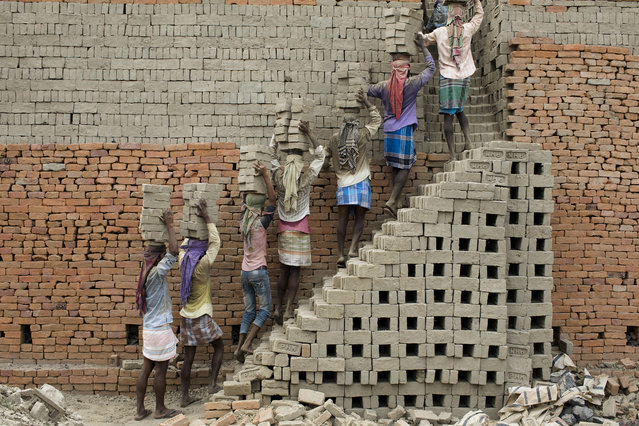
Indian labourers carry clay bricks to a brick kiln in Farakka, in the Indian state of West Bengal, on April 3, 2019. (Photo by Xavier Galiana/AFP Photo)
Details
09 Apr 2019 00:05:00
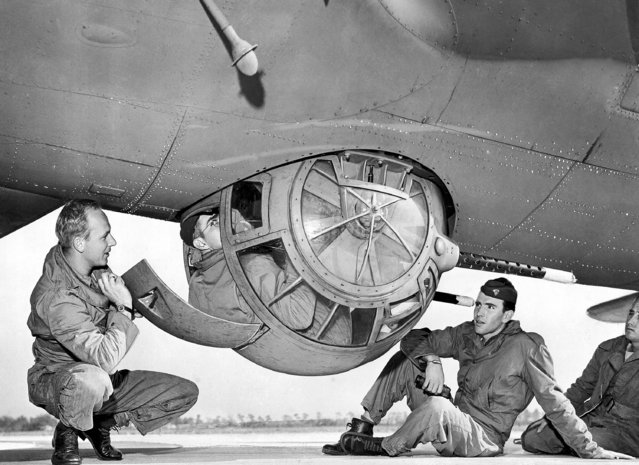
Private Harold L. Langhofer edges into the ball-turret, March 9, 1943. Curled in this position, he can turn the turret so that it fires in any direction. The turret can also be swung around so that the hatch opens into the plane, and the gunner can crawl into it while the Flying Fortress is in motion. (Photo by AP Photo)

Private Harold L. Langhofer edges into the ball-turret, March 9, 1943. Curled in this position, he can turn the turret so that it fires in any direction. The turret can also be swung around so that the hatch opens into the plane, and the gunner can crawl into it while the Flying Fortress is in motion. (Photo by AP Photo)
Details
05 Apr 2018 00:03:00
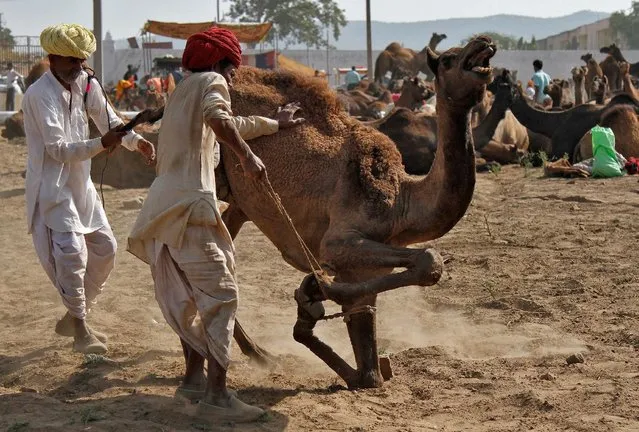
Traders try to control a camel at Pushkar Fair where animals, mainly camels, are brought to be sold and traded in the desert Indian state of Rajasthan November 6, 2016. (Photo by Himanshu Sharma/Reuters)

Traders try to control a camel at Pushkar Fair where animals, mainly camels, are brought to be sold and traded in the desert Indian state of Rajasthan November 6, 2016. (Photo by Himanshu Sharma/Reuters)
Details
07 Nov 2016 12:04:00
Models present creations “2033 (teens)” by Belarusian designer Anastasiya Kutepova during a show at the festival and contest Fashion Mill, amid the coronavirus disease (COVID-19) outbreak, in Minsk, Belarus on June 30, 2020. (Photo by Vasily Fedosenko/Reuters)

Models present creations “2033 (teens)” by Belarusian designer Anastasiya Kutepova during a show at the festival and contest Fashion Mill, amid the coronavirus disease (COVID-19) outbreak, in Minsk, Belarus on June 30, 2020. (Photo by Vasily Fedosenko/Reuters)
Details
02 Jul 2020 00:07:00
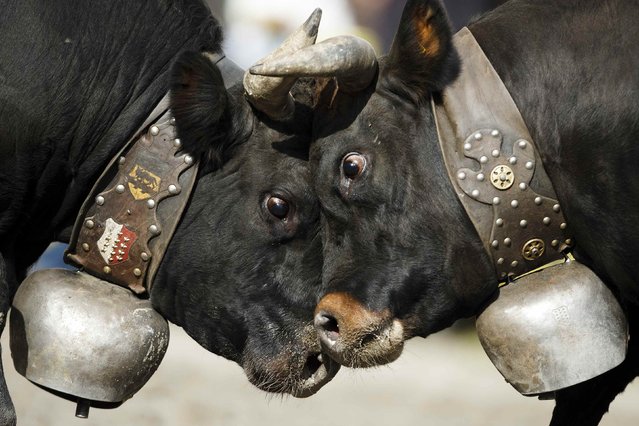
Two Herens cows lock horns during the qualification round of the annual “Battle of the Queens” cow fight finals in Aproz, in the western Alpine canton of Valais May 5, 2013. Each year when taken to the alpine pastures, the cows test their strength and fight for the herd's leadership. The competition continues until a new queen has forced all the other cows to retreat. (Photo by Valentin Flauraud/Reuters)

Two Herens cows lock horns during the qualification round of the annual “Battle of the Queens” cow fight finals in Aproz, in the western Alpine canton of Valais May 5, 2013. Each year when taken to the alpine pastures, the cows test their strength and fight for the herd's leadership. The competition continues until a new queen has forced all the other cows to retreat. (Photo by Valentin Flauraud/Reuters)
Details
06 May 2013 12:33:00
Two female soldiers have their picture taken by an army colleague at Mangyongdae. (Photo by Gavin John/Mediadrumworld.com)

Two female soldiers have their picture taken by an army colleague at Mangyongdae. (Photo by Gavin John/Mediadrumworld.com)
Details
16 May 2017 07:37:00
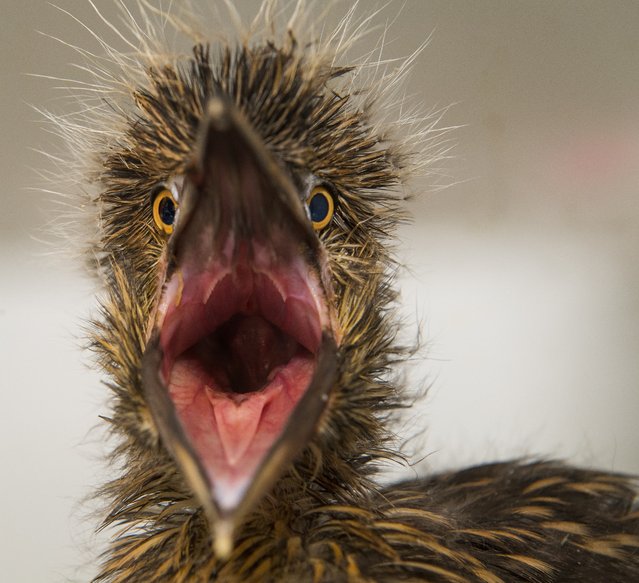
A baby Black-crowned Night Heron squawks in its incubator while being cared for at City Wildlife rescue and rehabilitation center in Washington, DC on May 31, 2017. The heron is one of several that have been brought to CW by the staff at The National Zoo over the past few years. The heron is a native bird and has made an established rookery inside the zoo grounds over a hundred years ago.  Every year at this time, some of the chicks get pushed or fall out of the nest and require human care.  Because the birds are native and not part of the Smithsonian collection, they partnered with CW to rehabilitate the herons for re-release back to the flock inside Zoo. They're reintroduced back to their flock so that they can migrate together in the Fall. The Black-crowned heron usually migrates from the DC area down to southeast North Carolina, some going as far as Jacksonville, FL in winter. The Black-crowned heron is the species of greatest conservation need in the District of Columbia because their numbers are in such rapid decline due to habitat loss. (Photo Linda Davidson/The Washington Post)

A baby Black-crowned Night Heron squawks in its incubator while being cared for at City Wildlife rescue and rehabilitation center in Washington, DC on May 31, 2017. The heron is one of several that have been brought to CW by the staff at The National Zoo over the past few years. (Photo Linda Davidson/The Washington Post)
Details
04 Jun 2017 08:04:00
Medic James E. Callahan of Pittsfield, Mass., gives mouth-to-mouth resuscitation to a dying soldier in war zone D, about 50 miles northeast of Saigon, June 17, 1967. Thirty-one men of the 1st Infantry Division were reported killed in the guerrilla ambush, with more than 100 wounded.  (Photo by Henri Huet/AP Photo)

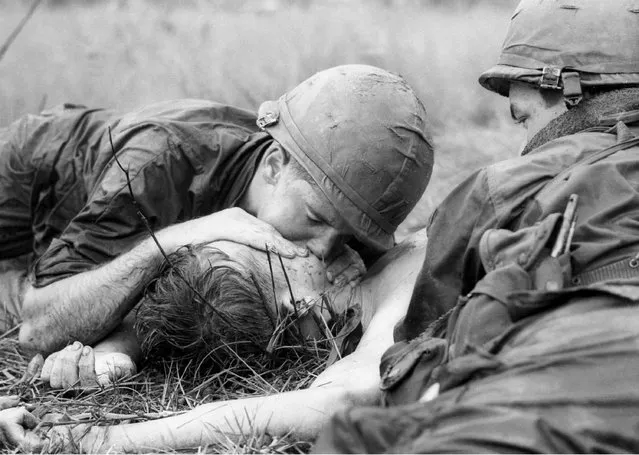
Medic James E. Callahan of Pittsfield, Mass., gives mouth-to-mouth resuscitation to a dying soldier in war zone D, about 50 miles northeast of Saigon, June 17, 1967. Thirty-one men of the 1st Infantry Division were reported killed in the guerrilla ambush, with more than 100 wounded. (Photo by Henri Huet/AP Photo)
Details
27 Jun 2017 08:38:00