Loading...
Done
Surgeons Prepare To Separate Conjoined Twin Toddlers

Conjoined twins Angelica (C) and Angelina Sabuco (L) play with child life specialist Allison Brooks during a press conference at the Lucile Packard Children's Hospital at Stanford on October 31, 2011 in Palo Alto, California. Two year-old conjoined twins Angelica and Angelina Subaco who are connected at the chest and abdomen are preparing for separation surgery by Dr. Gary Hartman. The surgery will last between 6 and 8 hours that is followed by three hours of reconstructive surgery for each girl. (Photo by Justin Sullivan/Getty Images)
Details
01 Nov 2011 11:10:00
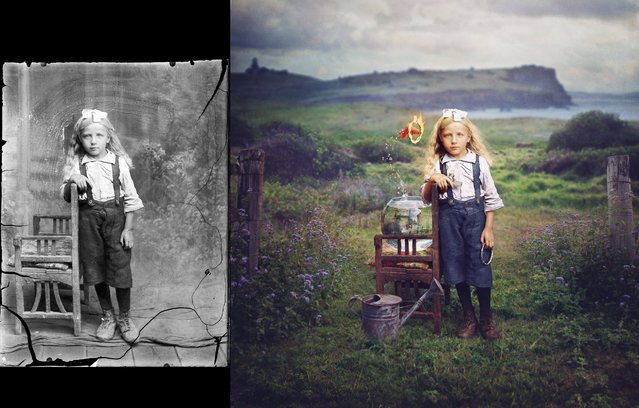
The Costica photo on the left inspired Australia-based photographer Jane Long to create her version, titled “Innocence”. (Photo by Costica Acsinte Archive/Jane Long)

The “Dancing With Costica” series began when Australia-based photographer Jane Long decided to brush up on her retouching skills. After finding the Costica Acsinte Archive on Flickr, she became fascinated with the images and their subjects, wanting to bring them to life and give them a story. Here: the Costica photo on the left inspired Jane Long to create her version, titled “Innocence”. (Photo by Costica Acsinte Archive/Jane Long)
Details
01 Sep 2014 09:48:00
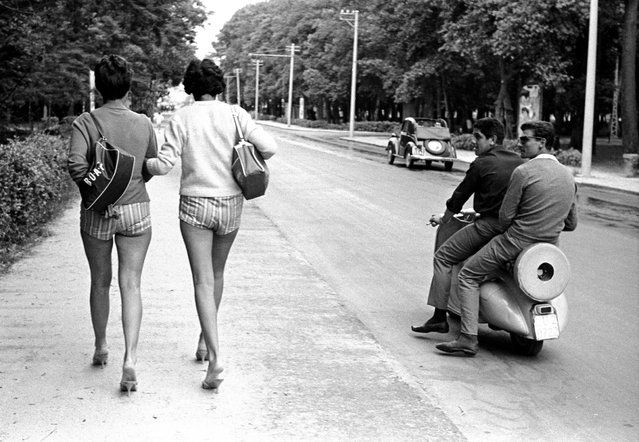
Viareggio in 1959. (Photo by Paolo Di Paolo/National Museum of 21st Century Arts)

The “Paolo Di Paolo: Lost World” exhibition presents more than 250 largely unseen images from the photographer’s archive. Di Paolo chronicled life in his country as an economic boom followed the destruction of the second world war. Although those were the years of la dolce vita he was an anti-paparazzo – he shunned the salacious and respected his subjects. The exhibition is at MAXXI, the National Museum of 21st Century Arts in Rome until 30 June. Here: Viareggio in 1959. (Photo by Paolo Di Paolo/National Museum of 21st Century Arts)
Details
01 May 2019 00:03:00
A woman poses with a cut-out of Vladimir Putin in the “President Cafe” in Krasnoyarsk, Siberia, Russia, April 7, 2016. (Photo by Ilya Naymushin/Reuters)

A woman poses with a cut-out of Vladimir Putin in the “President Cafe” in Krasnoyarsk, Siberia, Russia, April 7, 2016. Dozens of photos of Vladimir Putin, from childhood to Russian President, hang on the walls of President Cafe in a working-class area of Krasnoyarsk, a city in eastern Siberia. A life-size cut-out of Putin stands by the bar. Images of U.S. President Barack Obama, as well as leaders of Germany and Britain, greet customers in the toilets. (Photo by Ilya Naymushin/Reuters)
Details
14 Apr 2016 12:14:00
A Comb jelly – Beroe cucumis. (Photo by Alexander Semenovs/Caters News)

Underwater photographer Alexander Semenovs has snapped some of the most stunning, fragile life forms anywhere on planet Earth. Shot in deep, dark conditions, the images continue to provide an insight into what lies beneath, with glowing creatures appearing a lot like aliens in the pitch-black water. Semenovs has shot the likes of bioluminescent jellyfish, aggressive-looking worms and many species that leave a lot to the imagination. The 30-year-old from Moscow does the majority of his work in the White Sea, near the Arctic Circle. Here: A Comb jelly – Beroe cucumis. (Photo by Alexander Semenovs/Caters News)
Details
23 Nov 2015 08:06:00
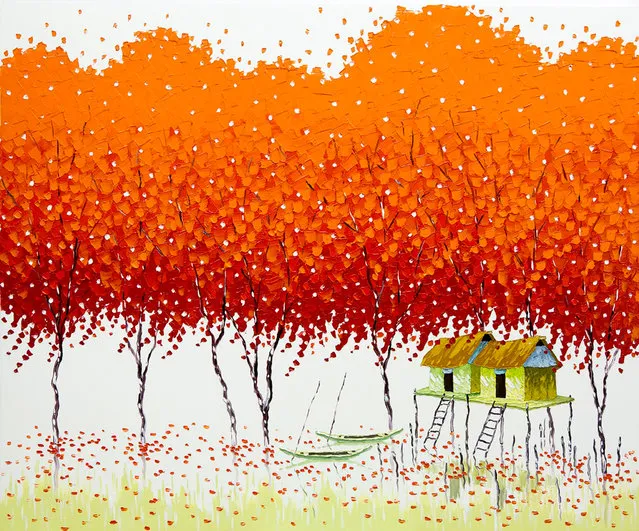
Vivid Paintings By Phan Thu Trang

Born in Hanoi, 1979, a member of the Young Painter Association of Vietnam, Trang is an emerging young artist whose mind has been engraved with images of the city and the Northern villages. She brings these vivid memories of the villagers and their life to her paintings. She paints scenes of landscapes in thick textural impasto with bright colours of red, orange, yellow, and blue, making the genre of landscape her own. Her paintings depict her passion to showcase the radiance and freshness of the landscapes in Vietnam. For every stroke of brush reflects her burning desire to bring out a world of complications to simple living and a deep appreciation of nature’s blessing and beauty.
Details
26 Oct 2013 10:10:00
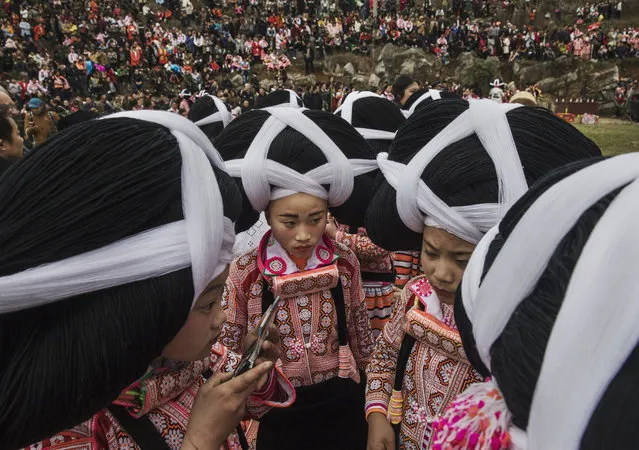
Girls of the Long Horn Miao ethnic minority group wear headdresses as they prepare gather for Tiaohua or Flower Festival as part of the Lunar New Year on February 6, 2017 in Longga village, Guizhou province, southern China. The Long Horn Miao are recognized for their declining practice of wrapping a blend of linen, wool, and the hair of their ancestors around animal horns or a wooden clip to make headdresses. Many young women say they now wear the headdresses only for special occasions and festivals, as the ornaments, which are attached by the horns to their real hair, have proved impractical for modern daily life in a fast changing world. China officially recognizes 56 different ethnic minorities, and statistics show over 7 million Chinese identifying themselves as Miao. But the small Long Horn Miao community counts only around 5000 people living in 12 villages, whose age-old traditions, language, and culture are fading. It is increasingly difficult in a modernizing China, as young people are drawn from remote rural villages to opportunities in bigger cities amongst wide-scale urbanization. Farming and labour remain the mainstays of life for the Long Horn Miao, leaving the area relatively poor in comparison with many parts of China. The government has invested significant amounts into local infrastructure and the tourism industry to try to bolster the local economy. (Photo by Kevin Frayer/Getty Images)

Girls of the Long Horn Miao ethnic minority group wear headdresses as they prepare gather for Tiaohua or Flower Festival as part of the Lunar New Year on February 6, 2017 in Longga village, Guizhou province, southern China. (Photo by Kevin Frayer/Getty Images)
Details
13 Feb 2017 00:01:00
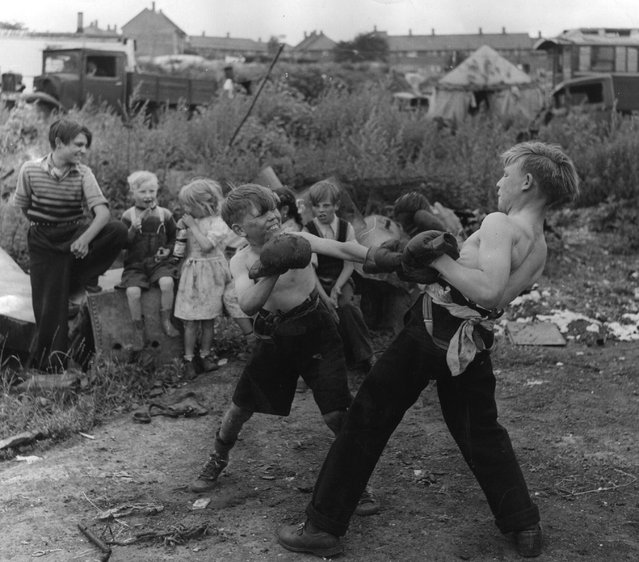
The unromantic gypsies. Children boxing in a gypsy camp in Kent, England on July 1, 1951. Like all boys these gypsy lads like to try their hand at boxing. Encouraged by their friends they fight it out on Corke's Meadow. Few Romanies now live a life of wandering romance. Most are like the three hundred squatters of Corke's Meadow, Kent, which is part of a “gypsy problem” that involves about 100,000 today. Of those about 25,000 can be rightly called gypsies, the rest are Mumpers and Posh-rats and Hobos. Corke's Meadow has both kinds. “Picture Post” cameraman Bert Hardy photographs the Corke's Meadow gypsies in their encampment. (Photo by Hulton-Deutsch Collection/Corbis via Getty Images)

The unromantic gypsies. Children boxing in a gypsy camp in Kent, England on July 1, 1951. Like all boys these gypsy lads like to try their hand at boxing. Encouraged by their friends they fight it out on Corke's Meadow. Few Romanies now live a life of wandering romance. Most are like the three hundred squatters of Corke's Meadow, Kent, which is part of a “gypsy problem” that involves about 100,000 today. Of those about 25,000 can be rightly called gypsies, the rest are Mumpers and Posh-rats and Hobos. Corke's Meadow has both kinds. “Picture Post” cameraman Bert Hardy photographs the Corke's Meadow gypsies in their encampment. (Photo by Hulton-Deutsch Collection/Corbis via Getty Images)
Details
12 Mar 2017 00:01:00