Loading...
Done
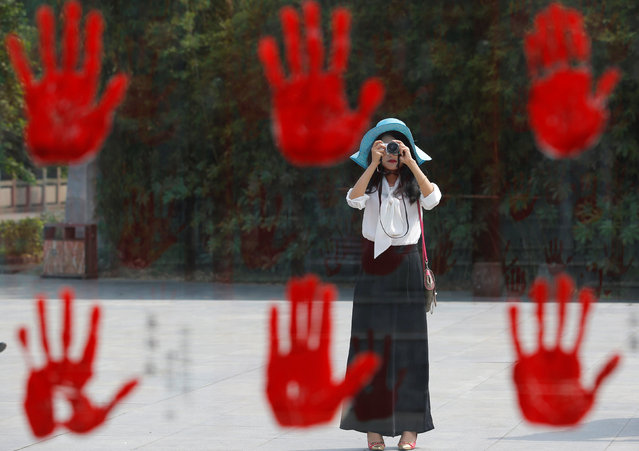
A visitor takes a picture of a display bearing hand prints of war heroes from the War of Resistance against Japan, at Jianchuan Museum Cluster in Anren, Sichuan Province, China, May 13, 2016. (Photo by Kim Kyung-Hoon/Reuters)

A visitor takes a picture of a display bearing hand prints of war heroes from the War of Resistance against Japan, at Jianchuan Museum Cluster in Anren, Sichuan Province, China, May 13, 2016. Tucked away in southwestern China's Sichuan province, a private collector stands virtually alone in exhibiting relics from the 1966-1976 Cultural Revolution. Monday marks the 50th anniversary of the start of the political movement, with no official commemorations planned. Official records whitewash the details of both periods, but admit that Mao made major mistakes. (Photo by Kim Kyung-Hoon/Reuters)
Details
16 May 2016 10:49:00
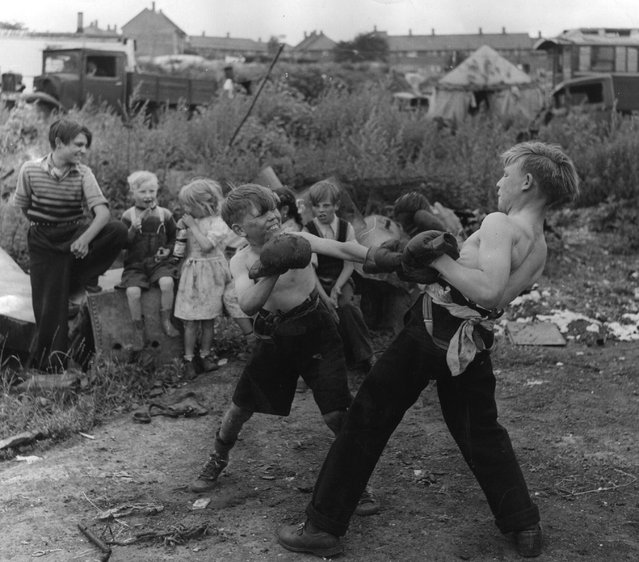
The unromantic gypsies. Children boxing in a gypsy camp in Kent, England on July 1, 1951. Like all boys these gypsy lads like to try their hand at boxing. Encouraged by their friends they fight it out on Corke's Meadow. Few Romanies now live a life of wandering romance. Most are like the three hundred squatters of Corke's Meadow, Kent, which is part of a “gypsy problem” that involves about 100,000 today. Of those about 25,000 can be rightly called gypsies, the rest are Mumpers and Posh-rats and Hobos. Corke's Meadow has both kinds. “Picture Post” cameraman Bert Hardy photographs the Corke's Meadow gypsies in their encampment. (Photo by Hulton-Deutsch Collection/Corbis via Getty Images)

The unromantic gypsies. Children boxing in a gypsy camp in Kent, England on July 1, 1951. Like all boys these gypsy lads like to try their hand at boxing. Encouraged by their friends they fight it out on Corke's Meadow. Few Romanies now live a life of wandering romance. Most are like the three hundred squatters of Corke's Meadow, Kent, which is part of a “gypsy problem” that involves about 100,000 today. Of those about 25,000 can be rightly called gypsies, the rest are Mumpers and Posh-rats and Hobos. Corke's Meadow has both kinds. “Picture Post” cameraman Bert Hardy photographs the Corke's Meadow gypsies in their encampment. (Photo by Hulton-Deutsch Collection/Corbis via Getty Images)
Details
12 Mar 2017 00:01:00
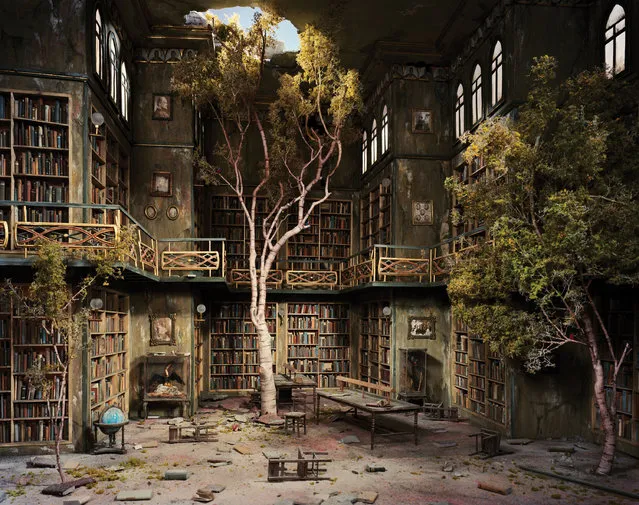
Library, 2007. Photographer Lori Nix says this is the most popular image she has made for this project that she calls “The City”. (Photo by Lori Nix)

Photographer Lori Nix hand-crafted dioramas are fictional scenes of a post-apocalyptic world in which plants and decay reclaim both grand and mundane structures. Each structure is built in Nix's living room and can take over half a year to build. Photo: Library, 2007. Photographer Lori Nix says this is the most popular image she has made for this project that she calls “The City”. (Photo by Lori Nix)
Details
18 Apr 2014 10:02:00
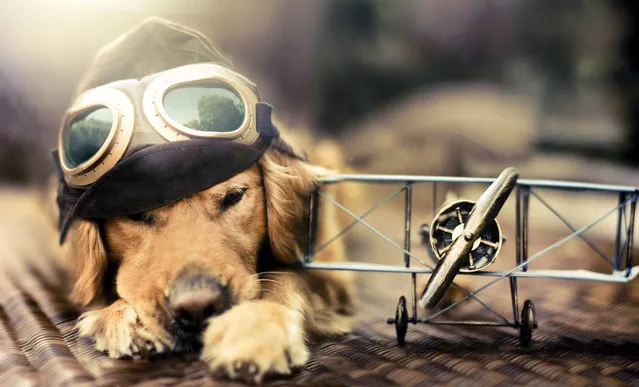
Dog photos by Jessica Trinh

I am 17 years old and an aspiring photographer. Ever since I set my hands on a camera, I knew I had unlocked a new dimension. One where you can expand your imagination and run for endless miles. Photography makes you look at things differently. You notice rain drops and the way the sun kisses the Earth. You breath in every moment of your life. You love to live and live to love. There is no time to waste because there is an urgency to capture each loving gesture, smile, and laugh in both humans and animals. Then every photograph becomes timeless and you smile, knowing that you hold a few split seconds in your hands. I live in a box called a camera with the lens as my window and everyday I sit on my couch watching the world outside through a different perspective. No worries, my dogs are right beside me looking at it the same way.

Jessica Trinh
Details
17 Dec 2012 13:46:00
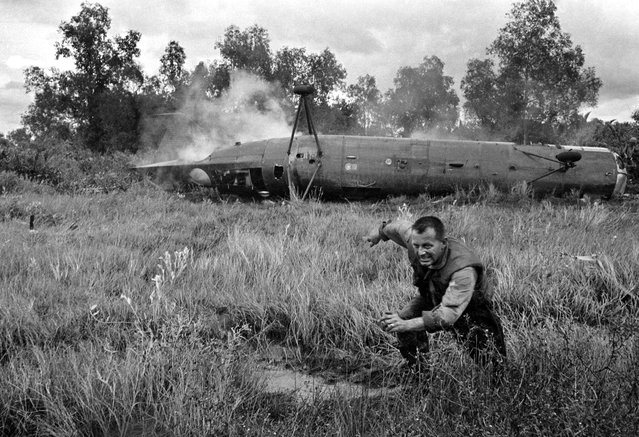
A U.S. crewman runs from a crashed CH-21 Shawnee troop helicopter near the village of Ca Mau in the southern tip of South Vietnam, Dec. 11, 1962

“Horst Faas (28 April 1933 – 10 May 2012) was a German photo-journalist and two-time Pulitzer Prize winner. He is best-known for his images of the Vietnam War”. – Wikipedia

Photo: A U.S. crewman runs from a crashed CH-21 Shawnee troop helicopter near the village of Ca Mau in the southern tip of South Vietnam, December 11, 1962. Two helicopters crashed without serious injuries during a government raid on the Viet Cong-infiltrated area. Both helicopters were destroyed to keep them out of enemy hands. (Photo by AP Photo/Horst Faas)
Details
24 May 2012 09:43:00
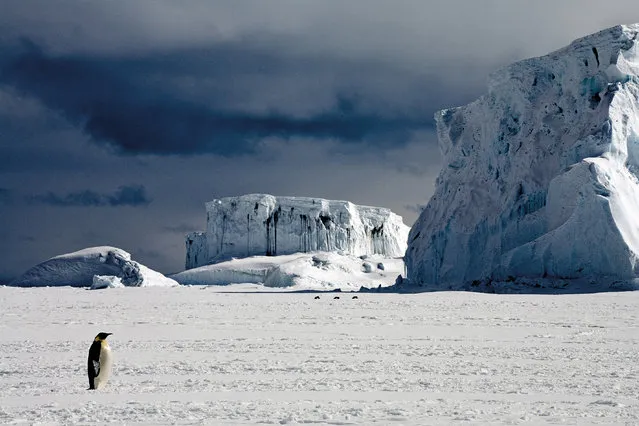
Image from Camille Seamans new book, “Melting Away”. (Photo by Camille Seaman/Barcroft Media)

Documenting the effects of climate change first hand over the past eight years, Camille Seaman fears we may be on the road to the last iceberg. Photographing the enormous frozen floats at both poles for the past eight years, the Californian adventurer has seen the receding ice shelves and experienced the changing warmer weather. Feeling that her intimate and emotional work documents a snapshot of history, Camille presents her series “The Last Iceberg” as a study of what she sees as the personality of each huge iceberg. Drawing parallels with the famous novel, “The Last of the Mohicans”, Camille, 42, wonders whether these unique, almost alien natural features will become a thing of the past or part of nature's renewal process. (Photo by Camille Seaman/Barcroft Media)
Details
02 Dec 2014 12:10:00
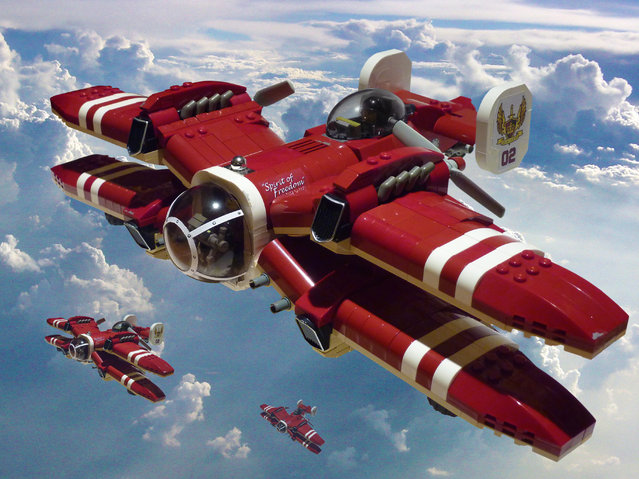
“The V-30 Warhawk was designed by Blackshaw Avionics as a long-range fighter and was primarily used by the Arcadian Air Force for escort duties. . (Jon Hall)

“The V-30 Warhawk was designed by Blackshaw Avionics as a long-range fighter and was primarily used by the Arcadian Air Force for escort duties. The plane pictured is the “Spirit of Freedom” and was one of the four planes that escorted the Arcadian Royal Airship during and after the Great War. The three other fighters were the “Spirit of Hope”, the “Spirit of Justice” and the “Spirit of Destiny”. All pilots were hand-picked by the Head of Airborne Forces and included some of the very finest pilots in the Kingdom. The crew consisted of one pilot and one gunner although both cabins were fitted so that if either crew member was killed the other could take over their duties. Each Warhawk was fitted with four Haverlock “Banshee” engines and four 24mm machine guns”. (Photo and comment by Jon Hall)


Details
11 Feb 2013 10:36:00
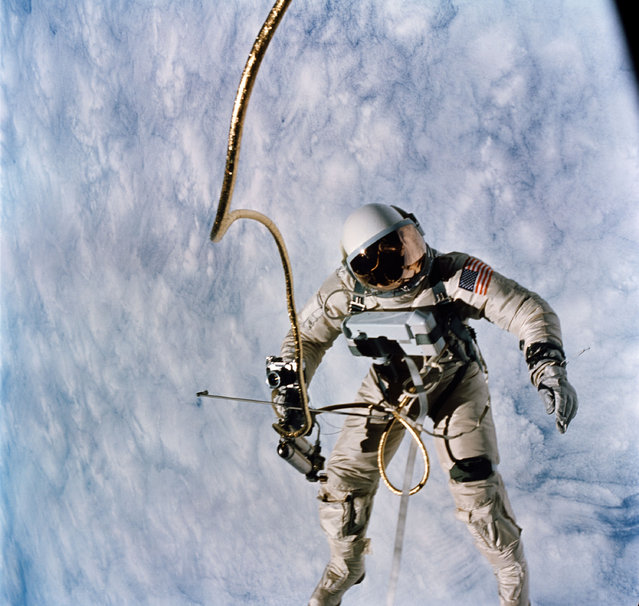
Astronaut Edward H. White II, pilot for the Gemini-Titan 4 (GT-4) spaceflight, floats in the zero-gravity of space during the third revolution of the GT-4 spacecraft on June 3, 1965. White wears a specially designed spacesuit. His face is shaded by a gold-plated visor to protect him from unfiltered rays of the sun. (Photo by NASA)

Astronaut Edward H. White II, pilot for the Gemini-Titan 4 (GT-4) spaceflight, floats in the zero-gravity of space during the third revolution of the GT-4 spacecraft on June 3, 1965. White wears a specially designed spacesuit. His face is shaded by a gold-plated visor to protect him from unfiltered rays of the sun. In his right hand he carries a Hand-Held Self-Maneuvering Unit (HHSMU) that gives him control over his movements in space. White also wears an emergency oxygen chest pack; and he carries a camera mounted on the HHSMU for taking pictures of the sky, Earth and the GT-4 spacecraft. He is secured to the spacecraft by a 25-feet umbilical line and a 23-feet tether line. Both lines are wrapped together in gold tape to form one cord. Astronaut James A. McDivitt, command pilot, remained inside the spacecraft during the extravehicular activity (EVA). Astronaut White died in the Apollo/Saturn 204 fire at Cape Kennedy on January 27, 1967. (Photo by NASA)
Details
22 Jul 2014 12:05:00