Loading...
Done
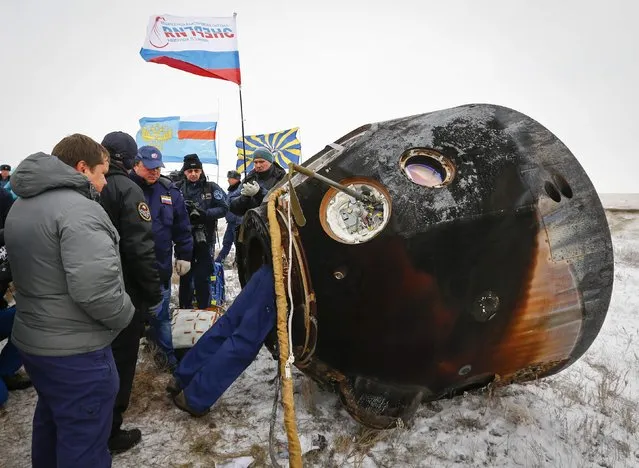
Ground personnel work next to the Soyuz TMA-13M capsule of the International Space Station (ISS) crew of Alexander Gerst of Germany, Maxim Suraev of Russia and Reid Wiseman of the U.S. after its landing near the town of Arkalyk in northern Kazakhstan November 10, 2014. (Photo by Shamil Zhumatov/Reuters)

Ground personnel work next to the Soyuz TMA-13M capsule of the International Space Station (ISS) crew of Alexander Gerst of Germany, Maxim Suraev of Russia and Reid Wiseman of the U.S. after its landing near the town of Arkalyk in northern Kazakhstan November 10, 2014. A veteran Russian cosmonaut and two International Space Station crewmates, one from the United States and one from Germany, returned safely to Earth on Sunday with a parachute landing of their Soyuz capsule in Kazakhstan, ending 5-1/2 months in orbit. (Photo by Shamil Zhumatov/Reuters)
Details
10 Nov 2014 13:58:00
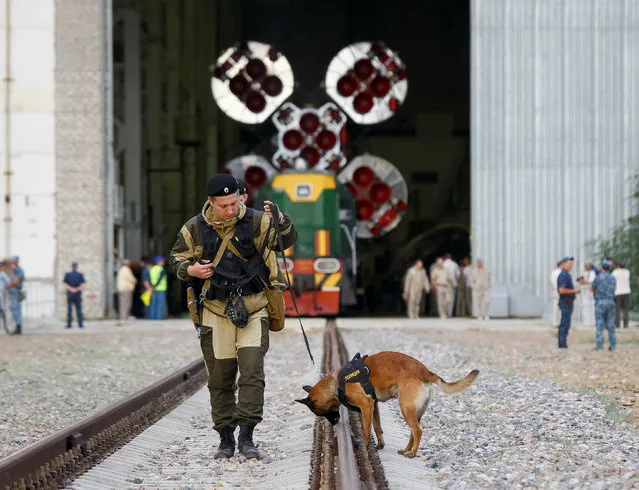
Police officers with a sniffer dog check a railway as the Soyuz MS spacecraft for the next International Space Station (ISS) crew of Kate Rubins of the U.S., Anatoly Ivanishin of Russia and Takuya Onishi of Japan is ready to be transported from an assembling hangar to the launchpad ahead of its launch scheduled on July 7, at the Baikonur cosmodrome in Kazakhstan July 4, 2016. (Photo by Shamil Zhumatov/Reuters)

Police officers with a sniffer dog check a railway as the Soyuz MS spacecraft for the next International Space Station (ISS) crew of Kate Rubins of the U.S., Anatoly Ivanishin of Russia and Takuya Onishi of Japan is ready to be transported from an assembling hangar to the launchpad ahead of its launch scheduled on July 7, at the Baikonur cosmodrome in Kazakhstan July 4, 2016. (Photo by Shamil Zhumatov/Reuters)
Details
06 Jul 2016 16:24:00
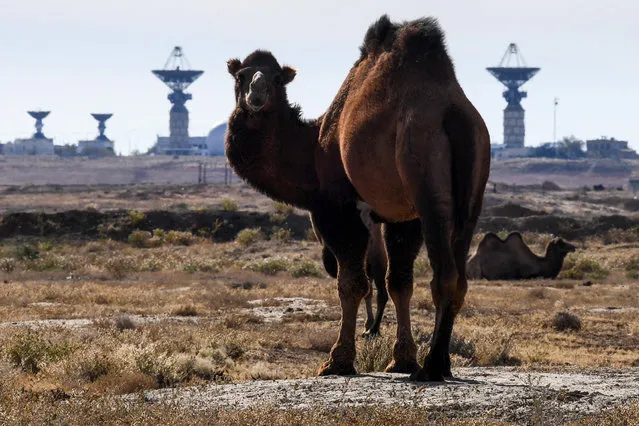
A camel is pictured in front of the Saturn tracking complex at the Russian-leased Baikonur cosmodrome in Kazakhstan on October 9, 2018. An astronaut and cosmonaut are due to travel to the ISS on October 11 aboard a Russian Soyuz MS-10 spacecraft from the Baikonur Cosmodrome in Kazakhstan. (Photo by Kirill Kudryavtsev/AFP Photo)

A camel is pictured in front of the Saturn tracking complex at the Russian-leased Baikonur cosmodrome in Kazakhstan on October 9, 2018. An astronaut and cosmonaut are due to travel to the ISS on October 11 aboard a Russian Soyuz MS-10 spacecraft from the Baikonur Cosmodrome in Kazakhstan. (Photo by Kirill Kudryavtsev/AFP Photo)
Details
08 Feb 2019 00:01:00
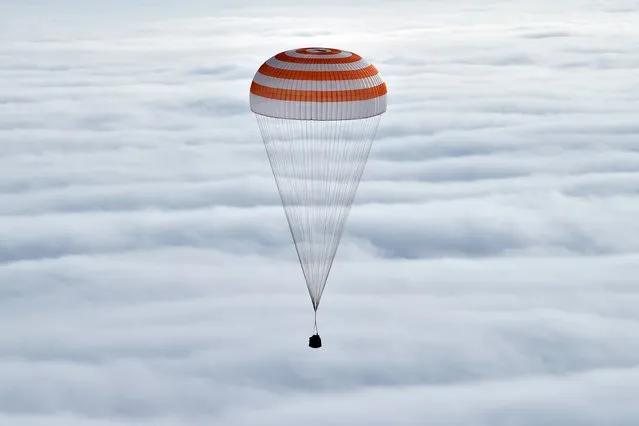
A Soyuz capsule carrying International Space Station (ISS) crew members U.S. astronaut Scott Kelly, Russian cosmonauts Sergei Volkov and Mikhail Korniyenko descends beneath a parachute near the town of Dzhezkazgan (Zhezkazgan), Kazakhstan, March 2, 2016. (Photo by Kirill Kudryavtsev/Reuters)

A Soyuz capsule carrying International Space Station (ISS) crew members U.S. astronaut Scott Kelly, Russian cosmonauts Sergei Volkov and Mikhail Korniyenko descends beneath a parachute near the town of Dzhezkazgan (Zhezkazgan), Kazakhstan, March 2, 2016. (Photo by Kirill Kudryavtsev/Reuters)
Details
03 Mar 2016 11:12:00
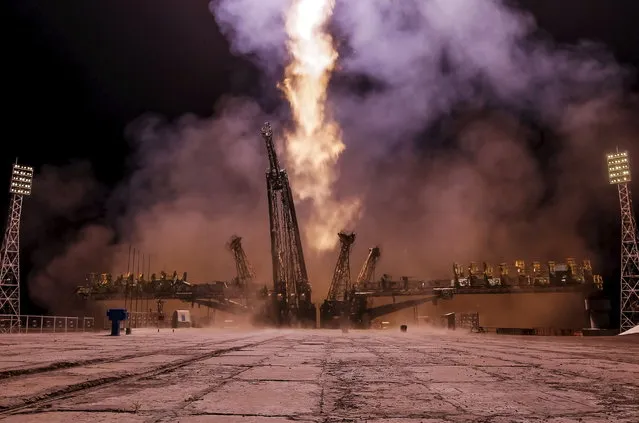
The Soyuz TMA-17M spacecraft carrying the International Space Station (ISS) crew blasts off from the launch pad at the Baikonur cosmodrome, Kazakhstan, July 23, 2015. (Photo by Shamil Zhumatov/Reuters)

The Soyuz TMA-17M spacecraft carrying the International Space Station (ISS) crew blasts off from the launch pad at the Baikonur cosmodrome, Kazakhstan, July 23, 2015. The Russian rocket carries Russian cosmonaut Oleg Kononenko, U.S. astronaut Kjell Lindgen and Japan astronaut Kimiya Yui. (Photo by Shamil Zhumatov/Reuters)
Details
23 Jul 2015 11:03:00
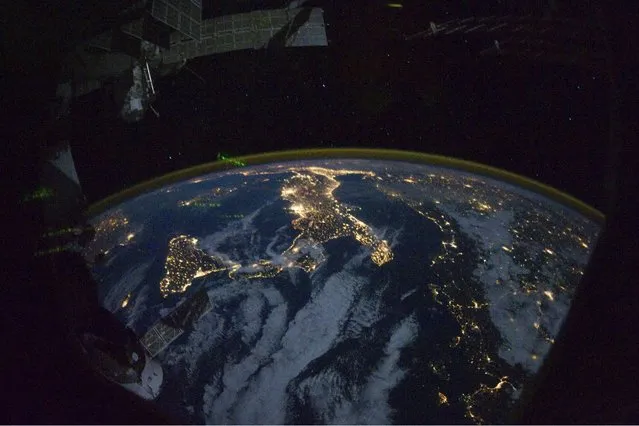
This image provided by NASA shows parts of Europe and Africa very easily recognizable in this night time image shot by one of the Expedition 25 crew members aboard the International Space Station flying 220 miles above Earth on Thursday Oct. 28, 2010. The view “looks” northward over Sicily and the “boot” of Italy, with the Mediterranean Sea representing most of the visible water in the view and the Adriatic Sea to the right of center. Tunisia is partially visible at left. Part of a docked Russian spacecraft and other components of the ISS are in the foreground. (Photo by AP photo/NASA)

This image provided by NASA shows parts of Europe and Africa very easily recognizable in this night time image shot by one of the Expedition 25 crew members aboard the International Space Station flying 220 miles above Earth on Thursday October 28, 2010. The view “looks” northward over Sicily and the “boot” of Italy, with the Mediterranean Sea representing most of the visible water in the view and the Adriatic Sea to the right of center. Tunisia is partially visible at left. Part of a docked Russian spacecraft and other components of the ISS are in the foreground. (Photo by AP Photo/NASA)
Details
11 May 2013 12:29:00
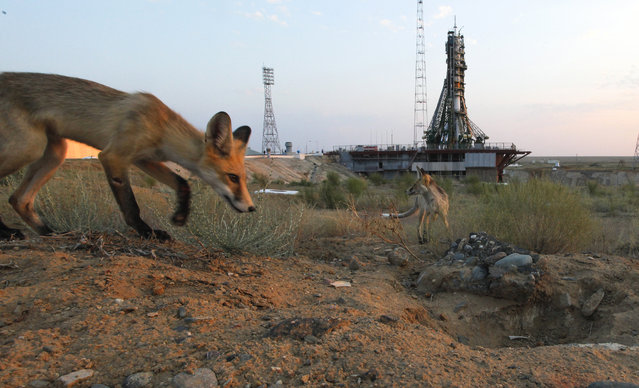
Wild foxes walk in front of a launch pad prior the launch of the Soyuz-FG rocket booster with Soyuz MS space ship carrying a new crew to the International Space Station, ISS at the Russian leased Baikonur cosmodrome, Kazakhstan, Thursday, July 7, 2016. The Russian rocket carries U.S. astronaut Kate Rubins, Russian cosmonaut Anatoly Ivanishin, and Japan astronaut Takuya Onishi. (Photo by Dmitri Lovetsky/AP Photo)

Wild foxes walk in front of a launch pad prior the launch of the Soyuz-FG rocket booster with Soyuz MS space ship carrying a new crew to the International Space Station, ISS at the Russian leased Baikonur cosmodrome, Kazakhstan, Thursday, July 7, 2016. The Russian rocket carries U.S. astronaut Kate Rubins, Russian cosmonaut Anatoly Ivanishin, and Japan astronaut Takuya Onishi. (Photo by Dmitri Lovetsky/AP Photo)

Details
08 Jul 2016 11:43:00
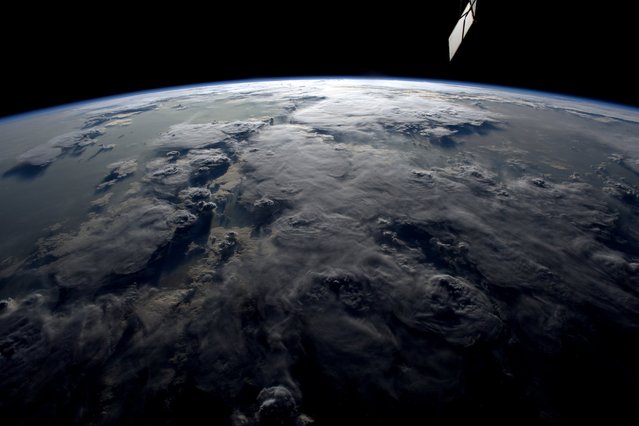
European Space Agency astronaut Tim Peake will return home after a six-month long mission on the International Space Station,on June 18, 2016. Peake was the first British ESA astronaut to visit the ISS and captured hundreds of photographs of the Earth during his mission. Here: “Lots of sun-glint right now during our whole orbit – we haven't seen a sunset for over 3 days”, he wrote. (Photo by Tim Peake/ESA/NASA)

European Space Agency astronaut Tim Peake will return home after a six-month long mission on the International Space Station,on June 18, 2016. Peake was the first British ESA astronaut to visit the ISS and captured hundreds of photographs of the Earth during his mission. Here: “Lots of sun-glint right now during our whole orbit – we haven't seen a sunset for over 3 days”, he wrote. (Photo by Tim Peake/ESA/NASA)
Details
18 Jun 2016 13:08:00