Loading...
Done
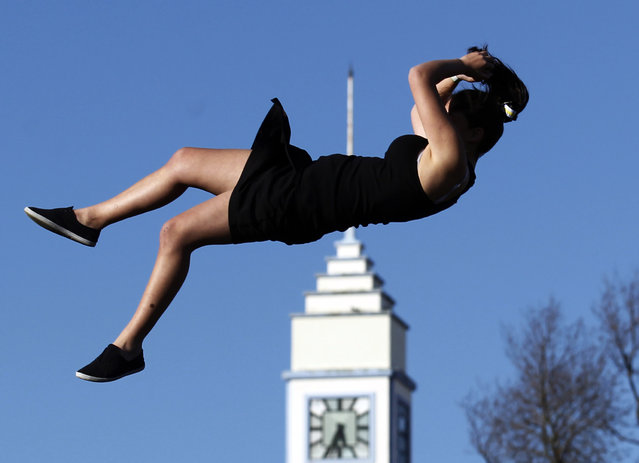
8. NEW ZEALAND: A woman dives from a platform into a giant air bed at a park in Palmerston North September 29, 2011. (Photo by Marcos Brindicci/Reuters)

The report, prepared by the Sustainable Development Solutions Network (SDSN) and the Earth Institute at Columbia University, showed Syria, Afghanistan and eight sub-Saharan countries as the 10 least happy places on earth to live. The top 10 this year were Denmark, Switzerland, Iceland, Norway, Finland, Canada, Netherlands, New Zealand, Australia, and Sweden. Denmark was in third place last year, behind Switzerland and Iceland. The bottom 10 were Madagascar, Tanzania, Liberia, Guinea, Rwanda, Benin, Afghanistan, Togo, Syria and Burundi. The United States came in at 13, the United Kingdom at 23, France at 32, and Italy at 50. Here: #8. NEW ZEALAND: A woman dives from a platform into a giant air bed at a park in Palmerston North September 29, 2011. (Photo by Marcos Brindicci/Reuters)
Details
26 Mar 2016 13:19:00
Upper Atmosphere Research Satellite (UARS)

In this artist illustration handout from the National Aeronautics and Space Administration (NASA), the Upper Atmosphere Research Satellite (UARS) is seen. According to NASA, the 12,500 pound satellite will fall from orbit into earth's atmosphere anytime between September 22 through 24. It is estimated that the space craft will break up into about 100 pieces, with an estimated 26 of which could hit the earth over a possible 500 mile debris field. (Illustration by NASA via Getty Images)
Details
21 Sep 2011 10:49:00


An image produced by the Hubble telescope of the perfectly “edge-on” galaxy, or NGC 4013, March 1, 2001. This new Hubble picture reveals, with great detail, huge clouds of dust and gas extending along, as well as far above, the galaxy's main disk. NGC 4013 is a spiral galaxy, similar to the Milky Way, lying some 55 million light-years from Earth in the direction of the constellation Ursa Major. Viewed face-on, it would look like a nearly circular pinwheel, but NGC 4013 happens to be seen edge-on from our vantage point. Even at 55 million light-years, the galaxy is larger than Hubble's field of view, and the image shows only a little more than half of the object, albeit with unprecedented detail. (Photo Courtesy of NASA/Newsmakers)
Details
28 Feb 2015 22:33:00
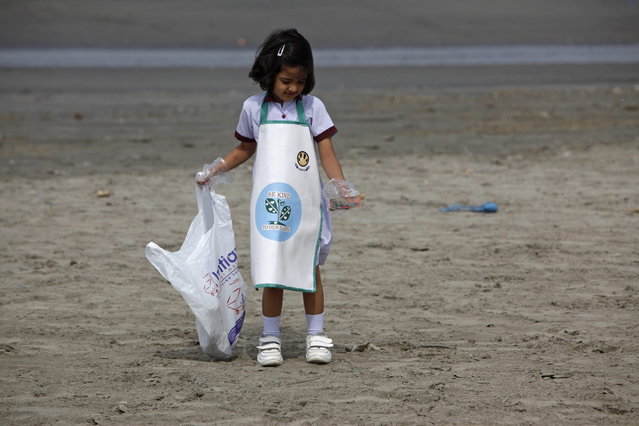
A schoolgirl collects rubbish from Karachi's Clifton beach early morning April 22, 2013, during a cleaning campaign as part of the commemoration of Earth Day. (Photo by Akhtar Soomro/Reuters)

A schoolgirl collects rubbish from Karachi's Clifton beach early morning April 22, 2013, during a cleaning campaign as part of the commemoration of Earth Day. (Photo by Akhtar Soomro/Reuters)
Details
23 Apr 2013 07:24:00
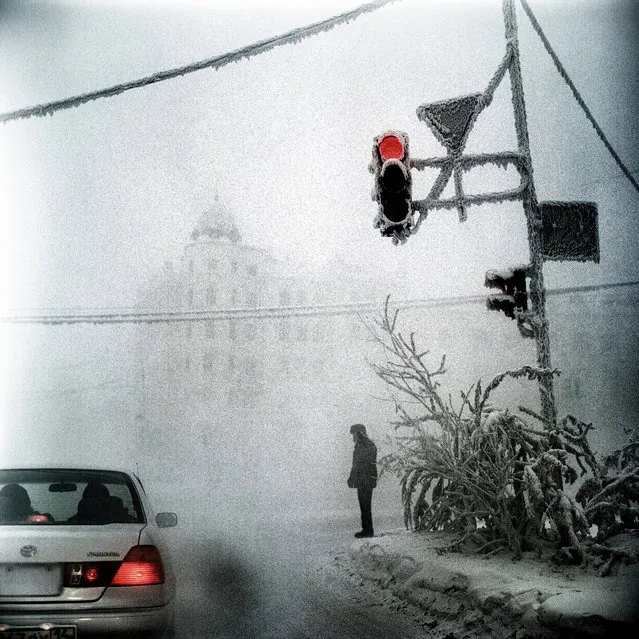
January 2013. A scene in Yakutsk, Siberia, the coldest city in the world. (Photo by Steeve Iuncker/Agence VU)

Yakutsk, a remote city in Eastern Siberia along the Lena River, is the coldest city in the world. Located 1840 km away from Irkoustk and 5000 km away from Moscow, this city founded in 1632 by the Cossacks imposes upon its inhabitants an extreme way of life. And yet, despite particularly harsh conditions, Yakutsk boasts a population of 270,000, or a quarter of the entire population of Siberia. No other place on the planet experiences the temperature extreme found here: in winter, the temperatures regularly fall to minus 40° (the coldest temperature recorded was –64°C) and in summer often reaches temperatures above 30°C. Photo: January 2013. A scene in Yakutsk, Siberia, the coldest city in the world. (Photo by Steeve Iuncker/Agence VU)
Details
29 Apr 2013 10:30:00
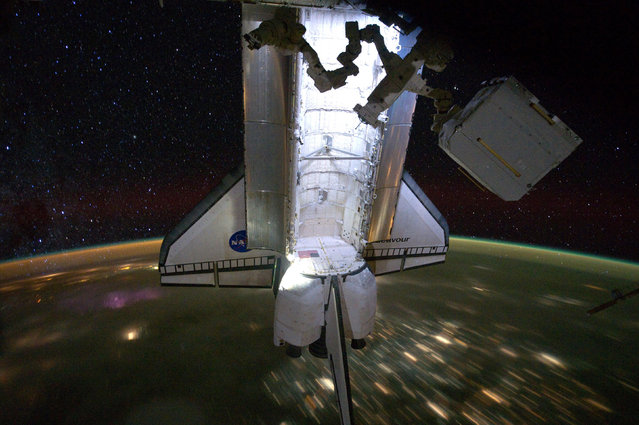
Backdropped by a night time view of the Earth and the starry sky, the Space Shuttle Endeavour is seen docked to the International Space Station on May 28, 2011. (Photo by Reuters/NASA)

Backdropped by a night time view of the Earth and the starry sky, the Space Shuttle Endeavour is seen docked to the International Space Station on May 28, 2011. (Photo by Reuters/NASA)
Details
21 Sep 2014 10:50:00
Russian cosmonaut Alexander Skvortsov, Expedition 40 flight engineer, attired in a Russian Orlan spacesuit, participates in a session of extravehicular activity (EVA) in support of science and maintenance on the International Space Station on August 18, 2014. During the five-hour, 11-minute spacewalk, Skvortsov and cosmonaut Oleg Artemyev (out of frame) deployed a small science satellite, retrieved and installed experiment packages and inspected components on the exterior of the orbital laboratory. (Photo by NASA)

Russian cosmonaut Alexander Skvortsov, Expedition 40 flight engineer, attired in a Russian Orlan spacesuit, participates in a session of extravehicular activity (EVA) in support of science and maintenance on the International Space Station on August 18, 2014. During the five-hour, 11-minute spacewalk, Skvortsov and cosmonaut Oleg Artemyev (out of frame) deployed a small science satellite, retrieved and installed experiment packages and inspected components on the exterior of the orbital laboratory. (Photo by NASA)
Details
13 Apr 2022 06:53:00
Launch Pad and Gantry with Hermes A-1 Rocket – V2 Launch Complex 33, White Sands missile range, New Mexico in 2006. (Photo by Roland Miller)

Roland Miller is on a mission to document the deserted sites of America’s space race. He has photographed launch pads, bunkhouses and research facilities across the country, some of which no longer exist or are closed to the public on secure military bases. His book, “Abandoned in Place”, is published by the University of New Mexico Press in March. Here: Launch Pad and Gantry with Hermes A-1 Rocket – V2 Launch Complex 33, White Sands missile range, New Mexico in 2006. (Photo by Roland Miller)
Details
25 Feb 2016 11:38:00