Loading...
Done
Fabrice Monteiro travelled to the most polluted places in Africa and created terrifying characters who roamed their midst dressed in eerie debris. They are spirits, he says, on a mission to make humans change their ways. Informed by Africa’s environmental problems, Fabrice Monteiro’s photographs aim to highlight urgent ecological issues all over the world. His series “The Prophecy” is on show at Photo Basel 2017 until 18 June. (Photo by Fabrice Monteiro/Photo Basel 2017/Mariane Ibrahim Gallery/The Guardian)

Fabrice Monteiro travelled to the most polluted places in Africa and created terrifying characters who roamed their midst dressed in eerie debris. They are spirits, he says, on a mission to make humans change their ways. Informed by Africa’s environmental problems, Fabrice Monteiro’s photographs aim to highlight urgent ecological issues all over the world. His series “The Prophecy” is on show at Photo Basel 2017 until 18 June. (Photo by Fabrice Monteiro/Photo Basel 2017/Mariane Ibrahim Gallery/The Guardian)
Details
17 Jun 2017 08:38:00


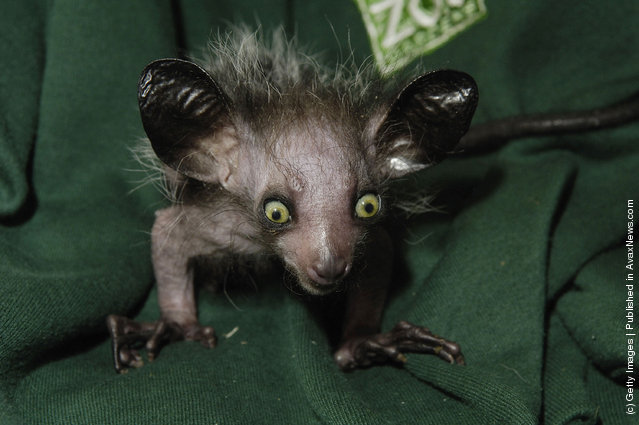
“The aye-aye (Daubentonia madagascariensis) is a lemur, a strepsirrhine primate native to Madagascar that combines rodent-like teeth and a special thin middle finger to fill the same ecological niche as a woodpecker. It is the world's largest nocturnal primate, and is characterized by its unusual method of finding food; it taps on trees to find grubs, then gnaws holes in the wood and inserts its narrow middle finger to pull the grubs out. The only other animal species known to find food in this way is the striped possum. From an ecological point of view the aye-aye fills the niche of a woodpecker as it is capable of penetrating wood to extract the invertebrates within”. – Wikipedia

Photo: In this handout image from Bristol Zoo is seen the first captive bred aye-aye in the UK named “Kintana” (meaning star in Malagasy) April 15, 2005 at Bristol Zoo Gardens, England. The zoo announced today only the second baby aye-aye to be hand-reared in the world (the first was in Jersey Zoo) and has now made his first public appearance since his birth on 11 February 2005. (Photo by Rob Cousins/Bristol Zoo via Getty Images)
Details
13 Apr 2011 13:33:00
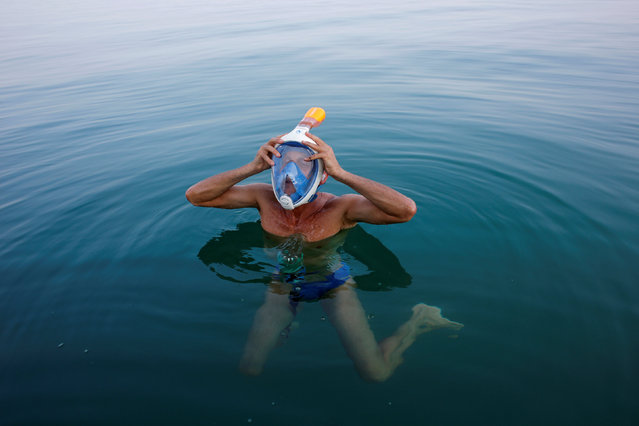
An environmental activist adjusts his mask while taking part in “The Dead Sea Swim Challenge”, swimming from the Jordanian to Israeli shore, to draw attention to the ecological threats facing the Dead Sea, in Kibbutz Ein Gedi, Israel November 15, 2016. (Photo by Nir Elias/Reuters)

An environmental activist adjusts his mask while taking part in “The Dead Sea Swim Challenge”, swimming from the Jordanian to Israeli shore, to draw attention to the ecological threats facing the Dead Sea, in Kibbutz Ein Gedi, Israel November 15, 2016. Swimmers from around the world plunged into the salty waters of the Dead Sea on Tuesday to attempt a seven-hour swim across the fabled lake in a bid to draw attention to its environmental degradation. Wearing protective masks and snorkels, 25 swimmers paddled through the muddy water to attempt the 9-mile (15-kilometer) swim from Jordan to Israel. (Photo by Nir Elias/Reuters)
Details
16 Nov 2016 10:59:00
The Wuppertal Suspension Railway in Wuppertal, Germany

The Wuppertal Suspension Railways is one a kind elevated railway located in Wuppertak, Germany. It is the oldest elevated railway in the world, though it doesn’t look like it. It is kept in great condition by the government and provides for a great attraction for the tourists. It provides a great overview, as it runs above a number of city streets and a small river. Moreover, since it is powered by electricity, it proves an ecologically clean method of travel for the residents of the city.
Details
03 Apr 2015 11:38:00
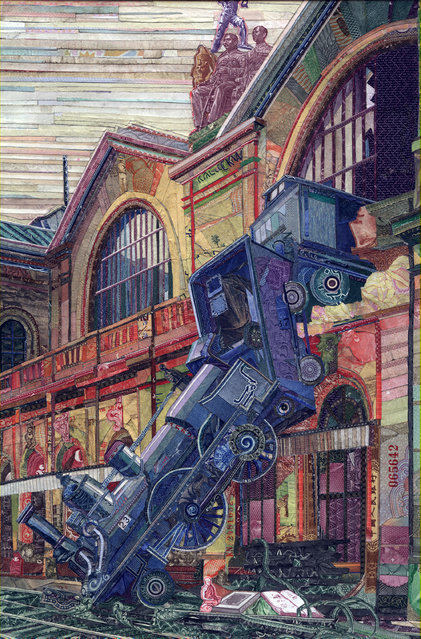
“Great Crash”. (Photo by C. K. Wilde)

Artist C. K. Wilde creates intricate collage compositions using pieces of paper currency from all over the world. His collages have referenced subjects ranging from space exploration, to mythology, religion, slavery, ecology, the history of warfare, the history of money, and art history. Photo: “Great Crash”. (Photo by C. K. Wilde)
Details
11 Jul 2014 12:06:00
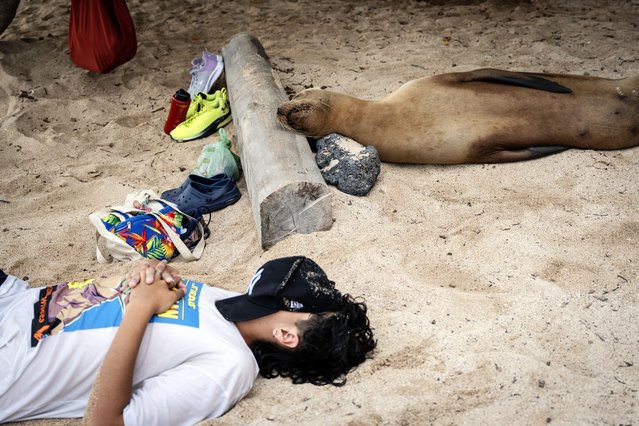
Sea lion is seen among people on a beach in San Cristobal island, part of Galapagos archipelago on February 11, 2025. Located in Ecuadorone of South America's most fascinating countriesthe Galapagos National Park spans 13 main islands and numerous islets, captivating biologists, environmental scientists, and tourists with its rich ecology. (Photo by Ozge Elif Kizil/Anadolu via Getty Images)

Sea lion is seen among people on a beach in San Cristobal island, part of Galapagos archipelago on February 11, 2025. Located in Ecuadorone of South America's most fascinating countriesthe Galapagos National Park spans 13 main islands and numerous islets, captivating biologists, environmental scientists, and tourists with its rich ecology. (Photo by Ozge Elif Kizil/Anadolu via Getty Images)
Details
13 Apr 2025 03:15:00
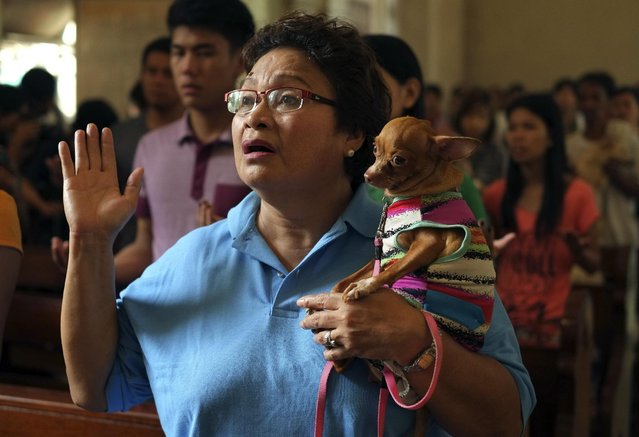
A Filipino pet owner carries her dog as she prays before the animal blessing rites at the Our Lady of Remedies Parish Church in Malate district, Manila, Philippines on Sunday, October 5, 2014. (Photo by Aaron Favila/AP Photo)

A Filipino pet owner carries her dog as she prays before the animal blessing rites at the Our Lady of Remedies Parish Church in Malate district, Manila, Philippines on Sunday, October 5, 2014. Several Filipinos brought their pets to be blessed during the annual event which is also done to celebrate the feast day of St. Francis of Assisi, the patron saint of animals and ecology. (Photo by Aaron Favila/AP Photo)
Details
05 Oct 2014 11:32:00
Elio Angulo (bottom C) lies inside a cardboard coffin next to Alejandro Blanchard as they introduce their product to potential customers at a mortuary in Valencia, in the state of Carabobo, Venezuela August 25, 2016. (Photo by Marco Bello/Reuters)

Elio Angulo (bottom C) lies inside a cardboard coffin next to Alejandro Blanchard as they introduce their product to potential customers at a mortuary in Valencia, in the state of Carabobo, Venezuela August 25, 2016. When Venezuelan entrepreneurs Alejandro Blanchard and Elio Angulo decided to create cardboard coffins, they were looking for an ecological selling point to compete against classic wood and brass caskets. Three years on, with the oil-rich country mired in deep economic crisis, their “bio-coffins” are becoming a viable option because of high prices for wooden coffins and shortages of brass ones. (Photo by Marco Bello/Reuters)
Details
27 Aug 2016 11:18:00