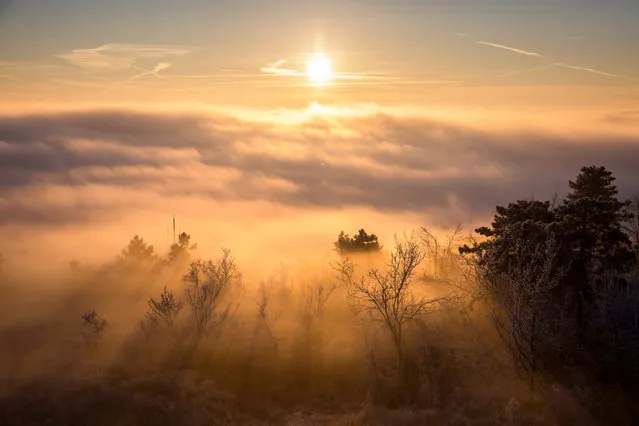
Rays from the rising sun shine through the foliage of trees as fog covers the ground near the Guckler Karoly Observatory in Budapest, Hungary, 02 January 2017. (Photo by Balazs Mohai/EPA)
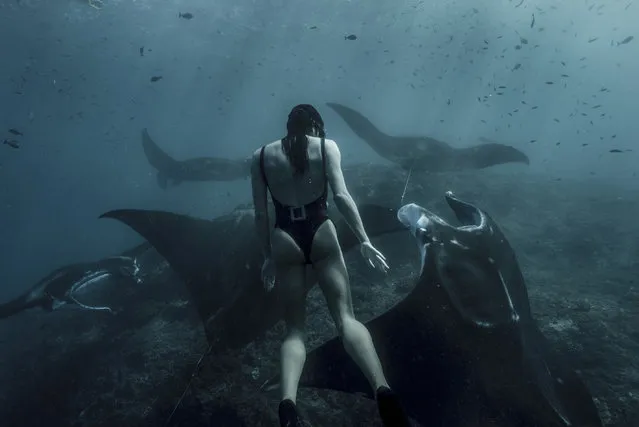
Julia Wheeler, 31, from Perth, Western Australia, has been a hands reach away from pilot whales, Bull sharks, manta rays and more during her time diving without any breathing equipment. Here real life mermaid Julia is diving with manta rays in Bali and looks incredible swimming among them while holding her breath for four and a half minute. (Photo by Julia Wheeler/Caters News Agency)
Jasmine Paolini hits a forehand during her first-round US Open match on Sunday, August 24, 2025 at USTA Billie Jean King National Tennis Center in the Flushing neighborhood of the Queens borough of New York City. (Photo by Ray Giubilo)
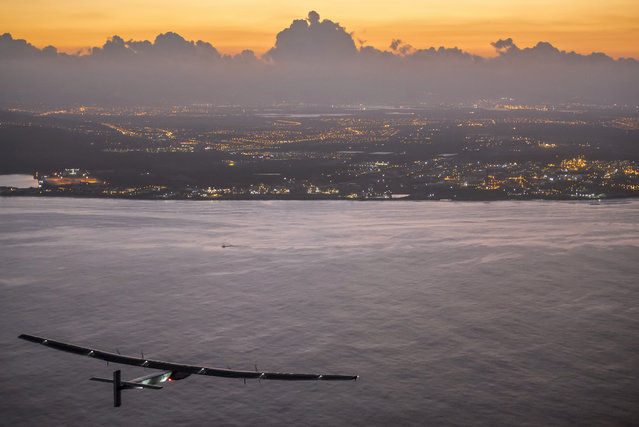
In this photo provided by Jean Revillard, Solar Impulse 2, a plane powered by the sun's rays and piloted by Andre Borschberg, approaches Kalaeloa Airport near Honolulu, Friday, July 3, 2015. His 120-hour voyage from Nagoya, Japan broke the record for the world's longest nonstop solo flight, his team said. (Photo by Jean Revillard/Global Newsroom via AP Photo)
Toby, an 11-year-old German shepherd-husky mix, can hold almost anything on his head that his owner, Pat Langner, can think up, including balls, Christmas trees, and even the ingredients for a peanut butter and jelly sandwich. He also shows remarkable self-restraint by not immediately gobbling down the food that his owner gives him to balance. Here: Toby balances halloween decorations on his head. (Photo by Pat Langer/Caters News Agency)
An Ethnic Kayan also know as a Long Neck girl sits at her parents souvenir shop in the Kayan village at the northern province of Chiang Rai, Thailand, July 16, 2018. (Photo by Soe Zeya Tun/Reuters)
Balinese traditional dancers take selfie as they await the arrival of G20 leaders at Ngurah Rai International airport at Tuban, Badung regency on Indonesia resort island of Bali, on November 13, 2022. (Photo by Sonny Tumbelaka/AFP Photo)
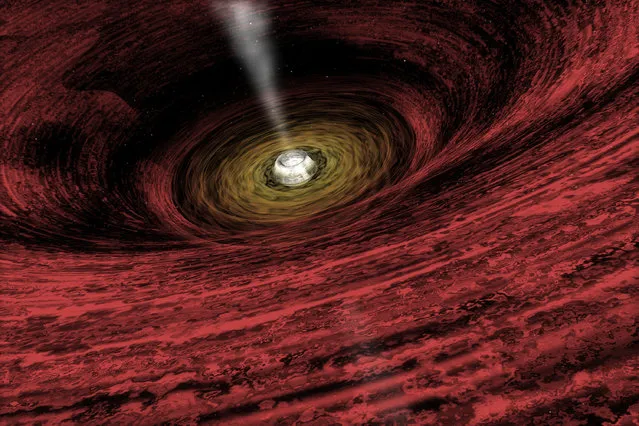
An artist's impression of a growing supermassive black hole located in the early Universe is seen in this NASA handout illustration released on June 15, 2011. Using the deepest X-ray image ever taken, astronomers found the first direct evidence that massive black holes were common in the early universe. This discovery from NASA's Chandra X-Ray Observatory shows that very young black holes grew more aggressively than previously thought, in tandem with the growth of their host galaxies. (Photo by Reuters/NASA/Chandra X-Ray Observatory/A.Hobart)