Loading...
Done
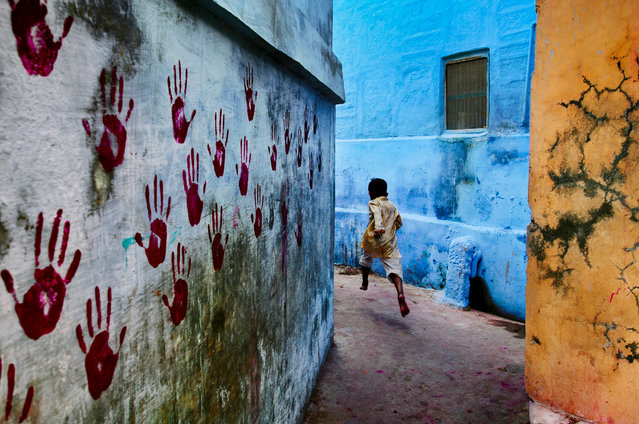
"Steve McCurry: India", co-organized by the Rubin Museum and the International Center of Photography, brings together photographs of India-its people, monuments, landscapes, seasons, and cities. The exhibition at the Rubin Museum in New York runs from November 18, 2015- April 4, 2016. Here: A boy in mid-flight in Jodhpur, Rajasthan, India, in 2007. (Photo by Steve McCurry)

"Steve McCurry: India", co-organized by the Rubin Museum and the International Center of Photography, brings together photographs of India-its people, monuments, landscapes, seasons, and cities. The exhibition at the Rubin Museum in New York runs from November 18, 2015 – April 4, 2016. Here: A boy in mid-flight in Jodhpur, Rajasthan, India, in 2007. (Photo by Steve McCurry)
Details
30 Nov 2015 08:06:00
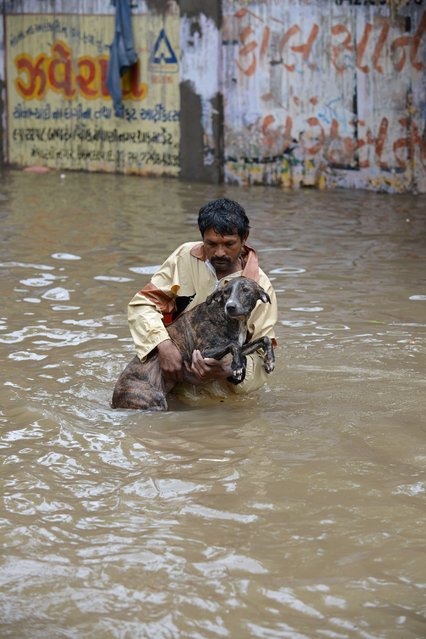
An Indian resident assists a dog as he wades through floodwaters in Ahmedabad on July 30, 2014. Rains lashed Ahmedabad and many regions of India's western Gujarat state, wth the Indian Metrological Department warning of heavy rains for the next 48 hours. (Photo by Sam Panthaky/AFP Photo)

An Indian resident assists a dog as he wades through floodwaters in Ahmedabad on July 30, 2014. Rains lashed Ahmedabad and many regions of India's western Gujarat state, wth the Indian Metrological Department warning of heavy rains for the next 48 hours. (Photo by Sam Panthaky/AFP Photo)
Details
31 Jul 2014 09:58:00
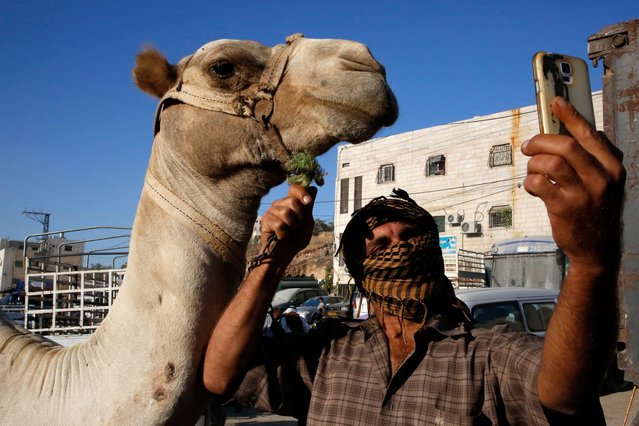
A Palestinian man takes a selfie picture next to a camel at a livestock market in the West Bank city of Hebron on August 9, 2019, as muslims prepare for the Eid al-Adha celebrations. Known as the “big” festival, Eid Al-Adha is celebrated each year by Muslims sacrificing various animals according to religious traditions, including cows, camels, goats and sheep. (Photo by Hazem Bader/AFP Photo)

A Palestinian man takes a selfie picture next to a camel at a livestock market in the West Bank city of Hebron on August 9, 2019, as muslims prepare for the Eid al-Adha celebrations. Known as the “big” festival, Eid Al-Adha is celebrated each year by Muslims sacrificing various animals according to religious traditions, including cows, camels, goats and sheep. (Photo by Hazem Bader/AFP Photo)
Details
11 Aug 2019 00:07:00
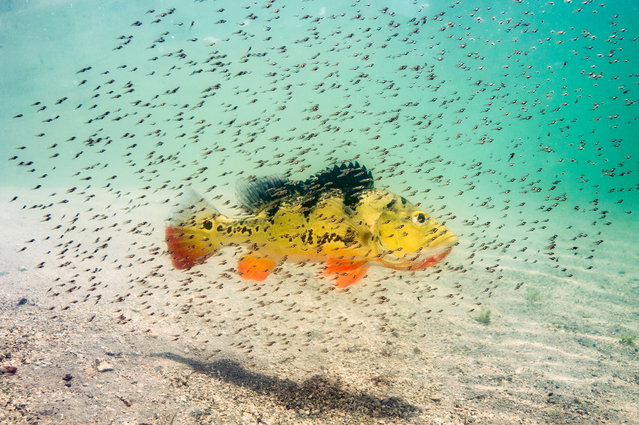
Michael O’Neill won a prize in animal portraits with fry of a peacock bass hovering around their mother for protection against predators in South Florida. (Photo by Michael Patrick O'Neill/2016 National Geographic Nature Photographer of the Year)

Michael O’Neill won a prize in animal portraits with fry of a peacock bass hovering around their mother for protection against predators in South Florida. (Photo by Michael Patrick O'Neill/2016 National Geographic Nature Photographer of the Year)
Details
10 Dec 2016 08:57:00
Mamoni Mandal, member of the Rapid Action Force (RAF), attends a training session at a police training school in Kolkata April 15, 2007. (Photo by Parth Sanyal/Reuters)

Mamoni Mandal, member of the Rapid Action Force (RAF), attends a training session at a police training school in Kolkata April 15, 2007. (Photo by Parth Sanyal/Reuters)
Details
08 Mar 2016 13:06:00
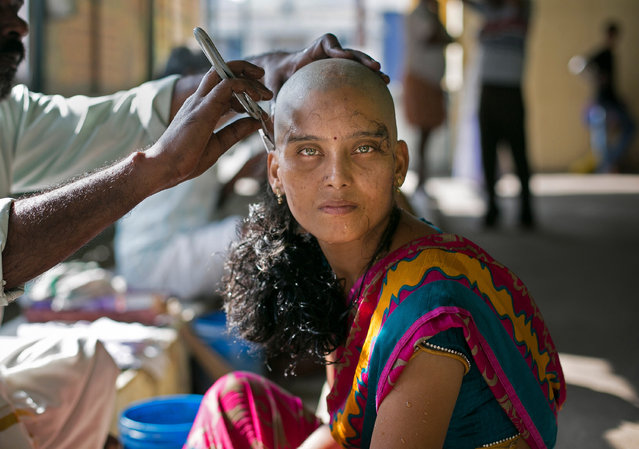
28 year old Rupa has her hair shaven to donate to the Gods at the Thiruthani Murugan Temple November 10, 2016 in Thiruttani, India. Rupa donated her hair with the wish that her daughter's illness is cured. The process of shaving ones hair and donating it to the Gods is known as tonsuring. It is common for Hindu believers to tonsure their hair at a temple as a young child, and also to celebrate a wish coming true, such as the birth of a baby or the curing of an illness. The “temple hair”, as it's known, is then auctioned off to a processing plant and then sold as pricey wigs and weaves in the US, Europe and Africa. (Photo by Allison Joyce/Getty Images)

28 year old Rupa has her hair shaven to donate to the Gods at the Thiruthani Murugan Temple November 10, 2016 in Thiruttani, India. Rupa donated her hair with the wish that her daughter's illness is cured. The process of shaving ones hair and donating it to the Gods is known as tonsuring. It is common for Hindu believers to tonsure their hair at a temple as a young child, and also to celebrate a wish coming true, such as the birth of a baby or the curing of an illness. The “temple hair”, as it's known, is then auctioned off to a processing plant and then sold as pricey wigs and weaves in the US, Europe and Africa. (Photo by Allison Joyce/Getty Images)
Details
21 Nov 2016 10:30:00
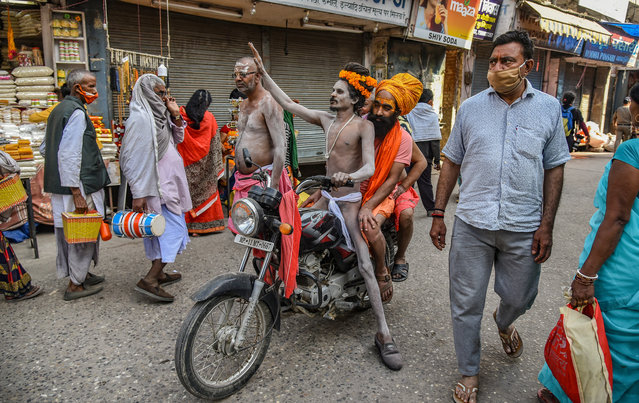
Indian holy men, or Naga Sadhu, ride a motorbike on their way to take a holy dip in the Ganges River during the Kumbh Mela at Haridwar, Uttarakhand, India, 14 April 2021. Thousands of pilgrims gather for the mass Hindu pilgrimage which occurs every twelve years and rotates among four locations. (Photo by Idrees Mohammed/EPA/EFE)

Indian holy men, or Naga Sadhu, ride a motorbike on their way to take a holy dip in the Ganges River during the Kumbh Mela at Haridwar, Uttarakhand, India, 14 April 2021. Thousands of pilgrims gather for the mass Hindu pilgrimage which occurs every twelve years and rotates among four locations. (Photo by Idrees Mohammed/EPA/EFE)
Details
16 Apr 2021 09:41:00
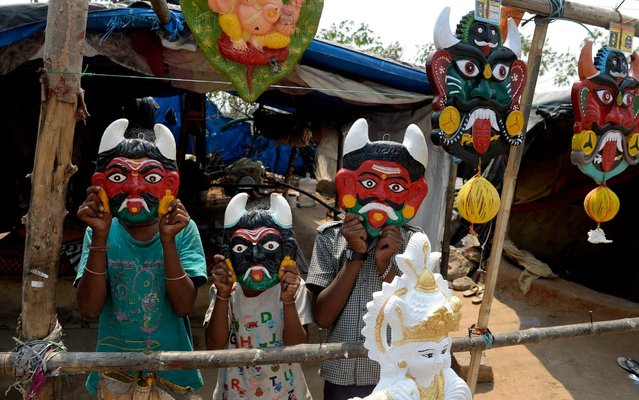
Children of a vendor pose with demon-masks to be hung outside homes believed to ward off negative energy during a government-imposed nationwide lockdown as a preventive measure against the COVID-19 coronavirus, at a roadside stall in Hyderabad, on April 18, 2020. (Photo by Noah Seelam/AFP Photo)

Children of a vendor pose with demon-masks to be hung outside homes believed to ward off negative energy during a government-imposed nationwide lockdown as a preventive measure against the COVID-19 coronavirus, at a roadside stall in Hyderabad, on April 18, 2020. (Photo by Noah Seelam/AFP Photo)
Details
24 Apr 2020 00:03:00