Loading...
Done
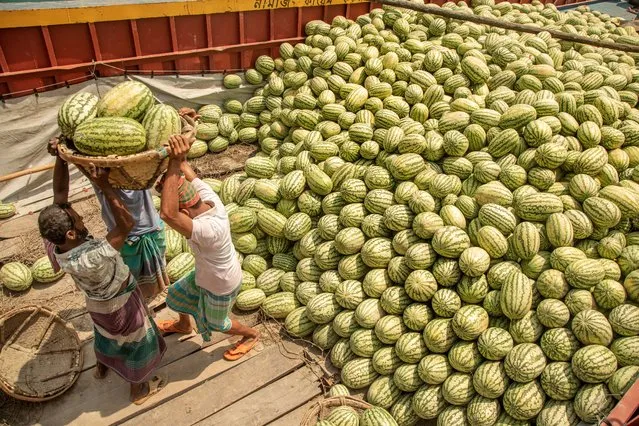
Bangladeshi laborers unload watermelons from a boat at the Buriganga River in Dhaka, Bangladesh, 03 April 2024. Watermelon is in harvesting season and is filling the city markets as it arrives from the southern part of Bangladesh. According to the Department of Agriculture Extension (DAE), Barishal has set an ambitious goal to expand watermelon cultivation to 54,002 hectares across six high-yielding districts in the division, which is 14 percent higher than last year. (Photo by Monirul Alam/EPA/EFE)

Bangladeshi laborers unload watermelons from a boat at the Buriganga River in Dhaka, Bangladesh, 03 April 2024. Watermelon is in harvesting season and is filling the city markets as it arrives from the southern part of Bangladesh. According to the Department of Agriculture Extension (DAE), Barishal has set an ambitious goal to expand watermelon cultivation to 54,002 hectares across six high-yielding districts in the division, which is 14 percent higher than last year. (Photo by Monirul Alam/EPA/EFE)
Details
19 Apr 2024 00:22:00
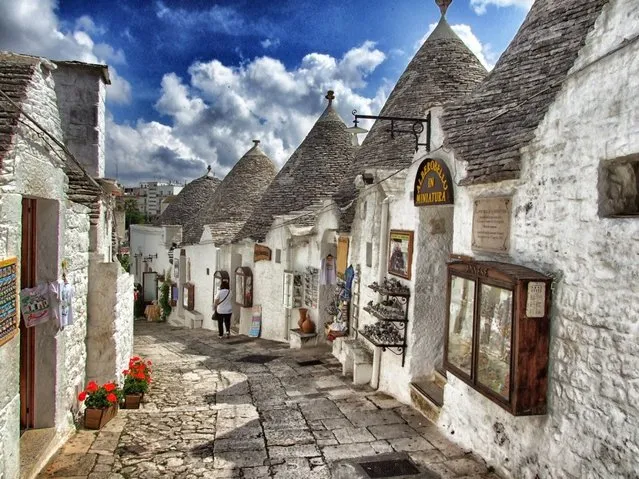
Ttrulli Alberobello, Italy‎

The stone huts and streets of this Italian city look like a scene from a fairytale. The buildings you see before you are called trulli. The rise in popularity of such houses was in 19th century when they were constructed as storehouses and temporary field shelters or as permanent shelters by agricultural laborers and small proprietors. Wouldn’t it be amazing to own such a house? To become engulfed by the fairytale as you sip a cup of coffee, looking out of a small window onto a crowded street.
Details
20 Nov 2014 12:36:00
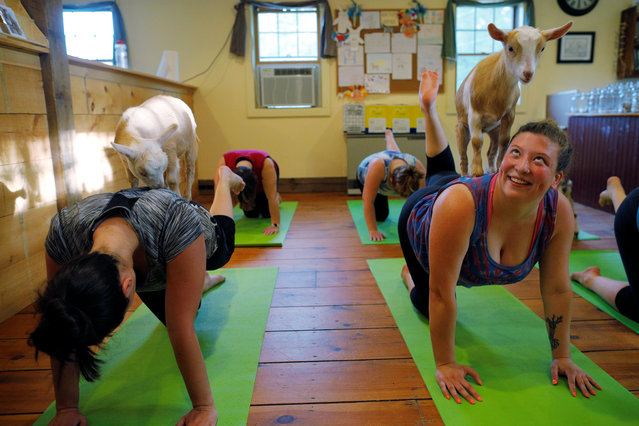
Goats climb on students during a yoga class with eight students and five goats at Jenness Farm in Nottingham, New Hampshire, U.S. on May 18, 2017. Tucked away in a wooded corner of southern New Hampshire, Jenness Farm is the latest small U.S. agricultural operation to cash in on the social media-driven trend, in which yoga enthusiasts practice moves like the cat pose and bridge pose while goats climb around and sometimes on them. (Photo by Brian Snyder/Reuters)

Goats climb on students during a yoga class with eight students and five goats at Jenness Farm in Nottingham, New Hampshire, U.S. on May 18, 2017. Tucked away in a wooded corner of southern New Hampshire, Jenness Farm is the latest small U.S. agricultural operation to cash in on the social media-driven trend, in which yoga enthusiasts practice moves like the cat pose and bridge pose while goats climb around and sometimes on them. (Photo by Brian Snyder/Reuters)
Details
20 May 2017 09:31:00
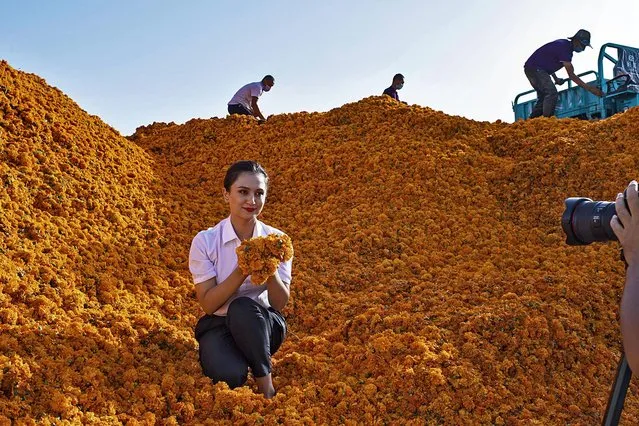
A staff member of Yutian County poses for a video on marigold industry at an agricultural industrial park in Yutian County, northwest China's Xinjiang Uygur Autonomous Region, September 20, 2020. As one of the five counties in Hotan Prefecture that have not been lifted out of poverty, Yutian County is accelerating its steps to shake off poverty by planting marigold. (Photo by Chine Nouvelle/SIPA Press/Rex Features/Shutterstock)

A staff member of Yutian County poses for a video on marigold industry at an agricultural industrial park in Yutian County, northwest China's Xinjiang Uygur Autonomous Region, September 20, 2020. As one of the five counties in Hotan Prefecture that have not been lifted out of poverty, Yutian County is accelerating its steps to shake off poverty by planting marigold. (Photo by Chine Nouvelle/SIPA Press/Rex Features/Shutterstock)
Details
01 Oct 2020 00:05:00
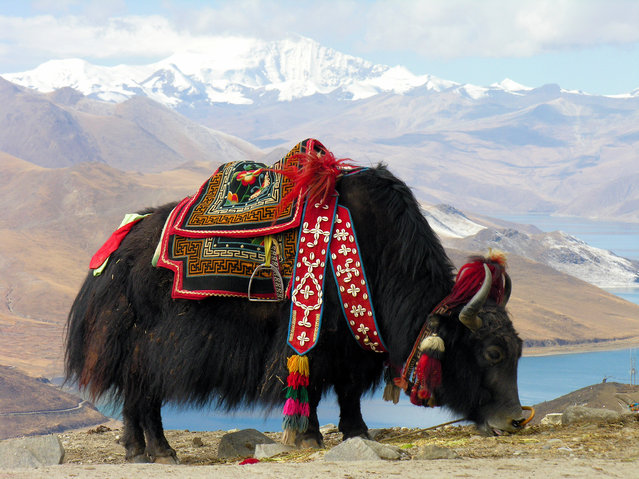
Yak near Yamdrok lake, Tibet. It is a long-haired bovinae found throughout the Himalayan region of south Central Asia, the Tibetan Plateau and as far north as Mongolia and Russia. The Tibetan economy is dominated by subsistence agriculture. Due to limited arable land, the primary occupation of the Tibetan Plateau is raising livestock, such as sheep, cattle, goats, camels, yaks, dzo, and horses. The Tibetan yak is an integral part of Tibetan life. (Photo by Dennis Jarvis)

Yak near Yamdrok lake, Tibet. It is a long-haired bovinae found throughout the Himalayan region of south Central Asia, the Tibetan Plateau and as far north as Mongolia and Russia. The Tibetan economy is dominated by subsistence agriculture. Due to limited arable land, the primary occupation of the Tibetan Plateau is raising livestock, such as sheep, cattle, goats, camels, yaks, dzo, and horses. The Tibetan yak is an integral part of Tibetan life. (Photo by Dennis Jarvis)
Details
10 Jun 2015 10:48:00
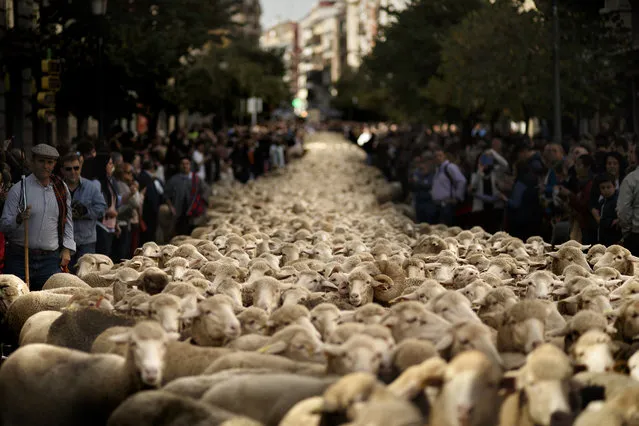
Shepherds lead their sheep through the centre of Madrid, Spain, Sunday, October 25, 2015. Shepherds have guided a flock of 2,000 sheep through Madrid streets in defense of ancient grazing, droving and migration rights increasingly threatened by urban sprawl and modern agricultural practices. Photo by Daniel Ochoa de Olza/AP Photo)

Shepherds lead their sheep through the centre of Madrid, Spain, Sunday, October 25, 2015. Shepherds have guided a flock of 2,000 sheep through Madrid streets in defense of ancient grazing, droving and migration rights increasingly threatened by urban sprawl and modern agricultural practices. Tourists and city-dwellers were surprised to see the capital's traffic cut to permit the ovine parade to bleat bells clanking its way past the city's most emblematic locations. (Photo by Daniel Ochoa de Olza/AP Photo)
Details
28 Oct 2015 08:02:00
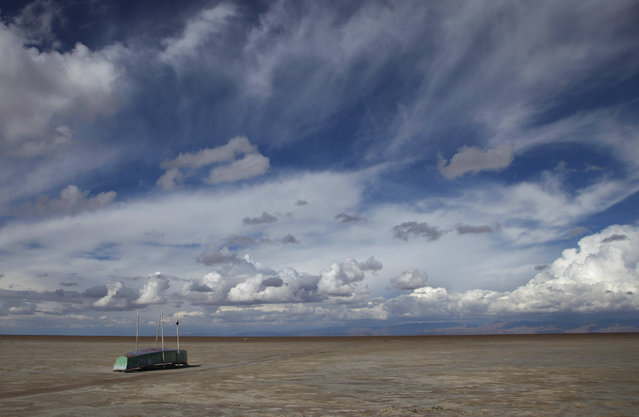
In this January 12, 2016 photo, an abandoned boat lies on the dried up lake bed of Lake Poopo, on the outskirts of Untavi, Bolivia. Drought caused by the recurrent El Nino meteorological phenomenon is considered the main driver of the lake's demise. Along with glacial melting, authorities say another factor is the diversion of water from Poopo's tributaries, mostly for mining but also for agriculture. (Photo by Juan Karita/AP Photo)

In this January 12, 2016 photo, an abandoned boat lies on the dried up lake bed of Lake Poopo, on the outskirts of Untavi, Bolivia. Drought caused by the recurrent El Nino meteorological phenomenon is considered the main driver of the lake's demise. Along with glacial melting, authorities say another factor is the diversion of water from Poopo's tributaries, mostly for mining but also for agriculture. (Photo by Juan Karita/AP Photo)
Details
21 Jan 2016 12:33:00
A picture made available on 13 May 2016 shows A Tiwa girl performing her traditional dance as they celebrated the Wanchuwa festival in Karbi Anglong District of Assam state, India, 11 May 2016. Wanchuwa is one of the most important festivals of the Tiwa tribal community living in the hills as it is related with agriculture which is the mainstay of their economy. Tiwas pray for a bountiful harvest during this festival and to protect their crops from pest and other natural calamities. (Photo by EPA/Stringer)

A picture made available on 13 May 2016 shows A Tiwa girl performing her traditional dance as they celebrated the Wanchuwa festival in Karbi Anglong District of Assam state, India, 11 May 2016. Wanchuwa is one of the most important festivals of the Tiwa tribal community living in the hills as it is related with agriculture which is the mainstay of their economy. Tiwas pray for a bountiful harvest during this festival and to protect their crops from pest and other natural calamities. Tiwa is a major tribe of Assam state who practice Jhum or shifting cultivation for their living in the hills. (Photo by EPA/Stringer)
Details
14 May 2016 11:45:00