Loading...
Done
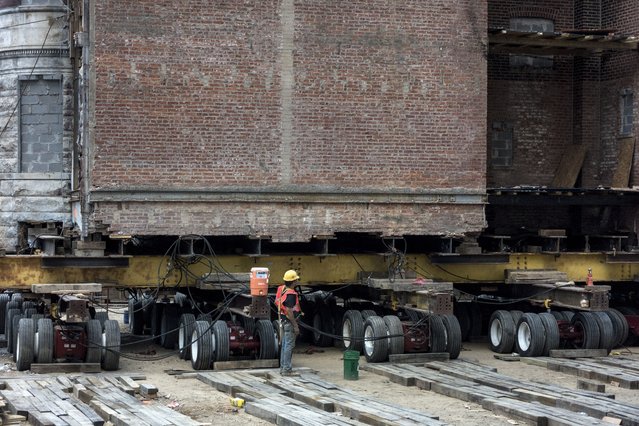
A worker stands by a historic building as it is moved down the block on wheels on New York Avenue to make way for a new construction July 28, 2014 in Washington, DC. (Photo by Brendan Smialowski/AFP Photo)

A worker stands by a historic building as it is moved down the block on wheels on New York Avenue to make way for a new construction July 28, 2014 in Washington, DC. A team from Expert House Movers have been moving the historic building near 4th Street which is one of the largest structures in the DC area to be moved. (Photo by Brendan Smialowski/AFP Photo)
Details
31 Jul 2014 09:48:00
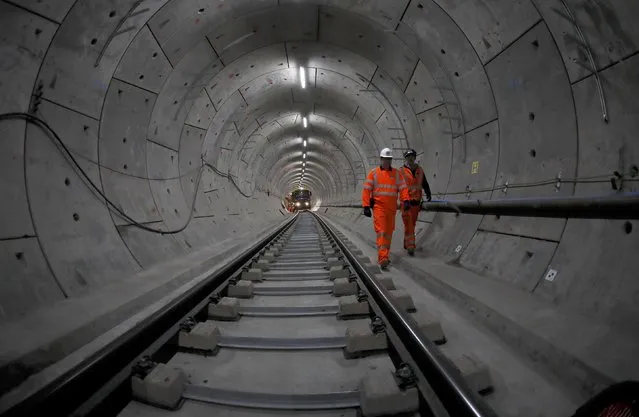
Workers lay railway track in a tunnel of the Crossrail project in Stepney, east London, Britain, November 16, 2016. (Photo by Stefan Wermuth/Reuters)

Workers lay railway track in a tunnel of the Crossrail project in Stepney, east London, Britain, November 16, 2016. Crossrail, which is Europe's largest construction project, is a railway link which will connect outlying areas to the east and west of London with tunnels under the centre of the capital. (Photo by Stefan Wermuth/Reuters)
Details
17 Nov 2016 11:14:00
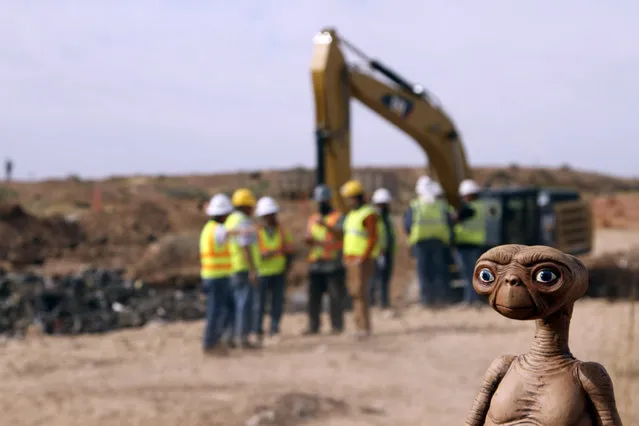
An E.T. doll is seen while construction workers prepare to dig into a landfill in Alamogordo, N.M., Saturday, April 26, 2014. Producers of a documentary are digging in the landfill in search of millions of cartridges of the Atari “E.T. The Extra-Terrestrial” game that has been called the worst game in the history of videogaming. A New York Times article from 1983 reported that Atari cartridges of “E.T. The Extraterrestrial” were dumped in the landfill in Alamogordo. (Photo by Juan Carlos Llorca/AP Photo)

An E.T. doll is seen while construction workers prepare to dig into a landfill in Alamogordo, N.M., Saturday, April 26, 2014. Producers of a documentary are digging in the landfill in search of millions of cartridges of the Atari “E.T. The Extra-Terrestrial” game that has been called the worst game in the history of videogaming. A New York Times article from 1983 reported that Atari cartridges of “E.T. The Extraterrestrial” were dumped in the landfill in Alamogordo. (Photo by Juan Carlos Llorca/AP Photo)
Details
28 Apr 2014 12:45:00


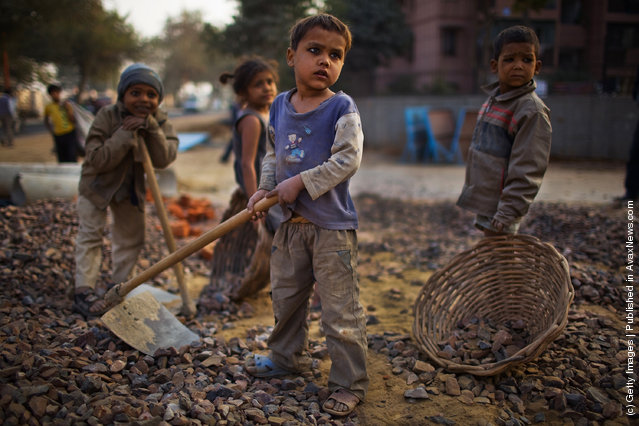
Indian children work nearby to their parents at a construction project in front of the Jawaharlal Nehru Stadium on January 30, 2010 in New Delhi, India. The children accompany their parents to the work site, where if they are prepared to work, they will receive money for bread an milk and be provided with dinner by the contractor. The sheer scale of the project has drawn an enormous population of migrant workers from all over India.
Details
20 May 2011 07:00:00
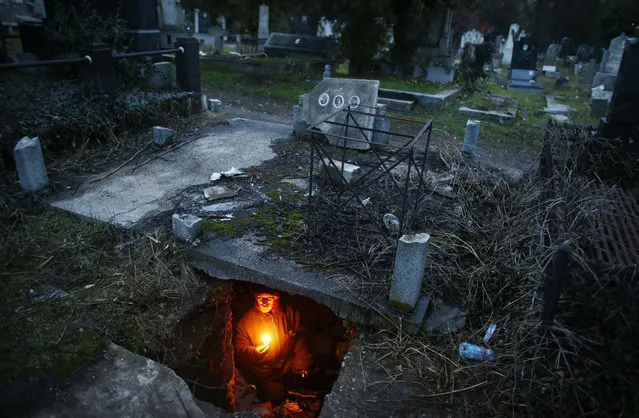
Bratislav Stojanovic : Guys Lives In Cemetery In Serbia

Bratislav Stojanovic, a homeless man, holds candles as sits in a tomb where he lives in southern Serbian town of Nis . Stojanovic, 43, a Nis-born construction worker never had a regular job. He first lived in abandoned houses, but about 15 years ago he settled in the old city cemetery.
Details
24 Feb 2013 20:37:00
Comedy Carpet by British artist Gordon Young

A construction worker sweeps up as the final touches are completed on “Comedy Carpet” by British artist Gordon Young, the latest art installation on Blackpool's promenade on October 7, 2011 in Blackpool, England. (Photo by Christopher Furlong/Getty Images)
Details
10 Oct 2011 08:02:00
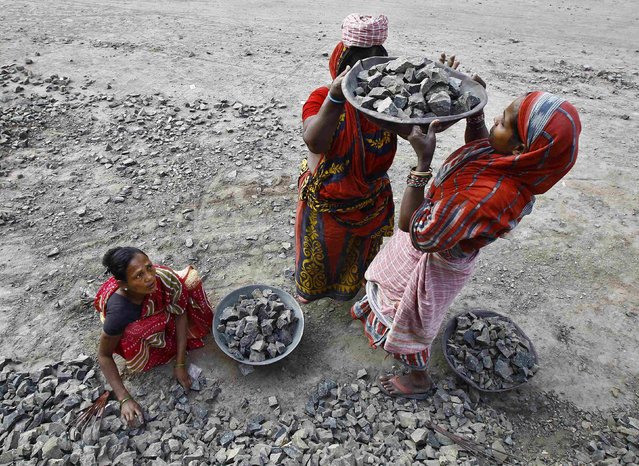
Women labourers work at the construction site of a road in Kolkata January 8, 2015. Across towns and cities in India, it is not uncommon to see women cleaning building sites, carrying bricks and or shoveling gravel - helping construct the infrastructure necessary for the country's economic and social development. (Photo by Rupak De Chowdhuri/Reuters)

Women labourers work at the construction site of a road in Kolkata January 8, 2015. Across towns and cities in India, it is not uncommon to see women cleaning building sites, carrying bricks and or shoveling gravel – helping construct the infrastructure necessary for the country's economic and social development. They help build roads, railway tracks, airports, and offices. They lay pipes for clean water supplies, cables for telecommunications, and dig the drains for sewage systems. But although women make up at least 20 percent of India's 40 million construction workers, they are less recognized than male workers with lower pay and often prone to safety hazards and sexual harassment. They are often unaware of their rights or scared to complain, say activists now trying to campaign for better treatment of women in the construction industry. (Photo by Rupak De Chowdhuri/Reuters)

Details
15 Jan 2015 13:47:00
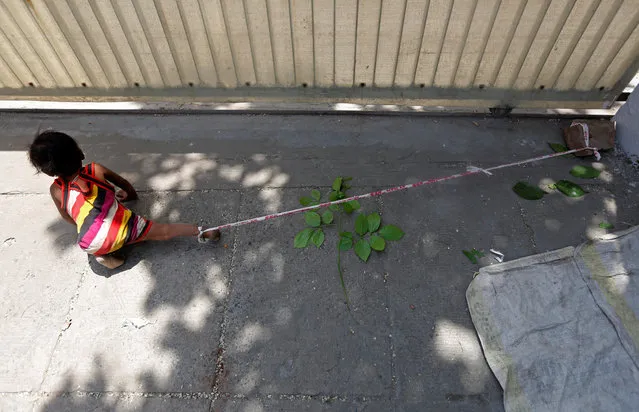
Barrier tape is tied around 15-month-old Shivani's ankle to prevent her from running away, while her mother Sarta Kalara works at a construction site nearby, in Ahmedabad, India, April 19, 2016. Kalara says she has no option but to tether her daughter Shivani to a stone despite her crying, while she and her husband work for 250 rupees ($3.8) each a shift digging holes for electricity cables in the city of Ahmedabad. There are about 40 million construction workers in India, at least one in five of them women, and the majority poor migrants who shift from site to site, building infrastructure for India's booming cities. Across the country it is not uncommon to see young children rolling in the sand and mud as their parents carry bricks or dig for new roads or luxury houses. (Photo by Amit Dave/Reuters)

Barrier tape is tied around 15-month-old Shivani's ankle to prevent her from running away, while her mother Sarta Kalara works at a construction site nearby, in Ahmedabad, India, April 19, 2016. Kalara says she has no option but to tether her daughter Shivani to a stone despite her crying, while she and her husband work for 250 rupees ($3.8) each a shift digging holes for electricity cables in the city of Ahmedabad. There are about 40 million construction workers in India, at least one in five of them women, and the majority poor migrants who shift from site to site, building infrastructure for India's booming cities. Across the country it is not uncommon to see young children rolling in the sand and mud as their parents carry bricks or dig for new roads or luxury houses. (Photo by Amit Dave/Reuters)
Details
14 Dec 2016 07:39:00