Loading...
Done
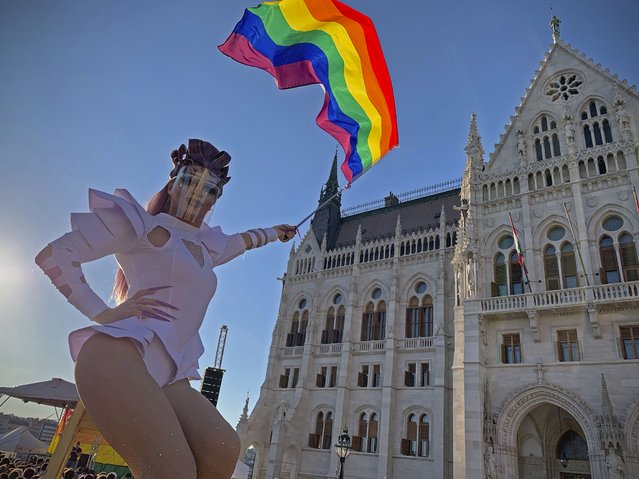
A drag queen waves a rainbow flag during an LGBT rights demonstration in front of the Hungarian Parliament building in Budapest, Hungary on June 14, 2021. During the protest human rights activists called on lawmakers in Hungary to reject legislation banning any content portraying or promoting homosexuality or sеx reassignment to anyone under 18. The bills, aiming at fighting pedophilia, have various amendments which would outlaw any depiction or discussion of different gender identities to youth in the public sphere. (Photo by Bela Szandelszky/AP Photo)

A drag queen waves a rainbow flag during an LGBT rights demonstration in front of the Hungarian Parliament building in Budapest, Hungary on June 14, 2021. During the protest human rights activists called on lawmakers in Hungary to reject legislation banning any content portraying or promoting homosexuality or sеx reassignment to anyone under 18. The bills, aiming at fighting pedophilia, have various amendments which would outlaw any depiction or discussion of different gender identities to youth in the public sphere. (Photo by Bela Szandelszky/AP Photo)
Details
15 Jun 2021 08:42:00
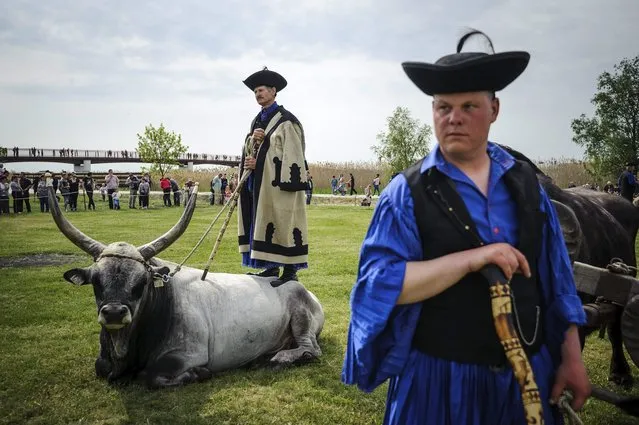
A herdsman stands on the back of a grey bull during a ceremony of driving sheep from their winter habitat to their summer pasture in the puszta or Hungarian steppe of Hortobagy, 183 kms east of Budapest, Hungary, 23 April 2016. Sheep are traditionally driven to their summer pasture at around St. George's Day in the Hortobagy region, because livestock breeding people traditionally consider St. George's Day the beginning of spring. (Photo by Zsolt Czegledi/EPA)

A herdsman stands on the back of a grey bull during a ceremony of driving sheep from their winter habitat to their summer pasture in the puszta or Hungarian steppe of Hortobagy, 183 kms east of Budapest, Hungary, 23 April 2016. Sheep are traditionally driven to their summer pasture at around St. George's Day in the Hortobagy region, because livestock breeding people traditionally consider St. George's Day the beginning of spring. (Photo by Zsolt Czegledi/EPA)
Details
24 Apr 2016 09:27:00
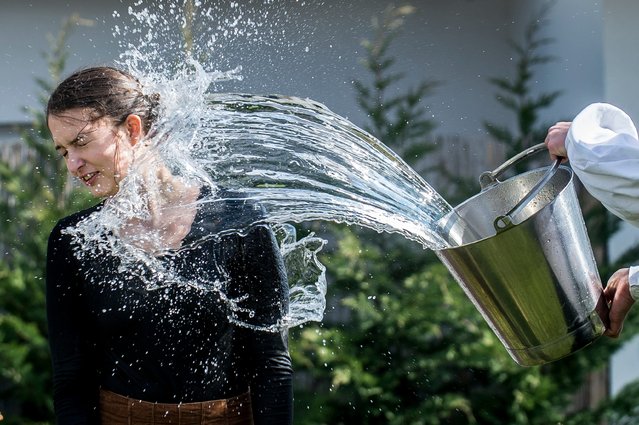
Members of the Mayossa folk dance group pour water on a young woman in Kiskunmajsa, Hungary on April 2, 2018. According to an old Hungarian tradition, celebrated for several hundred years, young men pour water on young women, who in exchange present their sprinklers with beautifully colored eggs on Easter Monday. (Photo by Sandor Ujvari/EPA/EFE/Rex Features/Shutterstock)

Members of the Mayossa folk dance group pour water on a young woman in Kiskunmajsa, Hungary on April 2, 2018. According to an old Hungarian tradition, celebrated for several hundred years, young men pour water on young women, who in exchange present their sprinklers with beautifully colored eggs on Easter Monday. (Photo by Sandor Ujvari/EPA/EFE/Rex Features/Shutterstock)
Details
08 Apr 2018 07:48:00
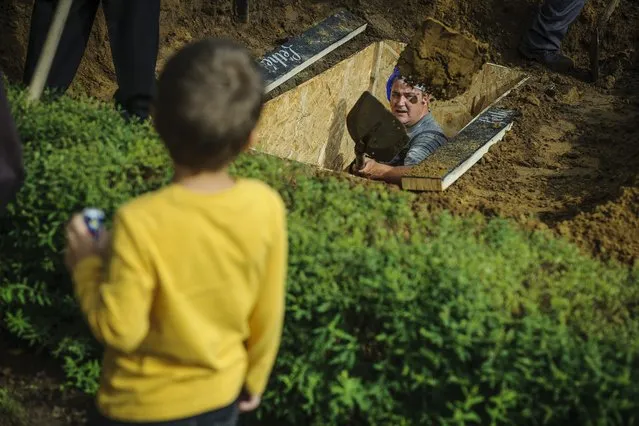
A gravedigger competes as a boy looks on during the first National Grave Digging competition at the public cemetery of Debrecen, 226 km east of Budapest, Hungary, Friday, June 3, 2016. (Photo by Zsolt Czegledi/MTI via AP Photo)

A gravedigger competes as a boy looks on during the first National Grave Digging competition at the public cemetery of Debrecen, 226 km east of Budapest, Hungary, Friday, June 3, 2016. Eighteen two-man teams of Hungarian gravediggers are demonstrating their skills for a place in a regional championship to be held in Slovakia. (Photo by Zsolt Czegledi/MTI via AP Photo)
Details
04 Jun 2016 11:58:00
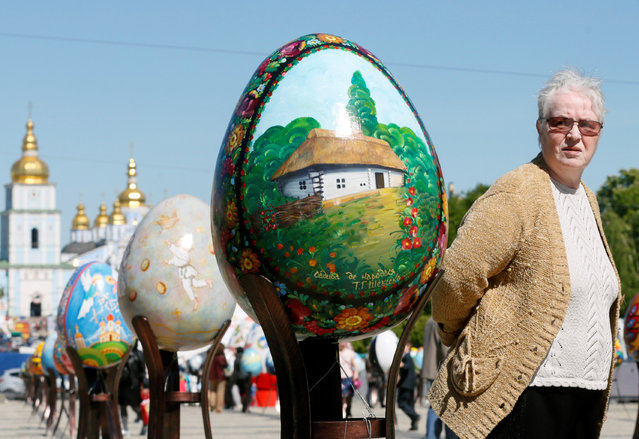
A woman looks at traditional Ukrainian Easter eggs “Pysanka”, installed as part of the upcoming celebrations of Easter, in central Kiev, Ukraine, April 29, 2016. A pysanka is a Ukrainian Easter egg, decorated with traditional Ukrainian folk designs using a wax-resist (batik) method. The word pysanka comes from the verb pysaty, “to write”, as the designs are not painted on, but written with beeswax. Many other eastern European ethnic groups decorate eggs using wax resist for Easter. These include the Belarusians, Bulgarians, Croats, Czechs, Hungarians, Lithuanians, Poles, Romanians, Serbs, Slovaks, Slovenes and Sorbs. (Photo by Valentyn Ogirenko/Reuters)

A woman looks at traditional Ukrainian Easter eggs “Pysanka”, installed as part of the upcoming celebrations of Easter, in central Kiev, Ukraine, April 29, 2016. A pysanka is a Ukrainian Easter egg, decorated with traditional Ukrainian folk designs using a wax-resist (batik) method. The word pysanka comes from the verb pysaty, “to write”, as the designs are not painted on, but written with beeswax. Many other eastern European ethnic groups decorate eggs using wax resist for Easter. These include the Belarusians, Bulgarians, Croats, Czechs, Hungarians, Lithuanians, Poles, Romanians, Serbs, Slovaks, Slovenes and Sorbs. (Photo by Valentyn Ogirenko/Reuters)
Details
30 Apr 2016 09:00:00
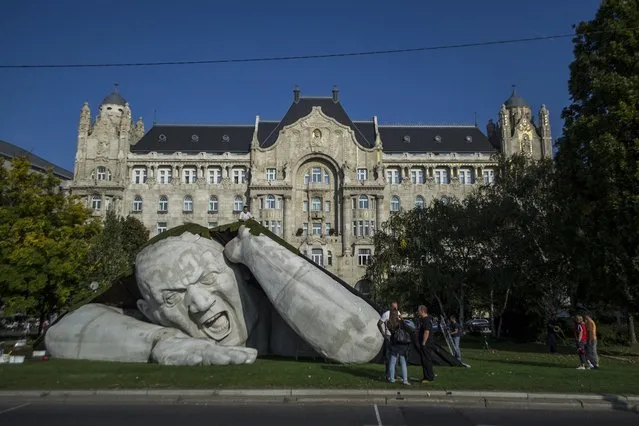
Sculpture By Ervin Loranth Herve

There are not many sculptures in the world that were purposely made to be grotesque, especially on such a large scale. Thus, a Hungarian artist Ervin Loránth Hervé has apparently decided that there isn’t enough horror in this world and created the Feltépve – a sculpture of a stone giant ripping apart the earth in order to break free. However, when we look from another perspective this sculpture might depict a grouchy giant trying to cover himself with a blanket of earth so that everyone would leave him alone. The latter interpretation of this sculpture was probably not intended by the sculptor; however, the way the arms of the giant are positioned makes it look as if it was truly the case.
Details
04 Nov 2014 11:49:00
Black women in Brazil sit at the intersection of racism and misogyny, and have in recent years been at the forefront of a movement that challenges issues ranging from sexual and domestic violence to police brutality and stereotyping. Kolor Collective considers itself to be a part of this movement and questions expectations imposed on black women with satirical and subversive images, as seen here. (Photo by Kolor Art Collective/The Guardian)

Photographer Pol Kurucz’s vivid collection of photos explores issues faced by black Brazilian women, from political misrepresentation to unrealistic beauty standards. Kolor Collective is a Rio de Janeiro-based creative group that challenges the struggle faced by black women in Brazil through theatrical and provocative art. It was founded in 2015 by Franco-Hungarian photographer Pol Kurucz, who often touches on his own experiences of discrimination to call out sensitive social problems. (Photo by Kolor Art Collective/The Guardian)
Details
28 Dec 2016 07:24:00
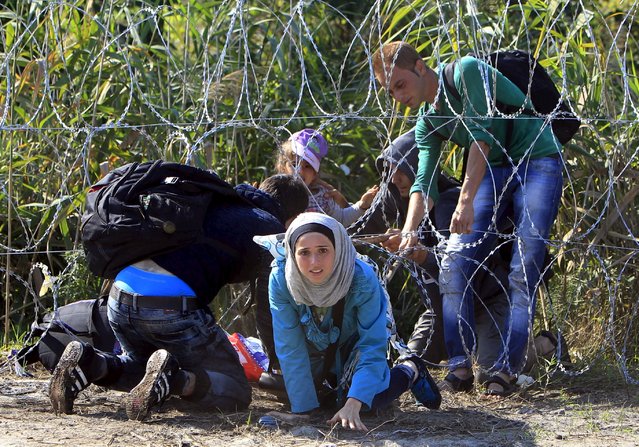
A Syrian migrant family enters Hungary at the border with Serbia near Roszke, Hungary August 28, 2015. (Photo by Bernadett Szabo/Reuters)

A Syrian migrant family enters Hungary at the border with Serbia near Roszke, Hungary August 28, 2015. As Europe struggles with its worst migrant crisis since World War II, Hungary has become, like Italy and Greece, a “frontline” state. So far this year, police say around 141,500 migrants have been intercepted crossing into Hungary, mostly from neighbouring Serbia. (Photo by Bernadett Szabo/Reuters)
Details
29 Aug 2015 11:33:00