Loading...
Done
A Google balloon sails through the air with the Southern Alps mountains in the background, in Tekapo, New Zealand. (Photo by Jon Shenk/Associated Press)

“Google is launching balloons into near space to provide internet access to buildings below on the ground. About 30 of the superpressure balloons are being launched from New Zealand from where they will drift around the world on a controlled path. Attached equipment will offer 3G-like speeds to 50 testers in the country”. – BBC News. Photo: A Google balloon sails through the air with the Southern Alps mountains in the background, in Tekapo, New Zealand. (Photo by Jon Shenk/Associated Press)
Details
16 Jun 2013 10:54:00
Google's vice president Alan Eustace looks out of his spacesuit into the stratosphere prior to a record-breaking skydive over New Mexico, in this still image taken from video October 24, 2014, a handout courtesy of the Paragon Space Development Corporation. Eustace was lifted up 135,890 ft (41,420 metres) by an enormous balloon while wearing a specially designed pressurized space suit, the Paragon Space Development Corporation said. (Photo by Reuters/Paragon Space Development Corporation)

Google's vice president Alan Eustace looks out of his spacesuit into the stratosphere prior to a record-breaking skydive over New Mexico, in this still image taken from video October 24, 2014, a handout courtesy of the Paragon Space Development Corporation. Eustace was lifted up 135,890 ft (41,420 metres) by an enormous balloon while wearing a specially designed pressurized space suit, the Paragon Space Development Corporation said. Eustace remained in a free fall for approximately 4.5 minutes before landing safely nearly 70 miles (43.4 kms) from his launch point, setting a world record for the highest skydive and breaking the sound barrier in the process. Eustace landed safely on the ground just 15 minutes after he was lifted into the air. (Photo by Reuters/Paragon Space Development Corporation)
Details
26 Oct 2014 12:16:00
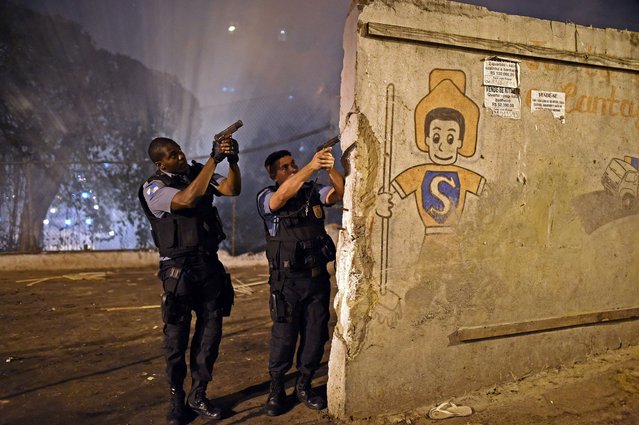
Rio de Janeiro's state military policemen aim their guns during a violent protest in a favela next to Copacabana, Rio de Janeiro on April 22, 2014. Violent protests broke out in Rio's landmark beachfront district, Copacabana, following the death of a resident last weekend during clashes with the Army in a nearby favela. (Photo by Christophe Simon/AFP Photo)

Rio de Janeiro's state military policemen aim their guns during a violent protest in a favela next to Copacabana, Rio de Janeiro on April 22, 2014. Violent protests broke out in Rio's landmark beachfront district, Copacabana, following the death of a resident last weekend during clashes with the Army in a nearby favela. (Photo by Christophe Simon/AFP Photo)
Details
24 Apr 2014 09:03:00
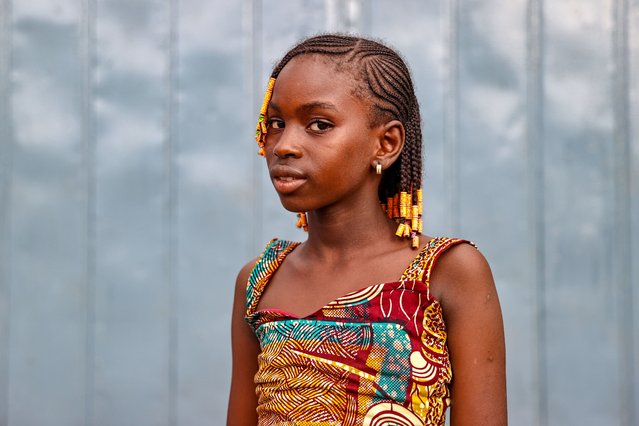
A Guinean kid poses for a photo in Conakry, Guinea on July 23, 2021. Children, most of whom start working after a certain age to support their families, have their hair braided in different ways and decorated with colorful beads on all special days, especially on holidays, despite these difficult conditions. (Photo by Ozkan Bilgin/Anadolu Agency via Getty Images)

A Guinean kid poses for a photo in Conakry, Guinea on July 23, 2021. Children, most of whom start working after a certain age to support their families, have their hair braided in different ways and decorated with colorful beads on all special days, especially on holidays, despite these difficult conditions. (Photo by Ozkan Bilgin/Anadolu Agency via Getty Images)
Details
29 Jul 2021 09:43:00
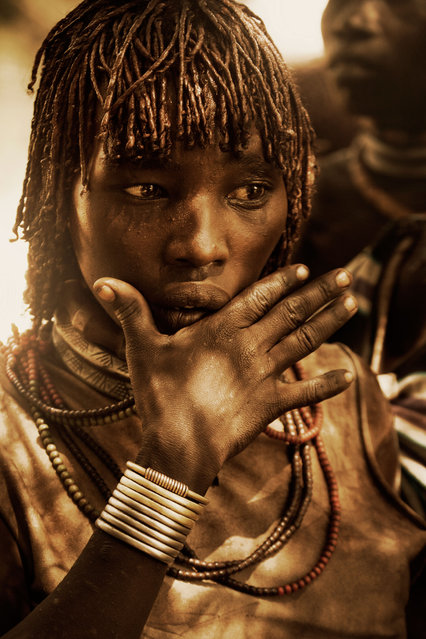
The Hamar people traditionally use red ocher clay to braid the hair of their women. (Photo by Diego Arroyo)

During his time in Ethiopia, New York-based art director and photographer Diego Arroyo spent time with the Hamar, Mursi, Dassanech, and Arbore Tribes. They, along with several others tribes, make up the 200,000 people situated in Africa’s Great Rift Valley. The people of the Omo Valley are still primarily herders and farmers, living an isolated and simple life. While they have yet to be truly touched by globalization, they could soon disappear. Their way of life is being threatened by a massive hydroelectric dam. (Photo by Diego Arroyo)
Details
13 Aug 2014 10:00:00
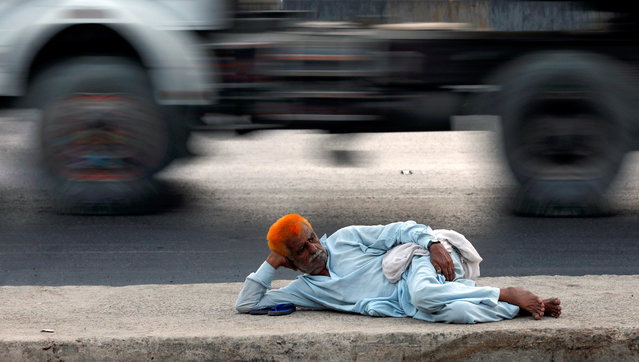
A man with henna-dyed hair rests on a road near the port area in Karachi, Pakistan on July 3, 2019. (Photo by Akhtar Soomro/Reuters)

A man with henna-dyed hair rests on a road near the port area in Karachi, Pakistan on July 3, 2019. (Photo by Akhtar Soomro/Reuters)
Details
13 Jul 2019 00:01:00
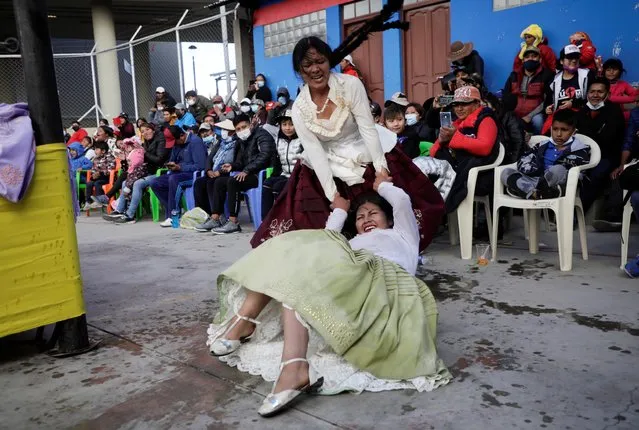
Barbara Quisbert and Susana La Bonita, cholitas wrestlers, fight during their return to the ring after the coronavirus disease (COVID-19) restrictions, in El Alto outskirts of La Paz, November 29, 2020. (Photo by David Mercado/Reuters)

The Fighting Cholitas are a group of female wrestlers who perform in El Alto, Bolivia. Tickets to the exhibitions cost $1. Like the general population of El Alto, which consists almost entirely of Aymara and Quechua residents, the Cholitas are indigenous. They wear braided hair, bowler hats and multilayered skirts in the ring. Here: Barbara Quisbert and Susana La Bonita, cholitas wrestlers, fight during their return to the ring after the coronavirus disease (COVID-19) restrictions, in El Alto outskirts of La Paz, November 29, 2020. (Photo by David Mercado/Reuters)
Details
12 Dec 2020 00:03:00
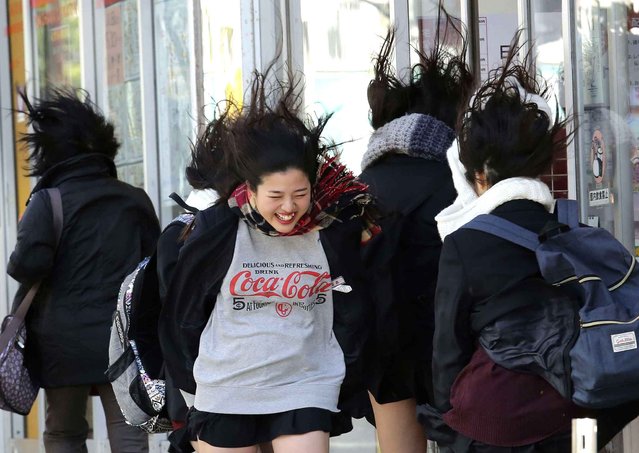
A girl smiles as her hair is blown by a strong wind in the Chinatown area in Yokohama, near Tokyo, Friday, January 27, 2017. (Photo by Koji Sasahara/AP Photo)

A girl smiles as her hair is blown by a strong wind in the Chinatown area in Yokohama, near Tokyo, Friday, January 27, 2017. (Photo by Koji Sasahara/AP Photo)
Details
29 Jan 2017 11:49:00