Loading...
Done
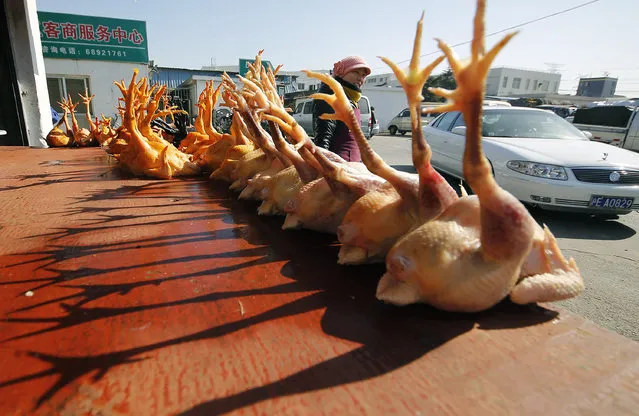
In this Tuesday January 21, 2014, file photo, slaughtered chickens are displayed for sale at a wholesale poultry market in Shanghai. The Chinese government on Tuesday, June 1, 2021, says a 41-year-old man has contracted what might be the world’s first human case of the H10N3 strain of bird flu, but the risk of large-scale spread is low. (Photo by AP Photo/File)

In this Tuesday January 21, 2014, file photo, slaughtered chickens are displayed for sale at a wholesale poultry market in Shanghai. The Chinese government on Tuesday, June 1, 2021, says a 41-year-old man has contracted what might be the w0orld’s first human case of the H10N3 strain of bird flu, but the risk of large-scale spread is low. (Photo by AP Photo/File)
Details
17 Jul 2021 08:51:00
Anti-frost candles burn in apricot plantations to protect flowering buds and blossoms from frost in the midst of the Swiss Alps, in Saxon, Canton of Valais, Switzerland, 05 April 2019. With an unusually low temperature forecast for the season, fruit growers try to protect their buds from frost damage with two different means, icy water or large candles. (Photo by Valentin Flauraud/EPA/EFE)

Anti-frost candles burn in apricot plantations to protect flowering buds and blossoms from frost in the midst of the Swiss Alps, in Saxon, Canton of Valais, Switzerland, 05 April 2019. With an unusually low temperature forecast for the season, fruit growers try to protect their buds from frost damage with two different means, icy water or large candles. (Photo by Valentin Flauraud/EPA/EFE)
Details
18 Apr 2019 00:03:00
A view of the facade of a house in the village of Cherevkovo, Arkhangelsk region, Russia, July 12, 2016. (Photo by Maxim Shemetov/Reuters)

A view of the facade of a house in the village of Cherevkovo, Arkhangelsk region, Russia, July 12, 2016. Traditional wooden houses, many featuring exquisite carvings and craftsmanship, are falling into decay across Russia because of neglect, lack of funds and an exodus from the countryside to the cities. Urbanisation and a low birth rate are emptying out the countryside, and residents and authorities are often largely indifferent towards the historical value of their properties. (Photo by Maxim Shemetov/Reuters)
Details
10 Nov 2016 12:11:00
Even upside down, a stereophonic turntable continues to play and  hold the interest of Helen Sorowitz, a visitor to the New York High Fidelity Show in New York, September 9, 1960. (Photo by Ruben Goldberg/AP Photo)

Even upside down, a stereophonic turntable continues to play and hold the interest of Helen Sorowitz, a visitor to the New York High Fidelity Show in New York, September 9, 1960. (Photo by Ruben Goldberg/AP Photo)
Details
14 Mar 2018 00:05:00
A staff member (R) looks on next to a cake, which was baked in the shape of a muscular man, for customers to try for free during a promotional event of a cake store in Shenyang, Liaoning province, China, December 6, 2015. (Photo by Reuters/Stringer)

A staff member (R) looks on next to a cake, which was baked in the shape of a muscular man, for customers to try for free during a promotional event of a cake store in Shenyang, Liaoning province, China, December 6, 2015. (Photo by Reuters/Stringer)
Details
09 Dec 2015 08:04:00
Baby Fennec Fox

“The fennec fox is a small nocturnal fox found in the Sahara of North Africa. Its most distinctive feature is unusually large ears. The name “fennec” comes from the Arabic word for fox, and the species name zerda has a Greek origin that refers to its habitat. The fennec is the smallest species of canid in the world; coat, ears and kidney functions have adapted to a high-temperature, low-water, desert environment. In addition, its hearing is sensitive enough to hear prey moving underground”. – Wikipedia

Photo: A Baby Fennec is seen at Sunshine International Aquarium on June 24, 2009 in Tokyo, Japan. The small nocturnal fox babies were born on May 17 2009. (Photo by Junko Kimura/Getty Images)
Details
16 Sep 2011 12:02:00
Tridacna Gigas, or Giant Clams

“The giant clam, Tridacna gigas (known as pā’ua in Cook Islands Māori), is the largest living bivalve mollusc. T. gigas is one of the most endangered clam species. It was mentioned as early as 1825 in scientific reports. One of a number of large clam species native to the shallow coral reefs of the South Pacific and Indian oceans, they can weigh more than 200 kilograms (440 lb) measure as much as 120 cm (47 in) across, and have an average lifespan in the wild of 100 years or more”. – Wikipedia

Photo: Tridacna Gigas, or Giant Clams spew water as a traditional fisherman passes by a small sanctuary on January 23, 2004 near Bolinao in the Northern Philippines. The clams, prime builders for coral reefs and providing shelter for spawning fish and other marine life, are exposed by low tides in the sanctuary. Overfishing and pollution throughout the country are not only threatening food security, but are also starting to choke one of the few working clam sanctuaries in the world. (Photo by David Greedy/Getty Images)

Details
01 Oct 2011 13:10:00
Giant panda Jia Jia enjoys her birthday cake made with ice and vegetables at Ocean Park in Hong Kong, Tuesday, July 28, 2015 as she celebrates her 37-year-old birthday. (Photo by Kin Cheung/AP Photo)

Giant panda Jia Jia enjoys her birthday cake made with ice and vegetables at Ocean Park in Hong Kong, Tuesday, July 28, 2015 as she celebrates her 37-year-old birthday. Jia Jia broke the Guinness World Records title for “Oldest Panda Living in Captivity” on Tuesday. (Photo by Kin Cheung/AP Photo)
Details
29 Jul 2015 11:17:00