Loading...
Done
A view of traditional bolinhos de bacalhau (fried codfish balls) in Rio de Janeiro, Brazil, May 7, 2016. (Photo by Sergio Moraes/Reuters)

If the most popular foods of Rio de Janeiro have one thing in common, it is their informality. You can find fine restaurants in the city, but they do not set Rio apart from other places. What does set it apart, and what invariably brings its residents, known as "Cariocas," together is the unpretentious food they eat in bright, loud, crowded bars and restaurants, on busy street corners, or after a day at the beach. Here: A view of traditional bolinhos de bacalhau (fried codfish balls) in Rio de Janeiro, Brazil, May 7, 2016. (Photo by Sergio Moraes/Reuters)
Details
05 Aug 2016 13:20:00
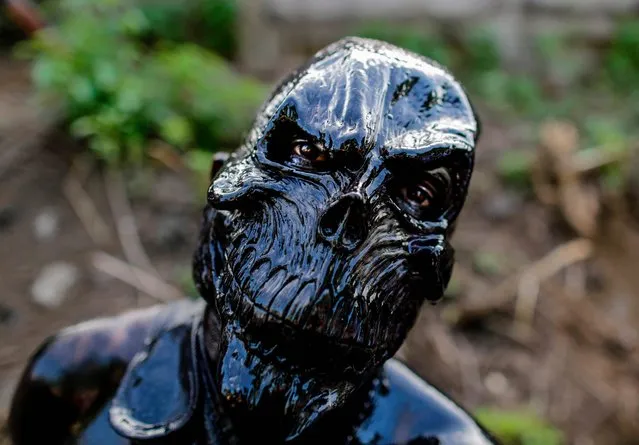
A catholic faithful smeared in burnt oil, takes part in the opening of the ten-day celebration of the Santo Domingo de Guzman festival in Managua, on August 1, 2019. (Photo by Inti Ocon/AFP Photo)

A catholic faithful smeared in burnt oil, takes part in the opening of the ten-day celebration of the Santo Domingo de Guzman festival in Managua, on August 1, 2019. In Central America the black devil, or El Cadejo, is an evil dog-like spirit with glowing red eyes that locals believe eats new born puppies. (Photo by Inti Ocon/AFP Photo)
Details
06 Aug 2019 00:01:00
De Markies – The Mobile Home

The mobile home “De Markies” was an entry in the “Temporary Living” competition 1985 and was conceived as a mobile home. Onthe road it measures 2.00 m by 4.50 m, and once it has arrived at its destination its floorspace can be increased threefold in a matter of seconds. “De Markies” was awarded the Public Prize at the Rotterdam Design Prize 1996. For further information please visit Bothlink.
Details
29 Jul 2013 12:16:00
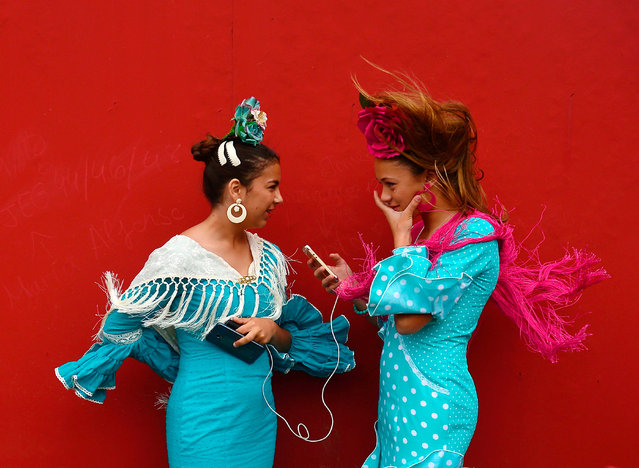
Two girls wearing traditional Sevillian dresses talk during the “Feria de Abril” (April Fair) in Sevilla on April 30, 2017. The fair dates back to 1847 when it was originally organized as a livestock fair but has turned into a week of flamenco dancing, music and bullfighting. (Photo by Cristina Quicler/AFP Photo)

Two girls wearing traditional Sevillian dresses talk during the “Feria de Abril” (April Fair) in Sevilla on April 30, 2017. The fair dates back to 1847 when it was originally organized as a livestock fair but has turned into a week of flamenco dancing, music and bullfighting. (Photo by Cristina Quicler/AFP Photo)
Details
06 May 2017 07:31:00
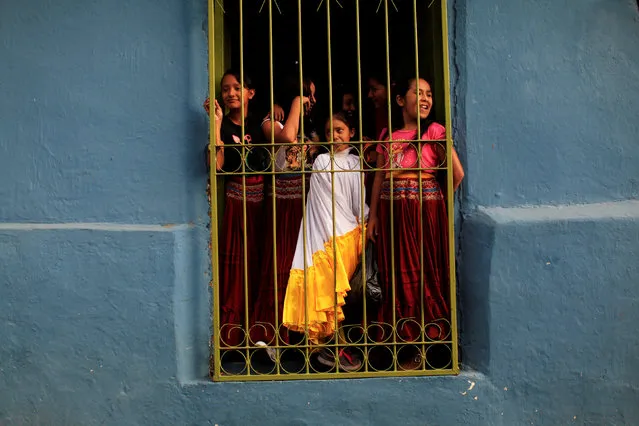
Girls watch a procession during the “Fiesta de las Palancas” celebration to ask for blessings and abundance during the new year in Panchimalco, El Salvador, January 5, 2017. (Photo by Jose Cabezas/Reuters)

Girls watch a procession during the “Fiesta de las Palancas” celebration to ask for blessings and abundance during the new year in Panchimalco, El Salvador, January 5, 2017. (Photo by Jose Cabezas/Reuters)
Details
08 Jan 2017 13:56:00
Kika-evolution, 5, an Auguste clown, poses for a photo during Mexico’s 17th annual clown convention, La Feria de la Risa, in Mexico City, October 23, 2012. Approximately 500 clowns gathered at two local theaters in the capital city to exchange ideas, compete for laughs and show off their comedy performances. (Photo by Anita BacaAP Photo)

Kika-evolution, 5, an Auguste clown, poses for a photo during Mexico’s 17th annual clown convention, La Feria de la Risa, in Mexico City, October 23, 2012. Approximately 500 clowns gathered at two local theaters in the capital city to exchange ideas, compete for laughs and show off their comedy performances. (Photo by Anita Baca/AP Photo)
Details
27 Oct 2012 07:51:00
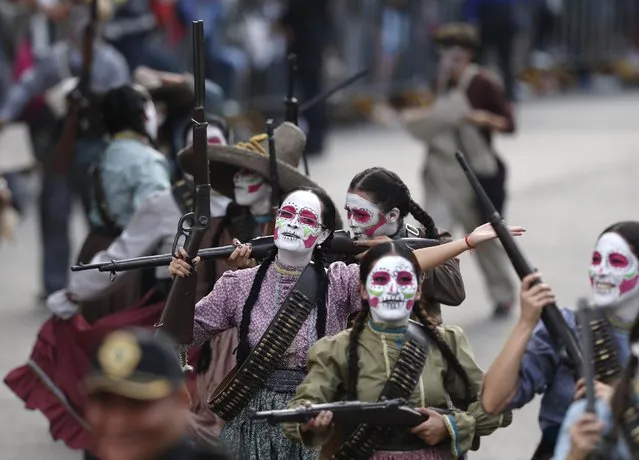
Performers participate in the Day of the Dead parade on Mexico City's main Reforma Avenue, Saturday, October 28, 2017. (Photo by Eduardo Verdugo/AP Photo)

Performers participate in the Day of the Dead parade on Mexico City's main Reforma Avenue, Saturday, October 28, 2017. Mexico's capital is holding its Day of the Dead parade, an idea actually born out of the imagination of a scriptwriter for the James Bond movie “Spectre”. (Photo by Eduardo Verdugo/AP Photo)
Details
29 Oct 2017 08:24:00
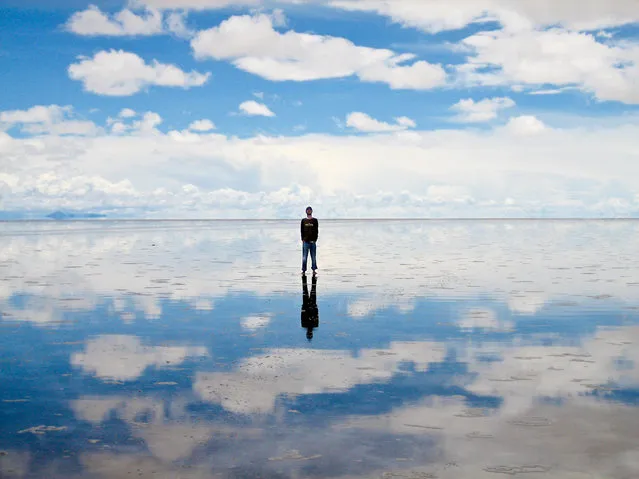
Salar de Uyuni

Salar de Uyuni (or Salar de Tunupa) is the world's largest salt flat at 10,582 square kilometers (4,086 sq mi). It is located in the Potosí and Oruro departments in southwest Bolivia, near the crest of the Andes, and is elevated 3,656 meters (11,995 ft) above mean sea level. The Salar was formed as a result of transformations between several prehistoric lakes. It is covered by a few meters of salt crust, which has an extraordinary flatness with the average altitude variations within one meter over the entire area of the Salar.
Details
04 Aug 2012 08:42:00