Loading...
Done
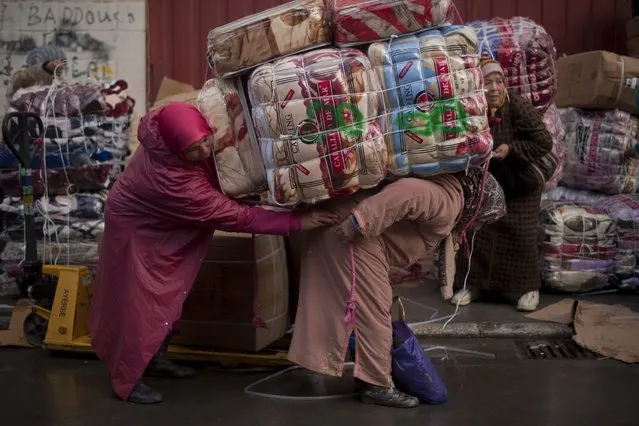
Women porters load bundles onto their back for transport across the El Tarajal boarder separating Morocco and Spain's North African enclave of Ceuta, in Ceuta on December 4, 2014. Unemployment among Ceuta and Melilla's native workforce is more than 30 percent – among the highest rates in Spain. Meanwhile, authorities say some 30,000 Moroccan traders and menial workers cross into each territory every day. (Photo by Jorge Guerrero/AFP Photo)

Women porters load bundles onto their back for transport across the El Tarajal boarder separating Morocco and Spain's North African enclave of Ceuta, in Ceuta on December 4, 2014. Unemployment among Ceuta and Melilla's native workforce is more than 30 percent – among the highest rates in Spain. Meanwhile, authorities say some 30,000 Moroccan traders and menial workers cross into each territory every day. (Photo by Jorge Guerrero/AFP Photo)
Details
29 Dec 2014 13:36:00


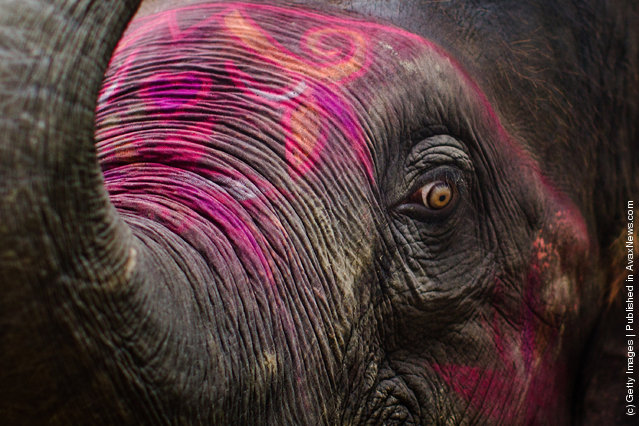
SONEPUR, INDIA - NOVEMBER 15: An elephant is painted in decorative colours during the Sonepur Mela on November 15, 2011 in Sonepur near Patna, India. The cattle fair, held in the Indian state of Bihar, has its origins during ancient times, when people traded elephants and horses across the auspicious river Ganges. The mela used to attract traders from places as distant as Central Asia. It is one of Asia's largest cattle fairs and lasts for a fortnight. (Photo by Daniel Berehulak/Getty Images)
Details
16 Nov 2011 02:42:00
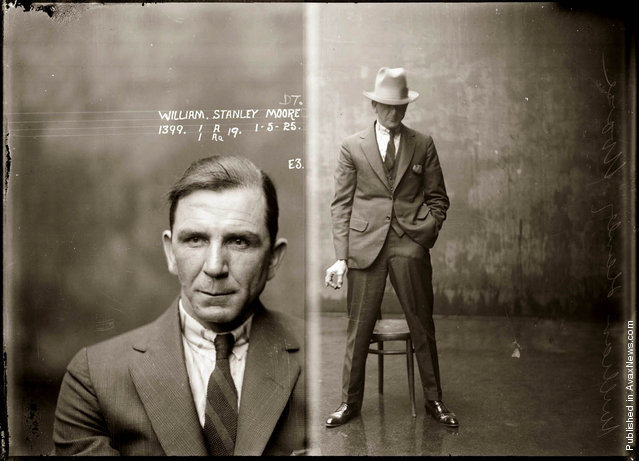
Mug shot of William Stanley Moore, 1 May 1925, Central Police Station, Sydney

Mug shot of William Stanley Moore, 1 May 1925, Central Police Station, Sydney. This picture appears in the Photo Supplement to the NSW Police Gazette, 28 July, 1926 captioned: “Opium dealer. Operates with large quantities of faked opium and cocaine. A wharf labourer; associates with water front thieves and drug traders”. (Photo by NSW Police Forensic Photography Archive, Justice & Police Museum, Histiric Houses Trust of NSW)
Details
24 Apr 2012 11:46:00
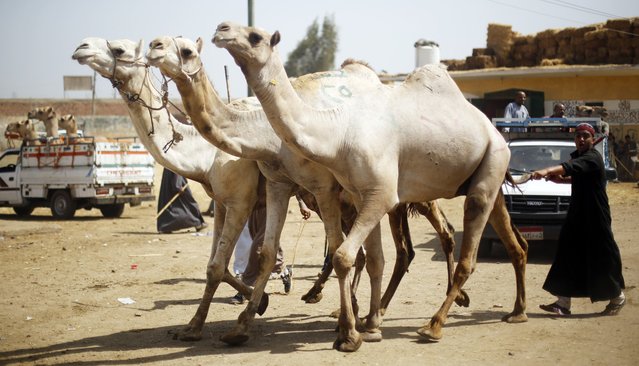
A man walks behind camels at the Birqash Camel Market, ahead of Eid al-Adha or Festival of Sacrifice, on the outskirts of Cairo September 29, 2014. (Photo by Amr Abdallah Dalsh/Reuters)

A man walks behind camels at the Birqash Camel Market, ahead of Eid al-Adha or Festival of Sacrifice, on the outskirts of Cairo September 29, 2014. Birqash Camel Market, one of the biggest markets for camel meat in Africa, draws sellers from Libya, Sudan, Somalia and other regions in Egypt. The camels sold at the market are also used in tourism. Traders say that the selling rate for a camel in 2014 is anywhere between 5,000 and 20,000 Egyptian pounds (700 – 2800 USD). (Photo by Amr Abdallah Dalsh/Reuters)
Details
02 Oct 2014 10:20:00
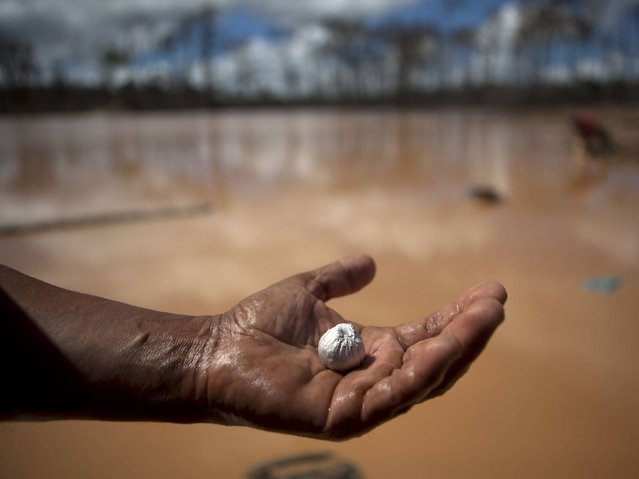
A miner holds an amalgam of mercury and gold he mined after working a 28-hour shift at an illegal gold mining process in La Pampa, in Peru's Madre de Dios region. (Photo by Rodrigo Abd/AP Photo)

In this May 4, 2014 photo, a miner holds an amalgam of mercury and gold he mined after working a 28-hour shift at an illegal gold mining process, in La Pampa, in Peru's Madre de Dios region. Thousands of artisanal gold miners sweat through the long shifts and endure, for a few grams of gold, the perils of collapsing earth, limb-crushing machinery and the toxic mercury used to bind gold flecks. (Photo by Rodrigo Abd/AP Photo)
Details
14 May 2014 10:05:00
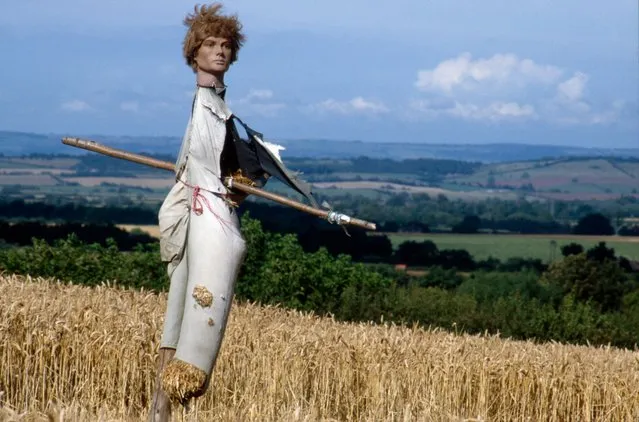
“The ripening crops eloquently signify that the scarecrow’s work is done. Few remain to see their task fulfilled because if they become entangled in the harvesting machinery it causes serious damage”. (Photo by Colin Garratt)

When Colin Garratt went to photograph the traditional sentinels of the British countryside, he found they ranged from the dapper to the downright sinister. “They are not from the anaesthetised world of the craft fair”, says Colin Garratt, “but are the direct descendants of the ancient spectres which have haunted the landscape for centuries”. The Scarecrow Exhibition is at Geddes Gallery, London, from 25 to 30 March. (Photo by Colin Garratt)
Details
29 Mar 2016 11:46:00
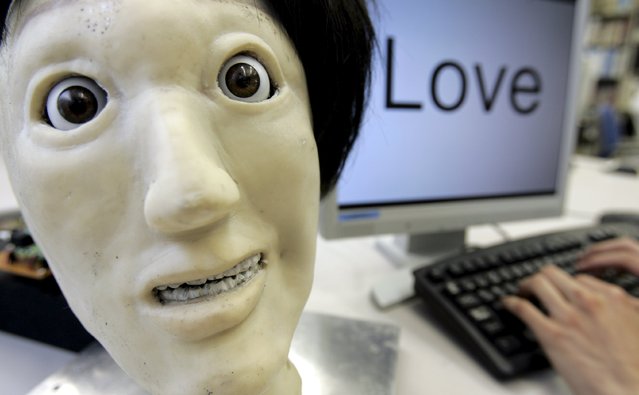
A humanoid robot named Kansei, meaning “sensibility” in Japanese, makes a facial expression depicting “happiness”, next to the word “Love” during a demonstration at a laboratory of Meiji University's Robot and Science Institute in Kawasaki, south of Tokyo in this June 4, 2007 file photo. (Photo by Yuriko Nakao/Reuters)

A humanoid robot named Kansei, meaning “sensibility” in Japanese, makes a facial expression depicting “happiness”, next to the word “Love” during a demonstration at a laboratory of Meiji University's Robot and Science Institute in Kawasaki, south of Tokyo in this June 4, 2007 file photo. Three-fourths of robot installations over the next decade are expected to be concentrated in four areas: transportation equipment, including the automotive sector; computer and electronic products; electrical equipment and machinery. Labor costs have climbed in countries such as China that have been popular for outsourcing production, while technological advances for robots allow them to be more flexible and perform more tasks. (Photo by Yuriko Nakao/Reuters)
Details
17 Apr 2015 09:39:00
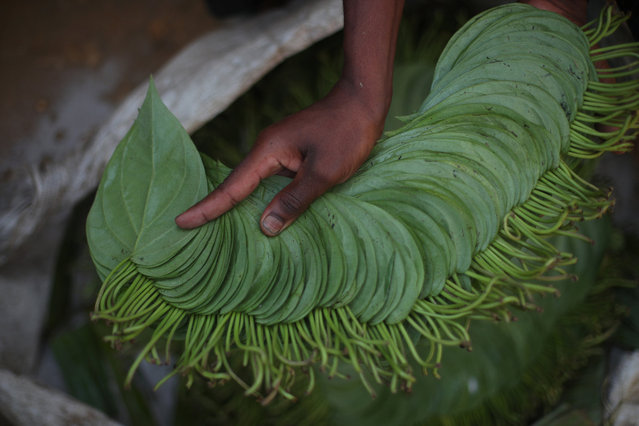
Faruk, 17, a Rohingya refugee trader holds betel leaves which are on sale at a stall in Palong Khali refugee camp near Cox's Bazar, Bangladesh, November 3, 2017. He left his village in Myanmar when the military opened fire towards the Rohingya. “I buy this betel leaf from Palong Khali market, in one bundle there are 160 pieces, I buy it for 80 taka and I sell it for 100 taka. Bangladeshi's and I sell for the same rate in the camp. Outside in the local market it is 80 taka per bundle. My problem is that I don't have money so I can't buy anything to eat, I can't buy fish to eat”, he said. (Photo by Hannah McKay/Reuters)

Faruk, 17, a Rohingya refugee trader holds betel leaves which are on sale at a stall in Palong Khali refugee camp near Cox's Bazar, Bangladesh, November 3, 2017. He left his village in Myanmar when the military opened fire towards the Rohingya. “I buy this betel leaf from Palong Khali market, in one bundle there are 160 pieces, I buy it for 80 taka and I sell it for 100 taka (1 Bangladeshi Taka = 0.012 US Dollar). Bangladeshi's and I sell for the same rate in the camp. Outside in the local market it is 80 taka per bundle. My problem is that I don't have money so I can't buy anything to eat, I can't buy fish to eat”, he said. (Photo by Hannah McKay/Reuters)
Details
27 Nov 2017 08:54:00