Loading...
Done
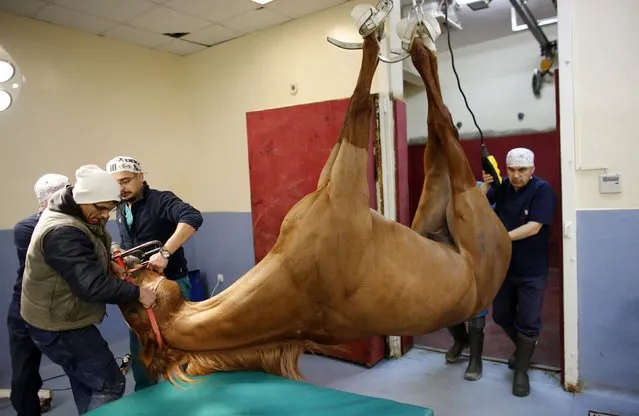
A racehorse is hoisted up before its operation at Veliefendi equine hospital in Istanbul March 3, 2015. (Photo by Murad Sezer/Reuters)

A racehorse is hoisted up before its operation at Veliefendi equine hospital in Istanbul March 3, 2015. A state-of-the-art hospital for hundreds of horses run by the Jockey Club of Turkey at Istanbul's Veliefendi racecourse is the country's oldest and biggest. Grooms and trainers at the equine clinic work with vets and nurses while owners hope their prize runners, often worth hundreds of thousands of dollars, will recover quickly and then run faster still. (Photo by Murad Sezer/Reuters)
Details
10 Apr 2015 07:12:00
Women in Pathein, Myanmar, construct in the last decade of August 2024 parasols that they will paint in vibrant colours to sell in nearby markets. (Photo by Nantapon Pattamakijsakul/Solent News)

Women in Pathein, Myanmar, construct in the last decade of August 2024 parasols that they will paint in vibrant colours to sell in nearby markets. (Photo by Nantapon Pattamakijsakul/Solent News)
Details
12 Sep 2024 03:14:00
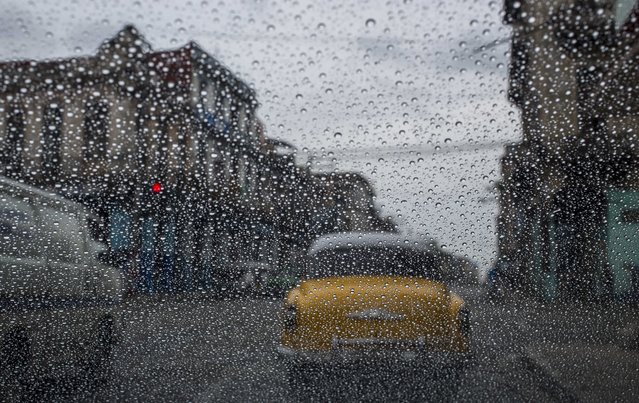
In this May 24, 2018 file photo, rain drops accumulate on a car's windshield as commuters wait at a red light in Havana, Cuba. (Photo by Desmond Boylan/AP Photo)

In this May 24, 2018 file photo, rain drops accumulate on a car's windshield as commuters wait at a red light in Havana, Cuba. (Photo by Desmond Boylan/AP Photo)
Details
02 Feb 2019 00:01:00
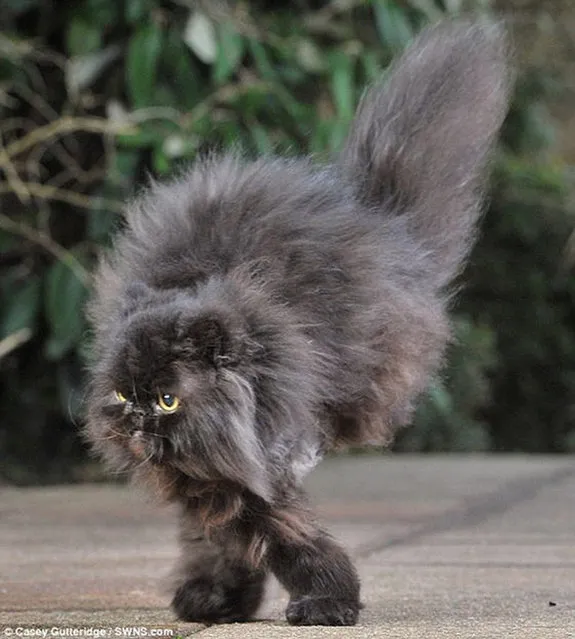
Caffrey The Amazing Two-legged Cat

CAFFREY the cat might only have two legs – but he doesn’t let it hold him back.
Details
14 Feb 2013 14:56:00
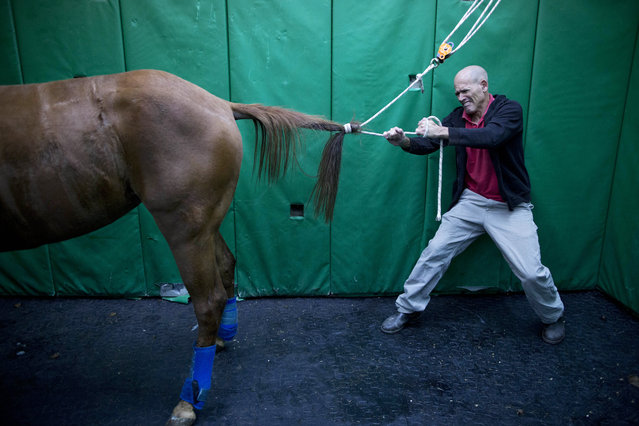
In this Wednesday, December 2, 2015 photo, Dr. Gal Kelmer, head of the department of large animals, unties a horse after its operation at the University's Koret School of Veterinary Medicine in Rishon Lezion, Israel. “Horses have an instinctive response of flight from danger”, Kelmer said. “The minute they wake up they start trying to stand and run, even if they don't have control of their limbs. So then they fall”. (Photo by Oded Balilty/AP Photo)

In this Wednesday, December 2, 2015 photo, Dr. Gal Kelmer, head of the department of large animals, unties a horse after its operation at the University's Koret School of Veterinary Medicine in Rishon Lezion, Israel. “Horses have an instinctive response of flight from danger”, Kelmer said. “The minute they wake up they start trying to stand and run, even if they don't have control of their limbs. So then they fall”. (Photo by Oded Balilty/AP Photo)
Details
15 Dec 2015 08:04:00
This photo taken on February 10, 2025 shows a captured green iguana being held by hunters after it was brought down by a slingshot in Pingtung. Taiwan's iguana population has exploded since the spikey-backed giant lizards were introduced from Central and South America more than 20 years ago as exotic pets. Many escaped or were dumped by their owners and have bred rapidly in the warm climate of southern Taiwan, invading neighbourhoods and ravaging farmers' crops. (Photo by I-Hwa Cheng/AFP Photo)

This photo taken on February 10, 2025 shows a captured green iguana being held by hunters after it was brought down by a slingshot in Pingtung. Taiwan's iguana population has exploded since the spikey-backed giant lizards were introduced from Central and South America more than 20 years ago as exotic pets. Many escaped or were dumped by their owners and have bred rapidly in the warm climate of southern Taiwan, invading neighbourhoods and ravaging farmers' crops. (Photo by I-Hwa Cheng/AFP Photo)
Details
02 Mar 2025 04:03:00
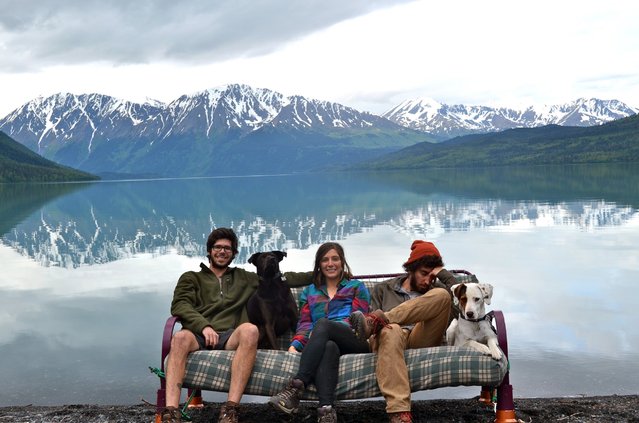
Becca D'Agostine, Andy Fuhrmann and Dafid Fine came up with a unique way to document their road trip by taking selfies on a couch at each location. Here they are seen at Mount Baker, Wash. (Photo by Caters News)

Becca D'Agostine, Andy Fuhrmann and Dafid Fine came up with a unique way to document their road trip by taking selfies on a couch at each location. Here they are seen at Mount Baker, Wash. (Photo by Caters News)
Details
21 Oct 2014 11:55:00
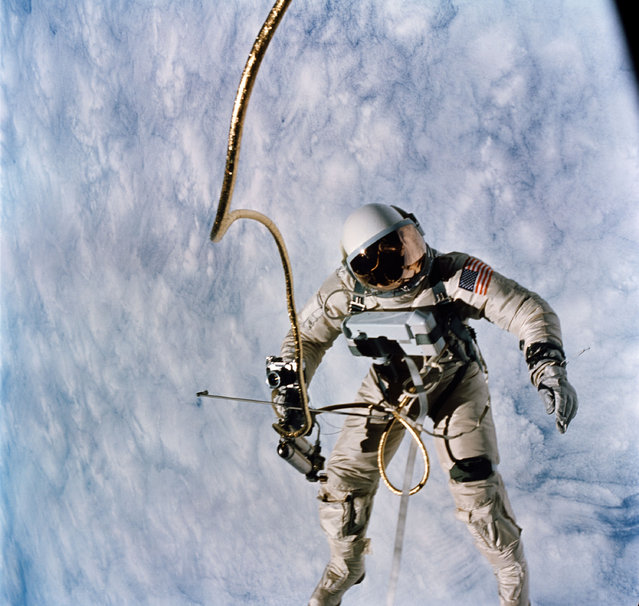
Astronaut Edward H. White II, pilot for the Gemini-Titan 4 (GT-4) spaceflight, floats in the zero-gravity of space during the third revolution of the GT-4 spacecraft on June 3, 1965. White wears a specially designed spacesuit. His face is shaded by a gold-plated visor to protect him from unfiltered rays of the sun. (Photo by NASA)

Astronaut Edward H. White II, pilot for the Gemini-Titan 4 (GT-4) spaceflight, floats in the zero-gravity of space during the third revolution of the GT-4 spacecraft on June 3, 1965. White wears a specially designed spacesuit. His face is shaded by a gold-plated visor to protect him from unfiltered rays of the sun. In his right hand he carries a Hand-Held Self-Maneuvering Unit (HHSMU) that gives him control over his movements in space. White also wears an emergency oxygen chest pack; and he carries a camera mounted on the HHSMU for taking pictures of the sky, Earth and the GT-4 spacecraft. He is secured to the spacecraft by a 25-feet umbilical line and a 23-feet tether line. Both lines are wrapped together in gold tape to form one cord. Astronaut James A. McDivitt, command pilot, remained inside the spacecraft during the extravehicular activity (EVA). Astronaut White died in the Apollo/Saturn 204 fire at Cape Kennedy on January 27, 1967. (Photo by NASA)
Details
22 Jul 2014 12:05:00