Loading...
Done
Afghanistan: Dogs of War Part 1

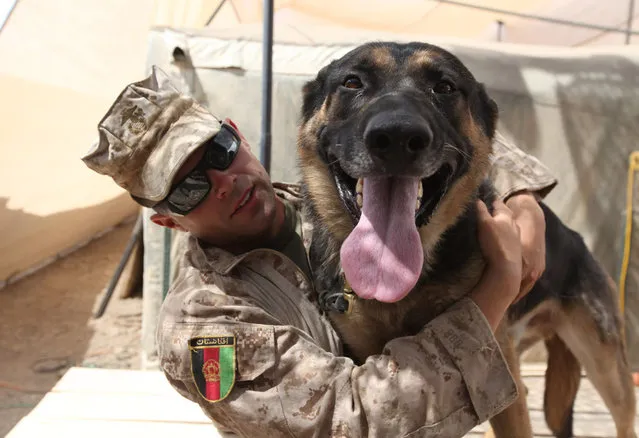
Throughout the course of the long war in Afghanistan, Coalition troops have relied on thousands of military working dogs to help keep them safe, and make their jobs easier. The dogs are trained to detect explosives, to find illegal drugs, to search for missing comrades, or target enemy combatants. Not only are they active on the front lines, but behind the lines they serve as therapy dogs, service dogs, and loyal companions. They also share the same risks as the ground troops, suffering injuries and sometimes death on the battlefields. Gathered here are images of these dogs and their handlers in Afghanistan and back home, from over the past several years, part of the ongoing series here on Afghanistan.
Details
03 Jun 2014 21:02:00
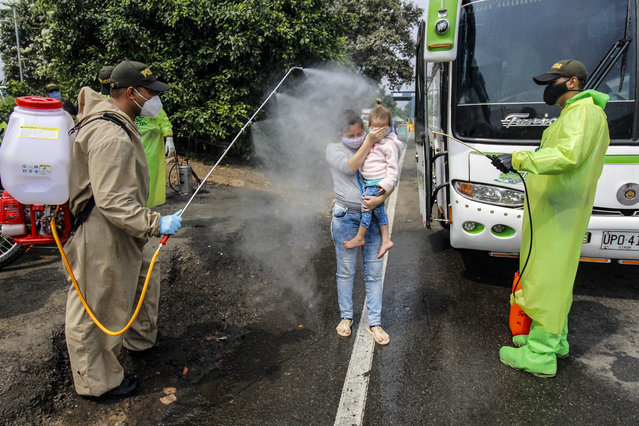
National Police members disinfect Venezuelan citizens returning to the country from Colombia, as a preventive measure against the spread of the coronavirus –COVID19- at the Simon Boliviar International Bridge, in Cucuta, Colombia-Venezuela border, on April 4, 2020. Since the first case of COVID-19 was detected last March 6, Colombia has reported 1,406 people infected and 32 dead. (Photo by Schneyder Mendoza/AFP Photo)

National Police members disinfect Venezuelan citizens returning to the country from Colombia, as a preventive measure against the spread of the coronavirus –COVID19- at the Simon Boliviar International Bridge, in Cucuta, Colombia-Venezuela border, on April 4, 2020. Since the first case of COVID-19 was detected last March 6, Colombia has reported 1,406 people infected and 32 dead. (Photo by Schneyder Mendoza/AFP Photo)
Details
14 Apr 2020 00:05:00
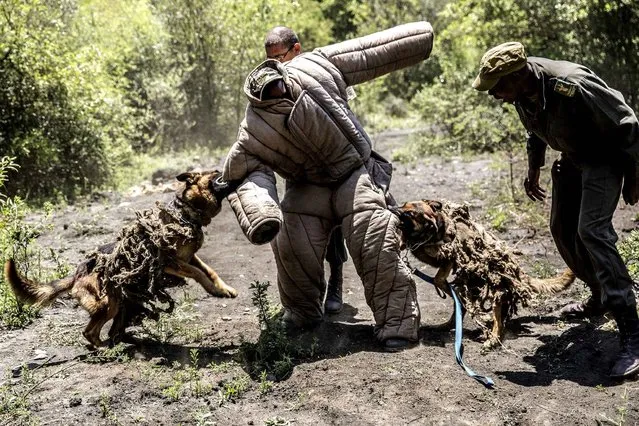
Ranger trainees and trainee dogs simulate an ambush against rhino poachers at the Paramount Group Anti-Poaching training and K9 (canine) academy on November 26, 2014 in Magaliesberg, South Africa. One of the largest of its kind in Africa, the Academy will address the ever increasing need for training of Conservation Officers in anti poaching activities, wildlife contraband detection, specialist K9 solutions and Ranger K9 handler training – all of which have proven success rates in combatting and apprehending poachers and their activities. (Photo by Gianluigi Guercia/AFP Photo)

Ranger trainees and trainee dogs simulate an ambush against rhino poachers at the Paramount Group Anti-Poaching training and K9 (canine) academy on November 26, 2014 in Magaliesberg, South Africa. One of the largest of its kind in Africa, the Academy will address the ever increasing need for training of Conservation Officers in anti poaching activities, wildlife contraband detection, specialist K9 solutions and Ranger K9 handler training – all of which have proven success rates in combatting and apprehending poachers and their activities. (Photo by Gianluigi Guercia/AFP Photo)
Details
29 Nov 2014 13:06:00
Amy Rimmer, Research Engineer at Jaguar Land Rover, demonstrates the car manufacturer's Advanced Highway Assist in a Range Rover, which drives the vehicle, overtakes and can detect vehicles in the blind spot, during the first demonstrations of the UK Autodrive Project at HORIBA MIRA Proving Ground in Nuneaton, Warwickshire on Friday October 21, 2016. (Photo by Fabio De Paola/PA Wire)

Amy Rimmer, Research Engineer at Jaguar Land Rover, demonstrates the car manufacturer's Advanced Highway Assist in a Range Rover, which drives the vehicle, overtakes and can detect vehicles in the blind spot, during the first demonstrations of the UK Autodrive Project at HORIBA MIRA Proving Ground in Nuneaton, Warwickshire on Friday October 21, 2016. (Photo by Fabio De Paola/PA Wire)
Details
21 Oct 2016 12:51:00
Participants perform parade in the street during Grebeg Sudiro festival on January 19, 2020 in Solo City, Central Java, Indonesia. Grebeg Sudiro festival is held as a prelude to the Chinese New Year, which falls on January 25th this year, welcoming the Year of the Rat. People bring offerings known as gunungan, including Chinese sweetcakes piled up into the shape of mountains, which are paraded in the streets followed by Chinese and Javanese performers. (Photo by Ulet Ifansasti/Getty Images)

Participants perform parade in the street during Grebeg Sudiro festival on January 19, 2020 in Solo City, Central Java, Indonesia. Grebeg Sudiro festival is held as a prelude to the Chinese New Year, which falls on January 25th this year, welcoming the Year of the Rat. People bring offerings known as gunungan, including Chinese sweetcakes piled up into the shape of mountains, which are paraded in the streets followed by Chinese and Javanese performers. (Photo by Ulet Ifansasti/Getty Images)
Details
23 Jan 2020 00:01:00
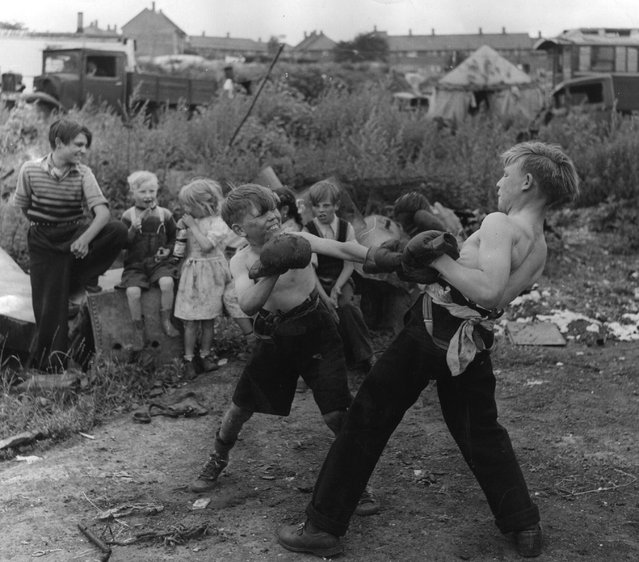
The unromantic gypsies. Children boxing in a gypsy camp in Kent, England on July 1, 1951. Like all boys these gypsy lads like to try their hand at boxing. Encouraged by their friends they fight it out on Corke's Meadow. Few Romanies now live a life of wandering romance. Most are like the three hundred squatters of Corke's Meadow, Kent, which is part of a “gypsy problem” that involves about 100,000 today. Of those about 25,000 can be rightly called gypsies, the rest are Mumpers and Posh-rats and Hobos. Corke's Meadow has both kinds. “Picture Post” cameraman Bert Hardy photographs the Corke's Meadow gypsies in their encampment. (Photo by Hulton-Deutsch Collection/Corbis via Getty Images)

The unromantic gypsies. Children boxing in a gypsy camp in Kent, England on July 1, 1951. Like all boys these gypsy lads like to try their hand at boxing. Encouraged by their friends they fight it out on Corke's Meadow. Few Romanies now live a life of wandering romance. Most are like the three hundred squatters of Corke's Meadow, Kent, which is part of a “gypsy problem” that involves about 100,000 today. Of those about 25,000 can be rightly called gypsies, the rest are Mumpers and Posh-rats and Hobos. Corke's Meadow has both kinds. “Picture Post” cameraman Bert Hardy photographs the Corke's Meadow gypsies in their encampment. (Photo by Hulton-Deutsch Collection/Corbis via Getty Images)
Details
12 Mar 2017 00:01:00
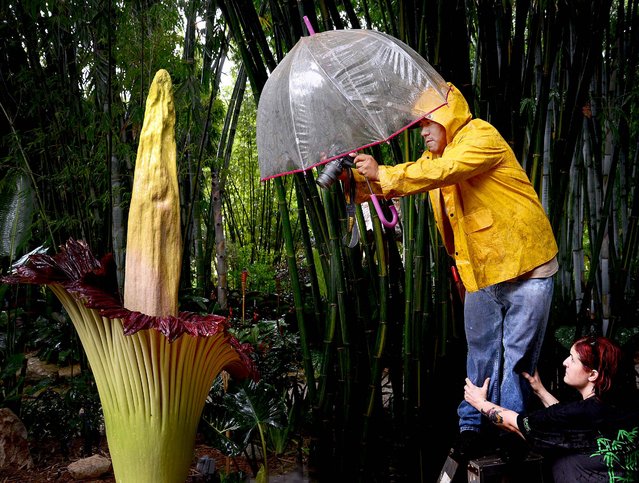
Mateo Santiago, Field Manager at Tropical Bamboo Nursery and Gardens, photographs rain water collecting in the corpse flower as Garden Manager Melanie Benson steadies a ladder. Santiago crinkled his nose up distastefully when he described its odor, which was at its worse Sunday night. “It smelled like a dead rat”. (Photo by Melanie Bell/Palm Beach Daily News)

Mateo Santiago, Field Manager at Tropical Bamboo Nursery and Gardens, photographs rain water collecting in the corpse flower as Garden Manager Melanie Benson steadies a ladder. Santiago crinkled his nose up distastefully when he described its odor, which was at its worse Sunday night. “It smelled like a dead rat”. (Photo by Melanie Bell/Palm Beach Daily News)
Details
23 Jul 2014 09:56:00
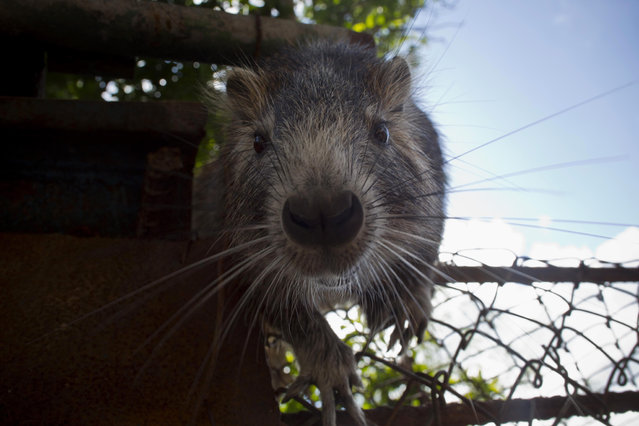
In this November 17, 2014 photo, Pancho, a domesticated huitia, confronts a camera, in Bainoa, Cuba. With their rope-like, dark tails, long front teeth, and whiskers that appear to be vibrating, huitias look like giant rats. They measure nearly a foot long (about 30 centimeters), with the largest ones weighing in bigger than a small dog. (Photo by Ramon Espinosa/AP Photo)

In this November 17, 2014 photo, Pancho, a domesticated huitia, confronts a camera, in Bainoa, Cuba. With their rope-like, dark tails, long front teeth, and whiskers that appear to be vibrating, huitias look like giant rats. They measure nearly a foot long (about 30 centimeters), with the largest ones weighing in bigger than a small dog. (Photo by Ramon Espinosa/AP Photo)
Details
21 Nov 2014 12:58:00