Loading...
Done
A view of traditional bolinhos de bacalhau (fried codfish balls) in Rio de Janeiro, Brazil, May 7, 2016. (Photo by Sergio Moraes/Reuters)

If the most popular foods of Rio de Janeiro have one thing in common, it is their informality. You can find fine restaurants in the city, but they do not set Rio apart from other places. What does set it apart, and what invariably brings its residents, known as "Cariocas," together is the unpretentious food they eat in bright, loud, crowded bars and restaurants, on busy street corners, or after a day at the beach. Here: A view of traditional bolinhos de bacalhau (fried codfish balls) in Rio de Janeiro, Brazil, May 7, 2016. (Photo by Sergio Moraes/Reuters)
Details
05 Aug 2016 13:20:00
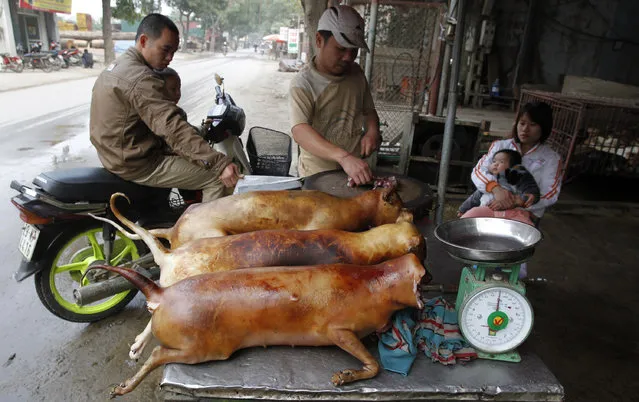
A vendor (C) cuts slaughtered dogs for sale at his roadside stall in Duong Noi village, outside Hanoi December 16, 2011. While animal rights activists have condemned eating dog meat as cruel treatment of the animals, it is still an accepted popular delicacy for some Vietnamese, as well in some other Asian countries. (Photo by Reuters/Kham)

A vendor (C) cuts slaughtered dogs for sale at his roadside stall in Duong Noi village, outside Hanoi December 16, 2011. While animal rights activists have condemned eating dog meat as cruel treatment of the animals, it is still an accepted popular delicacy for some Vietnamese, as well in some other Asian countries. Duong Noi is well-known as a dog-meat village, where hundreds of dogs are killed each day for sale as popular traditional food. Dog-eating as a custom is rooted in Vietnam and was developed as a result of poverty. One kilogram of dog meat costs about 130,000 dongs ($6.2). (Photo by Reuters/Kham)
Details
16 Jul 2013 11:40:00
In this photo taken Saturday, September 23, 2017, a mouse is cooked on a fire after being caught in a cornfield in Chidza, Masvingo Province, Zimbabwe. Considered a delicacy, the field mice are hunted in cornfields where they have grown plump on the grains, grass and wild fruits. (Photo by Tsvangirayi Mukwazhi/AP Photo)

In this photo taken Saturday, September 23, 2017, a mouse is cooked on a fire after being caught in a cornfield in Chidza, Masvingo Province, Zimbabwe. Considered a delicacy, the field mice are hunted in cornfields where they have grown plump on the grains, grass and wild fruits. (Photo by Tsvangirayi Mukwazhi/AP Photo)
Details
02 Oct 2017 08:20:00
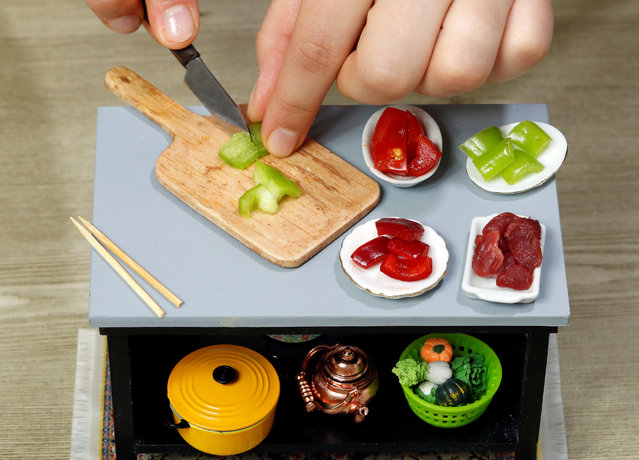
Miniature food cook Burcu Celenoglu Aydin prepares a dish at her mini kitchen in Istanbul, Turkey April 7, 2018. Social marketing coordinator Burcu Celenoglu Aydin and her husband videographer Anil Aydin cook renowned dishes of Turkish cuisine in tiny measures and upload the videos on social media. (Photo by Murad Sezer/Reuters)

Miniature food cook Burcu Celenoglu Aydin prepares a dish at her mini kitchen in Istanbul, Turkey April 7, 2018. Social marketing coordinator Burcu Celenoglu Aydin and her husband videographer Anil Aydin cook renowned dishes of Turkish cuisine in tiny measures and upload the videos on social media. (Photo by Murad Sezer/Reuters)
Details
16 Apr 2018 00:05:00
Shemika Charles limbos under her car at Niagara Falls State Park on May 28, 2015 in Buffalo, New York. A world record holding limbo queen thinks she has become the first person to shimmy under a car. Shemika Charles amazed herself and onlookers when she bent over backwards to get underneath the SUV earlier this week. The supple 22-year-old entered the record books in 2010 when she limboed down to an incredible eight and a half inches – the height of a beer bottle. (Photo by Ruaridh Connellan/Barcroft USA)

Shemika Charles limbos under her car at Niagara Falls State Park on May 28, 2015 in Buffalo, New York. A world record holding limbo queen thinks she has become the first person to shimmy under a car. Shemika Charles amazed herself and onlookers when she bent over backwards to get underneath the SUV earlier this week. The supple 22-year-old entered the record books in 2010 when she limboed down to an incredible eight and a half inches – the height of a beer bottle. She trains for up to four hours a day to keep her body in peak condition and now travels around America performing with her family. However, regular performances put an incredible strain on her body and she sees a chiropractor once a week to have her hips realigned. Her mother was also a successful limbo dancer in her home country of Trinidad and Tobago but had to give up due to injury. (Photo by Ruaridh Connellan/Barcroft USA)
Details
19 Dec 2015 08:07:00
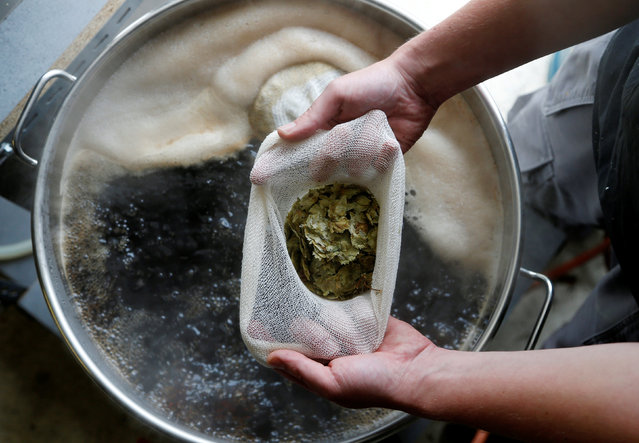
Arnaud Laloy, member of the Belgian Homebrewers association, adds hop in the brewing process to create his own beer in the garage of his house in Neufchateau, Belgium, August 11, 2016. (Photo by Francois Lenoir/Reuters)

In a country where some 200 breweries produce well over 1,000 different beers, surely no one is considering brewing their own? Wrong. Here: Arnaud Laloy, member of the Belgian Homebrewers association, adds hop in the brewing process to create his own beer in the garage of his house in Neufchateau, Belgium, August 11, 2016. (Photo by Francois Lenoir/Reuters)
Details
20 Aug 2016 11:30:00


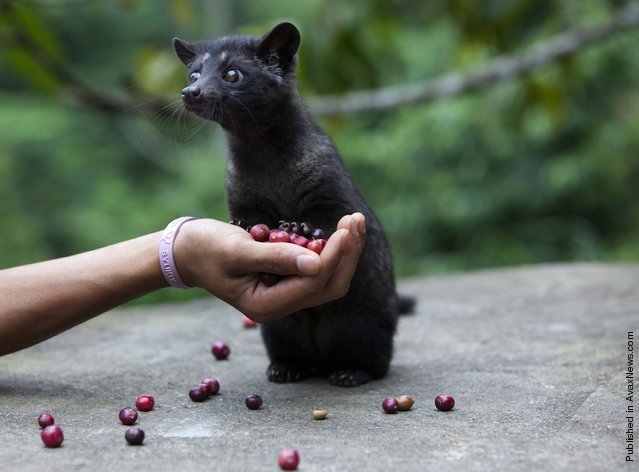
“Kopi luwak (Malay pronunciation), or civet coffee, is one of the world's most expensive and low-production coffee. It is made from the beans of coffee berries which have been eaten by the Asian Palm Civet (Paradoxurus hermaphroditus) and other related civets, then passed through its digestive tract. ...
Details
19 Mar 2011 18:41:00
Albertus in the church of St George in Burgrain, Germany. Incredibly, some of the skeletons, which took up to five years to decorate, were even found hidden away in lock-ups and containers. (Photo by Paul Koudounaris/BNPS)

A relic hunter dubbed “Indiana Bones” has lifted the lid on a macabre collection of 400-year-old jewel-encrusted skeletons unearthed in churches across Europe. Art historian Paul Koudounaris has hunted down and photographed dozens of gruesome skeletons in some of the world's most secretive religious establishments. Photo: Albertus in the church of St George in Burgrain, Germany. Incredibly, some of the skeletons, which took up to five years to decorate, were even found hidden away in lock-ups and containers. (Photo by Paul Koudounaris/BNPS)
Details
08 Sep 2013 07:20:00