Loading...
Done
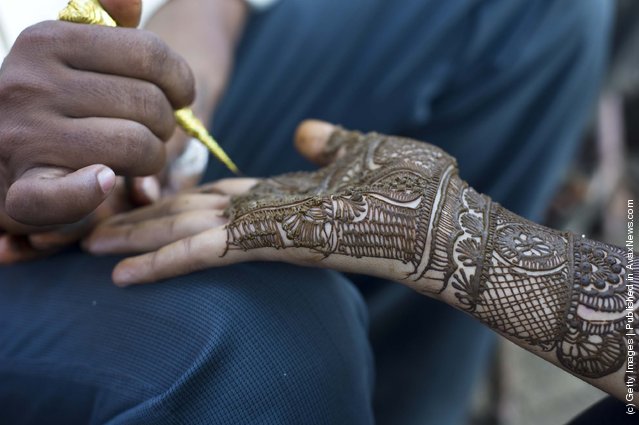
Application of henna or “Mehndi”  to a girls hand in a market in Jaipur, India

“Mehndi or menhdi is the application of henna as a temporary form of skin decoration in India, as well as by expatriate communities from the country. The word mehndi is derived from the Sanskrit word mendhikā. The use of mehndi and turmeric is described in the earliest Vedic ritual books. Haldi (Staining oneself with turmeric paste) as well as mehndi are important Vedic customs as a symbolic representation of the Outer and the Inner Sun. Vedic customs are meant to awaken the “inner light” and so the gold of the inner Sun has an important symbolic function”. – Wikipedia

Photo: Application of henna or “Mehndi” to a girls hand in a market on October 18, 2010 in Jaipur, India. (Photo by Simon de Trey-White/Getty Images)
Details
23 Nov 2011 13:33:00
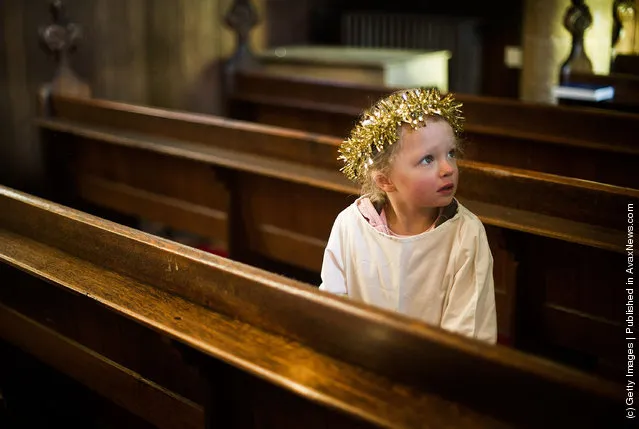
Children perform during a traditional Christmas Nativity

Cathryn Shrimpton, 4, prepares to play the Angle Gabriel during a traditional Christmas Nativity on December 18, 2011, at St Mary's Church, Myton Village, England. In schools and churches around the country children busy preparing and performing in the telling of the traditional nativity story. (Photo by Bethany Clarke/Getty Images)
Details
20 Dec 2011 13:18:00
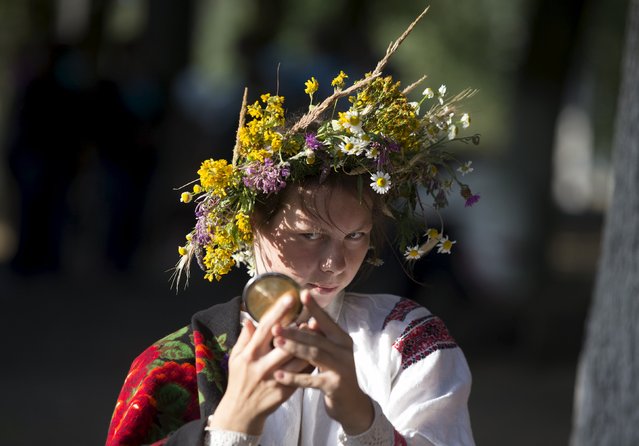
A Belarussian woman looks in the mirror as she takes part in the festival of national traditions “Piatrovski” in the village of Shipilovichi, south of Minsk, July 12, 2015. (Photo by Vasily Fedosenko/Reuters)

A Belarussian woman looks in the mirror as she takes part in the festival of national traditions “Piatrovski” in the village of Shipilovichi, south of Minsk, July 12, 2015. (Photo by Vasily Fedosenko/Reuters)
Details
13 Jul 2015 11:08:00
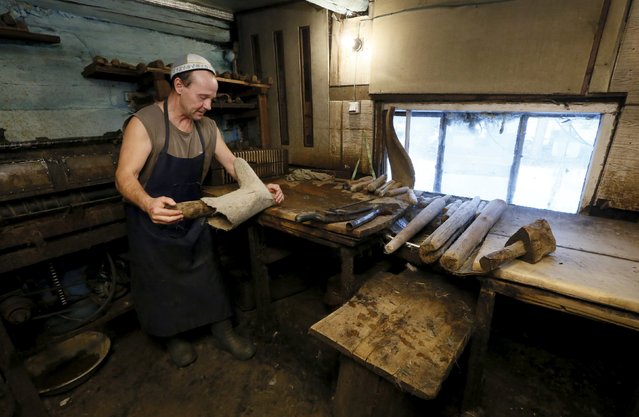
Ivan Plakhuta, 54, the owner of a small workshop manufacturing valenki, Russian traditional footwear, rolls a valenok in the remote Siberian village of Bolshaya Rechka, located in Taiga area in the foothills of the Western Sayan Mountain Ridge in the Yermakovsky district of Krasnoyarsk region, Russia, November 10, 2015. (Photo by Ilya Naymushin/Reuters)

Ivan Plakhuta, 54, the owner of a small workshop manufacturing valenki, Russian traditional footwear, rolls a valenok in the remote Siberian village of Bolshaya Rechka, located in Taiga area in the foothills of the Western Sayan Mountain Ridge in the Yermakovsky district of Krasnoyarsk region, Russia, November 10, 2015. (Photo by Ilya Naymushin/Reuters)
Details
16 Nov 2015 08:03:00
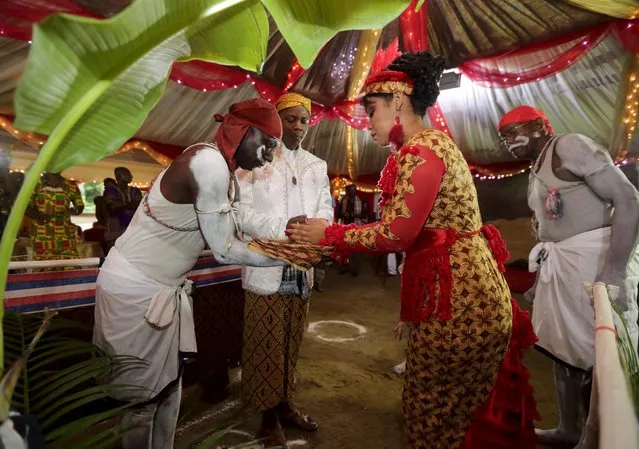
Winti spiritual leader Ramon Mac-Nack (2nd L) looks on as as his bride Melissa Karwafodi (2nd R) hands a gourd to a Maroon priest (L) as they are wedded in the first Winti marriage ever to be held in public, in district Para, Suriname, November 16, 2015. (Photo by Ranu Abhelakh/Reuters)

Winti spiritual leader Ramon Mac-Nack (2nd L) looks on as as his bride Melissa Karwafodi (2nd R) hands a gourd to a Maroon priest (L) as they are wedded in the first Winti marriage ever to be held in public, in district Para, Suriname, November 16, 2015. The Winti religion, which formed centuries ago out of elements of different religious traditions that African slaves brought with them to Suriname, was considered a form idolatry and prohibited by law since the days of slavery until it was finally officially recognized in 1971. (Photo by Ranu Abhelakh/Reuters)
Details
27 Nov 2015 05:51:00
Ancient Traditional Honey Hunters Of Nepal

Andrew Newey, an award-winning UK-based travel photographer, has captured gripping photographs of central Nepalese Gurung tribe members engaged in a dangerous and ancient tradition – honey hunting.
Details
19 Apr 2014 15:12:00
Clay "caganers" representing Spanish Prime Minister Mariano Rajoy (2nd L), Podemos's candidate Pablo Iglesias (R), Socialist Party (PSOE) leader Pedro Sanchez (2nd R) and Ciudadanos party leader Albert Rivera (L) are seen on display at the Santa Llucia Christmas market in central Barcelona, Spain, December 16, 2015. Catalans hide "caganers" or defecators, in Christmas Nativity scenes to let friends hunt for them during Christmas celebrations. The "caganers", which symbolise defecation and fertilization of the earth, are believed to bring prosperity and luck for the coming year. (Photo by Albert Gea/Reuters)

Clay "caganers" representing Spanish Prime Minister Mariano Rajoy (2nd L), Podemos's candidate Pablo Iglesias (R), Socialist Party (PSOE) leader Pedro Sanchez (2nd R) and Ciudadanos party leader Albert Rivera (L) are seen on display at the Santa Llucia Christmas market in central Barcelona, Spain, December 16, 2015. Catalans hide “caganers” or defecators, in Christmas Nativity scenes to let friends hunt for them during Christmas celebrations. The “caganers”, which symbolise defecation and fertilization of the earth, are believed to bring prosperity and luck for the coming year. (Photo by Albert Gea/Reuters)
Details
18 Dec 2015 08:00:00
Peruvian shamans holding a poster of Russia's President Vladimir Putin perform a ritual of predictions for the new year at Morro Solar hill in Chorrillos, Lima, Peru, December 29, 2015. (Photo by Mariana Bazo/Reuters)

Peruvian shamans holding a poster of Russia's President Vladimir Putin perform a ritual of predictions for the new year at Morro Solar hill in Chorrillos, Lima, Peru, December 29, 2015. The ritual is an end-of-the-year tradition and the shamans called for world peace and wished good luck for the upcoming elections in Peru and the U.S. (Photo by Mariana Bazo/Reuters)
Details
01 Jan 2016 08:06:00