Loading...
Done
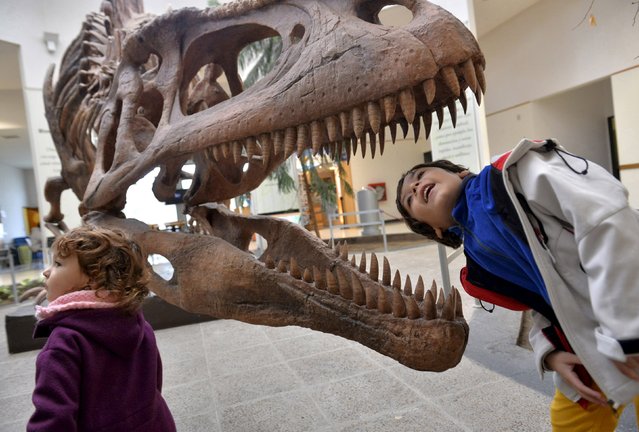
A boy looks inside the skull of a Tyrannosaurus Rex replica at the Egidio Feruglio Museum in Trelew, Argentina, in this May 18, 2014 file photograph. Scientists on July 28, 2015 unveiled a comprehensive analysis of the teeth of the group of carnivorous dinosaurs called theropods, which include the Tyrannosaurus Rex, detailing a unique serrated structure that let them chomp efficiently through the flesh and bones of large prey. (Photo by Maxi Jonas/Reuters)

A boy looks inside the skull of a Tyrannosaurus Rex replica at the Egidio Feruglio Museum in Trelew, Argentina, in this May 18, 2014 file photograph. Scientists on July 28, 2015 unveiled a comprehensive analysis of the teeth of the group of carnivorous dinosaurs called theropods, which include the Tyrannosaurus Rex, detailing a unique serrated structure that let them chomp efficiently through the flesh and bones of large prey. (Photo by Maxi Jonas/Reuters)
Details
29 Jul 2015 11:55:00
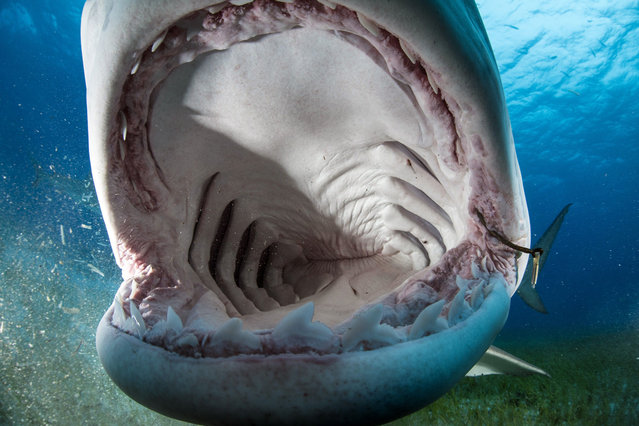
These jaw-some images show what its like to look inside the mouth of a tiger shark. Captured in amazing detail, the unique pictures show the alien-like anatomy of the shark and reveal rows upon rows of razor sharp teeth and white coloured gills. The incredible photographs were taken when a curious shark began to inspect the camera of British born photographer, Adam Hanlon, 46.(Photo by Adam Hanlon/Caters News)

These jaw-some images show what its like to look inside the mouth of a tiger shark. Captured in amazing detail, the unique pictures show the alien-like anatomy of the shark and reveal rows upon rows of razor sharp teeth and white coloured gills. The incredible photographs were taken when a curious shark began to inspect the camera of British born photographer, Adam Hanlon, 46. After sensing electronic impulses omitted by Adams camera, the inquisitive creature began to gently mouth at the cameras housing allowing him capture the unusual perspective. (Photo by Adam Hanlon/Caters News)
Details
29 Jan 2015 11:50:00
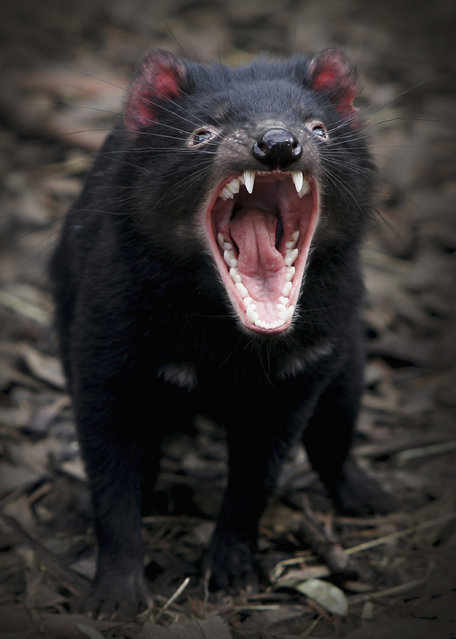
A Tasmanian Devil bears it's teeth at a quarantine facility August 31, 2005 in Hobart, Australia. The Devil, a native marsupial unique to Tasmania, is under threat from Devil Facial Tumor Disease (DFTD) which is decimating numbers throughout Tasmania. (Photo by Ian Waldie/Getty Images)

“The Tasmanian devil (Sarcophilus harrisii) is a carnivorous marsupial of the family Dasyuridae now found in the wild only in the Australian island state of Tasmania. The size of a small dog, it became the largest carnivorous marsupial in the world following the extinction of the thylacine in 1936. It is characterised by its stocky and muscular build, black fur, pungent odour, extremely loud and disturbing screech, keen sense of smell, and ferocity when feeding”. – Wikipedia. Photo: A Tasmanian Devil bears it's teeth at a quarantine facility August 31, 2005 in Hobart, Australia. (Photo by Ian Waldie/Getty Images)
Details
27 Jan 2014 09:45:00
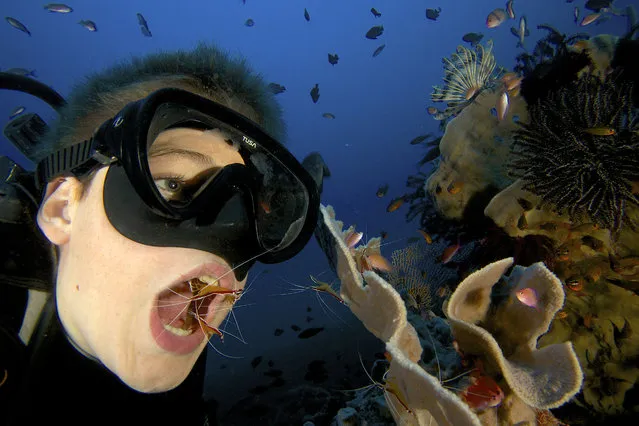
These unique photos capture the moment a boy has his teeth picked clean by amazing underwater shrimp. These fascinating creatures spend their lives diving inside the mouths of fish to remove the parasites that lurk there. Russell Laman imitated the behaviour of the surrounding fish swarm to entice the cleaner shrimp into his mouth whilst snorkelling with his father Tim Laman in Bali, Indonesia. The 13-year-old queued with the waiting fish and then opened his mouth when the shrimps came near. (Photo by Tim Laman/Caters News)

These unique photos capture the moment a boy has his teeth picked clean by amazing underwater shrimp. These fascinating creatures spend their lives diving inside the mouths of fish to remove the parasites that lurk there. Russell Laman imitated the behaviour of the surrounding fish swarm to entice the cleaner shrimp into his mouth whilst snorkelling with his father Tim Laman in Bali, Indonesia. The 13-year-old queued with the waiting fish and then opened his mouth when the shrimps came near. (Photo by Tim Laman/Caters News)
Details
17 Jul 2014 12:01:00
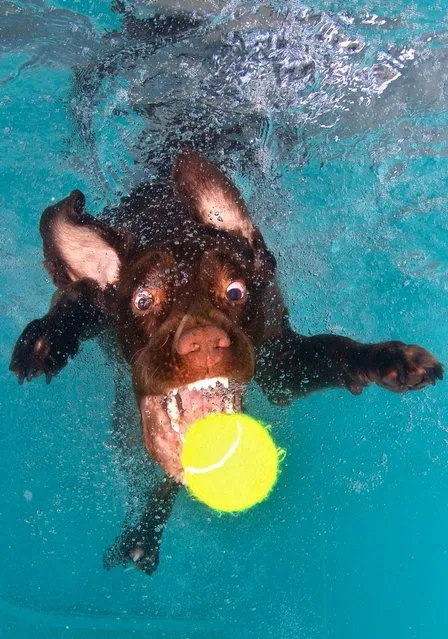
Photographer Lucy Ray says she has been scratched by the pooches who are diving underwater to try and catch a tennis ball. Their wide-eyed desperation has been captured by a specialist underwater photographer who admits she has been bitten and scratched by the pooches who only had eyes for the ball. Lucy Ray, 34, said: “A dog could have the cutest face on land but as soon as they get in the water they can be terrifying. Their eyes bulge and teeth shoot out of their mouth just like an alien as they try to catch the ball”. (Photo by Lucy Ray)

Photographer Lucy Ray says she has been scratched by the pooches who are diving underwater to try and catch a tennis ball. Their wide-eyed desperation has been captured by a specialist underwater photographer who admits she has been bitten and scratched by the pooches who only had eyes for the ball. Lucy Ray, 34, said: “A dog could have the cutest face on land but as soon as they get in the water they can be terrifying. Their eyes bulge and teeth shoot out of their mouth just like an alien as they try to catch the ball”. (Photo by Lucy Ray)
Details
15 Sep 2014 10:47:00
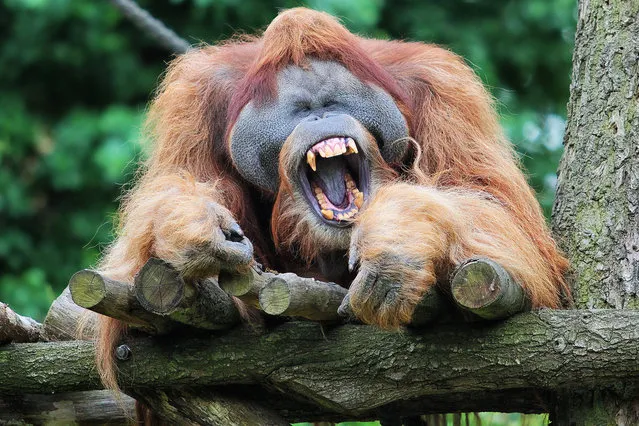
This huge male orangutan is having a right old laugh as he squints his eyes and shows his huge teeth.  The orangutan, called Bimbo, was relaxing on a platform around 5m high in his enclosure when he broke out into a laugh. But his happy smile soon disappeared when another orangutan came over to see what was going on.  Bimbo – the only male in the group of five apes at Leipzig Zoo, in Germany - appears to be laughing in much the same way as a human would. (Photo by Martina Radtke/Solent News)

This huge male orangutan is having a right old laugh as he squints his eyes and shows his huge teeth. The orangutan, called Bimbo, was relaxing on a platform around 5m high in his enclosure when he broke out into a laugh. But his happy smile soon disappeared when another orangutan came over to see what was going on. Bimbo – the only male in the group of five apes at Leipzig Zoo, in Germany - appears to be laughing in much the same way as a human would. (Photo by Martina Radtke/Solent News)
Details
29 Aug 2015 11:10:00
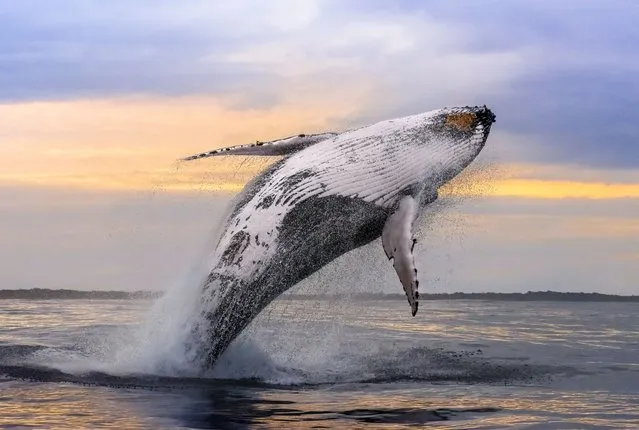
A 40-tonne humpback launching out of the water in an incredible breach in New South Wales, Australia on October 2022 in front of a sunset. The humpback whale can grow up to 56 feet long and typically covers 9,900 miles a year as it travels through the oceans of the world. Humpback whales are a species of Baleen whale, meaning they don't have teeth. Instead, they have baleen which helps them to filter feed. Their main source of food is krill or tiny bait fish. (Photo by Jodie Lowe/Media Drum Images)

A 40-tonne humpback launching out of the water in an incredible breach in New South Wales, Australia on October 2022 in front of a sunset. The humpback whale can grow up to 56 feet long and typically covers 9,900 miles a year as it travels through the oceans of the world. Humpback whales are a species of Baleen whale, meaning they don't have teeth. Instead, they have baleen which helps them to filter feed. Their main source of food is krill or tiny bait fish. (Photo by Jodie Lowe/Media Drum Images)
Details
30 Oct 2022 04:28:00
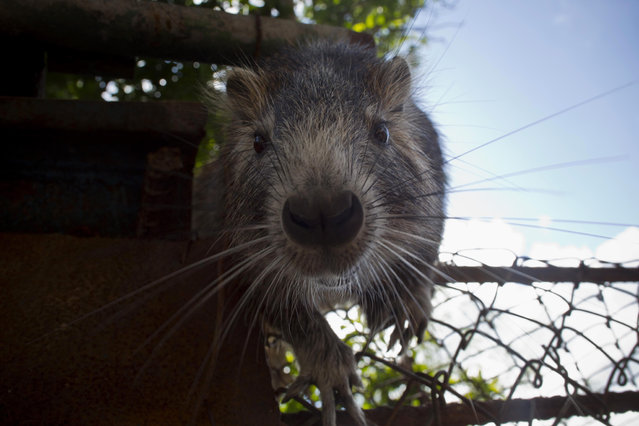
In this November 17, 2014 photo, Pancho, a domesticated huitia, confronts a camera, in Bainoa, Cuba. With their rope-like, dark tails, long front teeth, and whiskers that appear to be vibrating, huitias look like giant rats. They measure nearly a foot long (about 30 centimeters), with the largest ones weighing in bigger than a small dog. (Photo by Ramon Espinosa/AP Photo)

In this November 17, 2014 photo, Pancho, a domesticated huitia, confronts a camera, in Bainoa, Cuba. With their rope-like, dark tails, long front teeth, and whiskers that appear to be vibrating, huitias look like giant rats. They measure nearly a foot long (about 30 centimeters), with the largest ones weighing in bigger than a small dog. (Photo by Ramon Espinosa/AP Photo)
Details
21 Nov 2014 12:58:00