Loading...
Done


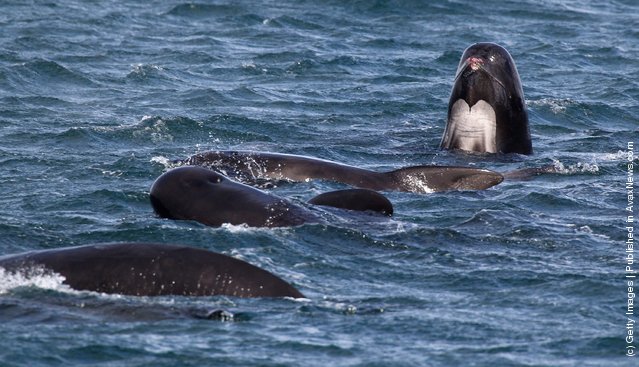
“Pilot whales are cetaceans belonging to the genus Globicephala. There are two extant species, the long-finned pilot whale (G. melas) and the short-finned pilot whale (G. macrorhynchus). The two are not readily distinguished at sea and analysis of the skulls is the best way to tell the difference between the two species. Between the two species, pilot whales range in waters nearly worldwide with long-finned pilot whales living in cooler waters and short-finned pilot whales living in warmer waters. Pilot whales are among the largest of the oceanic dolphins, exceeded in size only by the killer whale. They and other large members of the dolphin family are also known as blackfish”. – Wikipedia

Photo: Pilot whales swim in Loch Carron on May 20, 2011 in South Uist, Scotland. A major operation is underway to prevent up to 100 pilot whales from stranding on the rocky shoreline of Loch Carron on South Uist in the Western Isles. (Photo by Jeff J Mitchell/Getty Images)
Details
21 May 2011 07:58:00


Children, wearing traditional Bavarian folk costumes specific to their region, prepare for the competition in the “Schuhplattler” style of Bavarian folk dancing for the Bavarian Lion Award at the Huosigau Heimat and Folklore Society on May 28, 2011 in Weilheim, Germany. (Photo by Johannes Simon/Getty Images)
Details
29 May 2011 10:14:00


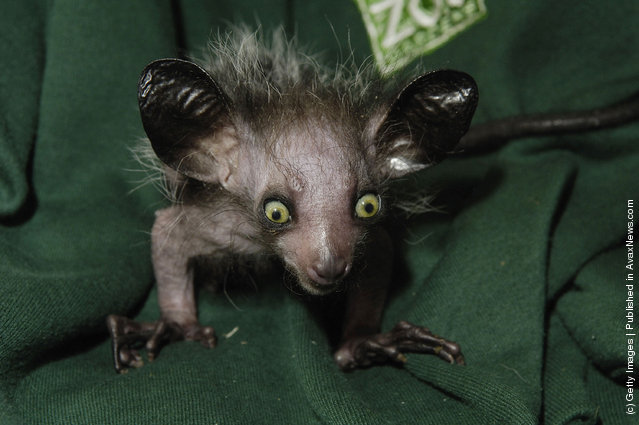
“The aye-aye (Daubentonia madagascariensis) is a lemur, a strepsirrhine primate native to Madagascar that combines rodent-like teeth and a special thin middle finger to fill the same ecological niche as a woodpecker. It is the world's largest nocturnal primate, and is characterized by its unusual method of finding food; it taps on trees to find grubs, then gnaws holes in the wood and inserts its narrow middle finger to pull the grubs out. The only other animal species known to find food in this way is the striped possum. From an ecological point of view the aye-aye fills the niche of a woodpecker as it is capable of penetrating wood to extract the invertebrates within”. – Wikipedia

Photo: In this handout image from Bristol Zoo is seen the first captive bred aye-aye in the UK named “Kintana” (meaning star in Malagasy) April 15, 2005 at Bristol Zoo Gardens, England. The zoo announced today only the second baby aye-aye to be hand-reared in the world (the first was in Jersey Zoo) and has now made his first public appearance since his birth on 11 February 2005. (Photo by Rob Cousins/Bristol Zoo via Getty Images)
Details
13 Apr 2011 13:33:00


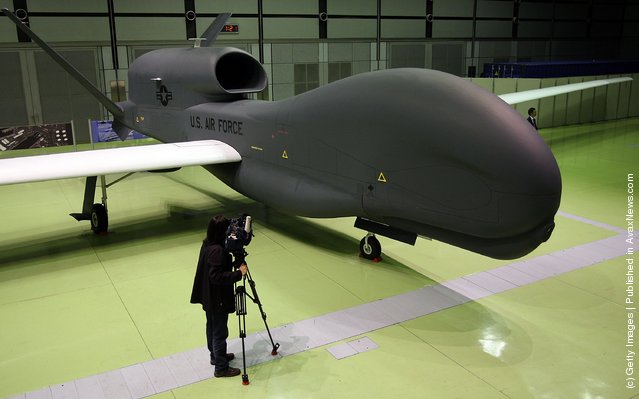
“The Northrop Grumman (formerly Ryan Aeronautical) RQ-4 Global Hawk (known as Tier II+ during development) is an unmanned aerial vehicle (UAV) used by the United States Air Force and Navy as a surveillance aircraft”. – Wikipedia

Photo: A full-scale model of The RQ-4 Global Hawk unmanned plane is displayed during a presentation at PiO Exhibition Center on March 24, 2010 in Tokyo, Japan. (Photo by Koichi Kamoshida/Getty Images)
Details
23 Jul 2011 12:31:00
A woman looks at head of bluefin tuna on display in front of a store at Tsukiji fish market in Tokyo, Monday, February 19, 2018.  The large bluefin are particularly valuable in Japan, where they are considered a premium sushi and sashimi fish. A single fish sold for more than $1.75 million at an auction in Japan in 2013. (Photo by Koji Sasahara/AP Photo)

A woman looks at head of bluefin tuna on display in front of a store at Tsukiji fish market in Tokyo, Monday, February 19, 2018. The large bluefin are particularly valuable in Japan, where they are considered a premium sushi and sashimi fish. A single fish sold for more than $1.75 million at an auction in Japan in 2013. (Photo by Koji Sasahara/AP Photo)
Details
06 Mar 2018 00:05:00
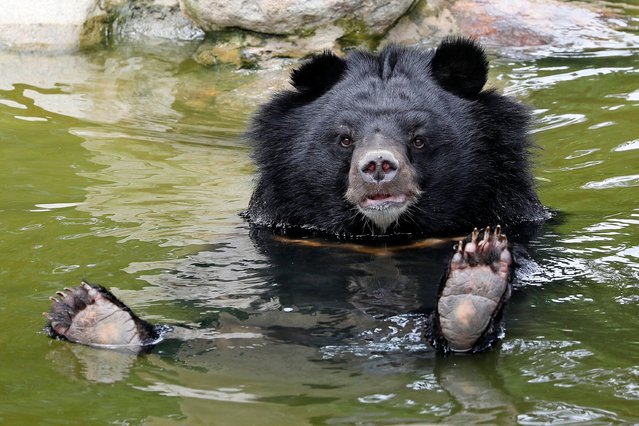
A moon bear rests in a pool inside an enclosure at the Vietnam bear rescue centre, in Tam Dao national park, Vinh Phuc, Vietnam, 09 July 2019. The center is operated by international organization Animals Asia. There are currently 184 bears living at the the Vietnam Bear Rescue Centre. It is estimated that there are less than a few hundred bears left in the wild in Vietnam. According to the latest data from the Ministry of Agriculture and Rural development, around 600 bears are still being kept on farms. In Vietnam, Animals Asia has rescued a total of 209 sun bears and moon bears. (Photo by Minh Hoang/EPA/EFE/Rex Features/Shutterstock)

A moon bear rests in a pool inside an enclosure at the Vietnam bear rescue centre, in Tam Dao national park, Vinh Phuc, Vietnam, 09 July 2019. The center is operated by international organization Animals Asia. There are currently 184 bears living at the the Vietnam Bear Rescue Centre. It is estimated that there are less than a few hundred bears left in the wild in Vietnam. According to the latest data from the Ministry of Agriculture and Rural development, around 600 bears are still being kept on farms. In Vietnam, Animals Asia has rescued a total of 209 sun bears and moon bears. (Photo by Minh Hoang/EPA/EFE/Rex Features/Shutterstock)
Details
14 Jul 2019 00:05:00
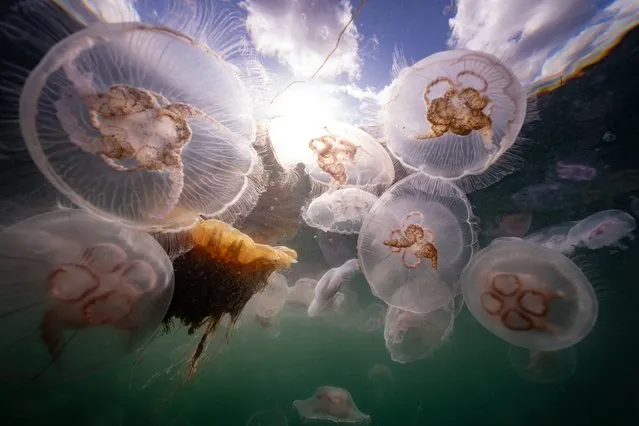
This picture taken on September 11, 2023 shows Moon Jellyfish (with rings) and Sting Jellyfish (yellow-orange inside) among a smack of a several thousand swimming off Seglvik, in northern Norway. (Photo by Olivier Morin/AFP Photo)

This picture taken on September 11, 2023 shows Moon Jellyfish (with rings) and Sting Jellyfish (yellow-orange inside) among a smack of a several thousand swimming off Seglvik, in northern Norway. (Photo by Olivier Morin/AFP Photo)
Details
07 Mar 2024 06:09:00
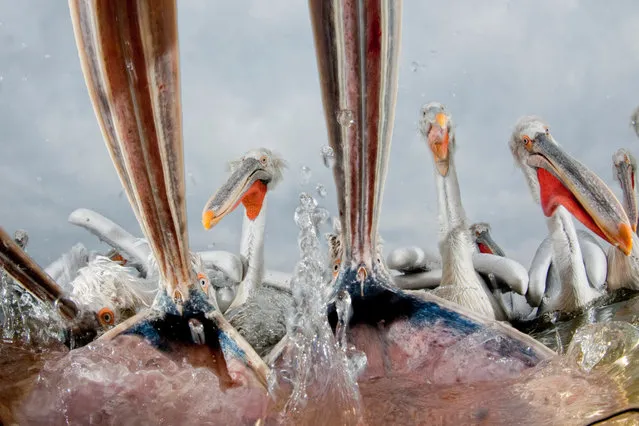
A pool ingeniously filled with clear water in the middle of Lake Kerniki in Greece enabled this shot of feeding pelicans. (Photo by Bence Mate/Close Up Photographer of the Year 2020)

A pool ingeniously filled with clear water in the middle of Lake Kerniki in Greece enabled this shot of feeding pelicans. (Photo by Bence Mate/Close Up Photographer of the Year 2020)
Details
02 Oct 2020 00:03:00