Loading...
Done
Two women wearing nun outfits drink beer while watching the 2014 Tim Hortons Brier curling championships in Kamloops, British Columbia in this March 8, 2014 file photo. (Photo and caption by Ben Nelms/Reuters)

Two women wearing nun outfits drink beer while watching the 2014 Tim Hortons Brier curling championships in Kamloops, British Columbia in this March 8, 2014 file photo. Although some people might conclude that a curling event could produce a dull atmosphere, it is actually far from it. Some of the most energetic and loyal fans are committed to showing their colours at tournaments around the world. There was a lull in the games that were being held on this day and I remember spotting these nuns sitting in their seats earlier. Although them just sitting there didn't produce a picture, I kept my eye on them for the entire match. As soon as I spotted them with beer in their hands, I slowly turned my camera towards them and waited for them to take a drink. One of the challenges of shooting this image was to not have everyone notice me taking the photo. I had a longer lens on and was right in the middle of the rink. I slowly turned my lens, not to make my intentions too obvious, and waited until they drank from their beers together. (Photo and caption by Ben Nelms/Reuters)
Details
27 Nov 2014 14:39:00
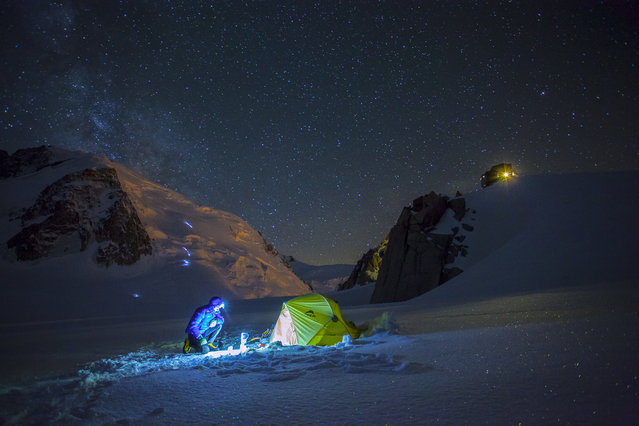
“A snapshot from mountaineer's life”. Have you ever wondered how does a mountaineer's day start? (Photo and caption by Kamil Tamiola/National Geographic Traveler Photo Contest)

“A snapshot from mountaineer's life”. Have you ever wondered how does a mountaineer's day start? I will give you a hint: you wake up at 3 am, set the stove, wake up your partner, pretend it is warm, quickly consume a high-calorie breakfast, watch your friends slowly ascending the icy slopes of your dream summit with their tiny head torches glimmering against perfectly blue ice, and hope for the good weather. One would ask: why all this trouble? The answer is easy: for the love of the adventure and the unknown. Location: Chamonix, Haute Savoye, France. (Photo and caption by Kamil Tamiola/National Geographic Traveler Photo Contest)

ATTENTION! All pictures are presented in high resolution. To see Hi-Res images – just TWICE click on any picture. In other words, click small picture – opens the BIG picture. Click BIG picture – opens VERY BIG picture.
Details
27 Jun 2013 12:47:00
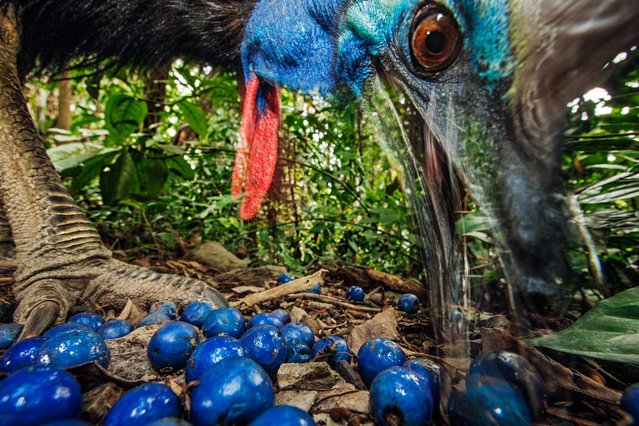
“Cassowaries are large, flightless birds related to emus and (more distantly) to ostriches, rheas, and kiwis”, writes Olivia Judson in the September issue of National Geographic magazine. (Photo by Christian Ziegler/National Geographic)

“Cassowaries are large, flightless birds related to emus and (more distantly) to ostriches, rheas, and kiwis”, writes Olivia Judson in the September issue of National Geographic magazine. How large? People-size: Adult males stand well over five foot five and top 110 pounds. Females are even taller, and can weigh more than 160 pounds. Dangerous when roused, they’re shy and peaceable when left alone. But even birds this big and tough are prey to habitat loss. The dense New Guinea and Australia rain forests where they live have dwindled. Today cassowaries might number 1,500 to 2,000. And because they help shape those same forests – by moving seeds from one place to another – “if they vanish”, Judson writes, “the structure of the forest would gradually change” too. (Photo by Christian Ziegler/National Geographic)
Details
06 Jan 2014 12:21:00
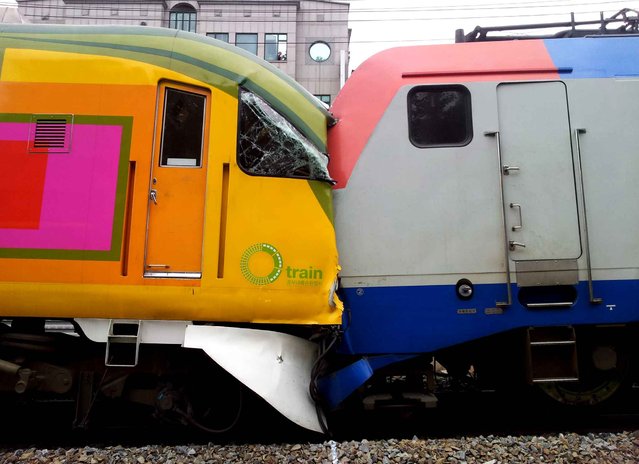
Collided passenger train cars are seen in Taebaek, South Korea, Tuesday, July 22, 2014. Two passenger trains collided head-on in eastern South Korea on Tuesday afternoon, killing one passenger and injuring dozens, fire officials said. (Photo by AFP Photo/Yonhap)

Collided passenger train cars are seen in Taebaek, South Korea, Tuesday, July 22, 2014. Two passenger trains collided head-on in eastern South Korea on Tuesday afternoon, killing one passenger and injuring dozens, fire officials said. (Photo by AFP Photo/Yonhap)
Details
26 Jul 2014 12:09:00
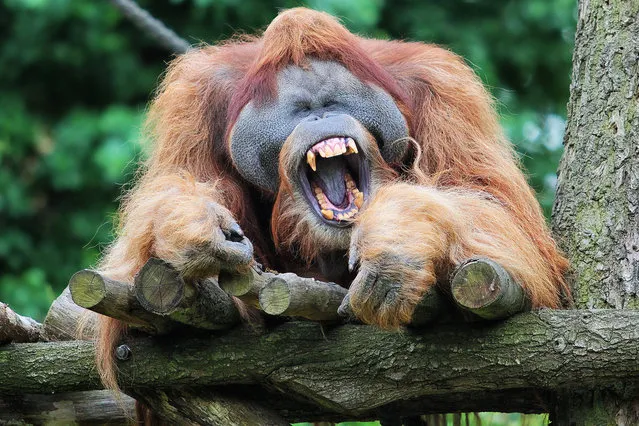
This huge male orangutan is having a right old laugh as he squints his eyes and shows his huge teeth.  The orangutan, called Bimbo, was relaxing on a platform around 5m high in his enclosure when he broke out into a laugh. But his happy smile soon disappeared when another orangutan came over to see what was going on.  Bimbo – the only male in the group of five apes at Leipzig Zoo, in Germany - appears to be laughing in much the same way as a human would. (Photo by Martina Radtke/Solent News)

This huge male orangutan is having a right old laugh as he squints his eyes and shows his huge teeth. The orangutan, called Bimbo, was relaxing on a platform around 5m high in his enclosure when he broke out into a laugh. But his happy smile soon disappeared when another orangutan came over to see what was going on. Bimbo – the only male in the group of five apes at Leipzig Zoo, in Germany - appears to be laughing in much the same way as a human would. (Photo by Martina Radtke/Solent News)
Details
29 Aug 2015 11:10:00
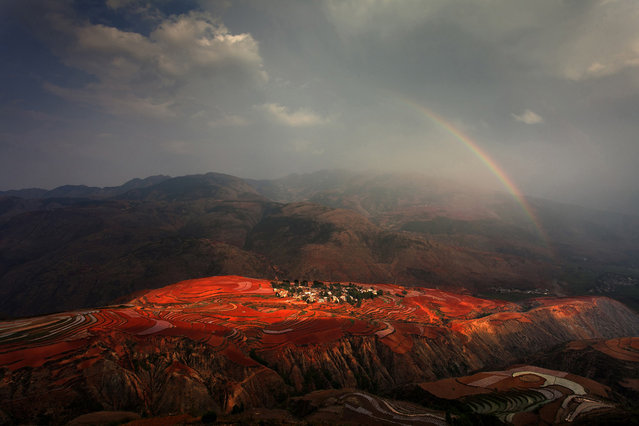
“Red Land: Sunset Cloud Village is one of the most picturesque places in Red Land, China. As its name indicates, it's best to see before sunset. The reddish brown soil turns redder after rainfall and after farmers plow the land”. (Photo and comment by Peng Jiang/National Geographic Photo Contest via The Atlantic)

“Red Land: Sunset Cloud Village is one of the most picturesque places in Red Land, China. As its name indicates, it's best to see before sunset. The reddish brown soil turns redder after rainfall and after farmers plow the land”. (Photo and comment by Peng Jiang/National Geographic Photo Contest via The Atlantic)


Details
05 Dec 2012 11:07:00
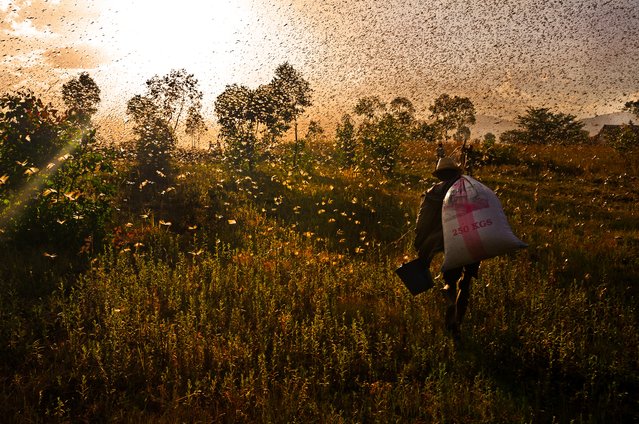
“Locusts & Men”. Oppression, interaction, collaboration. In the life cycle of nature nothing is lost, but the coexistence of different species is sometimes difficult. In Madagascar periodically returns the archaic antagonism between man and the migratory locust, in a circle of life where the two species are looking for space and food for their survival. Photo location: Madagascar, 2013. (Photo and caption by Michele Martinelli/National Geographic Photo Contest)

“Locusts & Men”. Oppression, interaction, collaboration. In the life cycle of nature nothing is lost, but the coexistence of different species is sometimes difficult. In Madagascar periodically returns the archaic antagonism between man and the migratory locust, in a circle of life where the two species are looking for space and food for their survival. At the end of the day a man walks home carrying on his shoulders the heavy bag which contains the locusts captured during the day. The insects provide nutritious meals for the man and his family. Photo location: Madagascar, 2013. (Photo and caption by Michele Martinelli/National Geographic Photo Contest)

ATTENTION! All pictures are presented in high resolution. To see Hi-Res images – just TWICE click on any picture. In other words, click small picture – opens the BIG picture. Click BIG picture – opens VERY BIG picture.
Details
03 Dec 2013 10:59:00
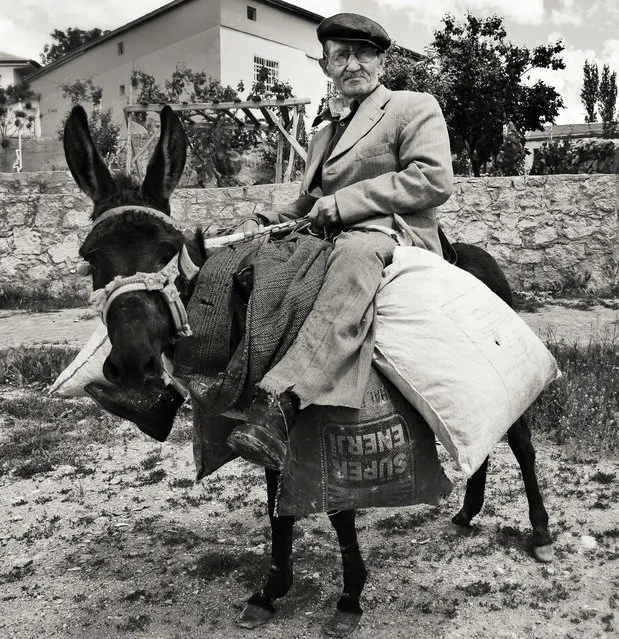
“Super Enerji”. Taken on my road trip through Turkey. (Photo and caption by Michelle Brandemuehl/National Geographic Traveler Photo Contest)

“Super Enerji”. Taken on my road trip through Turkey. (Photo and caption by Michelle Brandemuehl/National Geographic Traveler Photo Contest)

ATTENTION! All pictures are presented in high resolution. To see Hi-Res images – just TWICE click on any picture. In other words, click small picture – opens the BIG picture. Click BIG picture – opens VERY BIG picture.
Details
05 Jul 2013 11:17:00