Loading...
Done
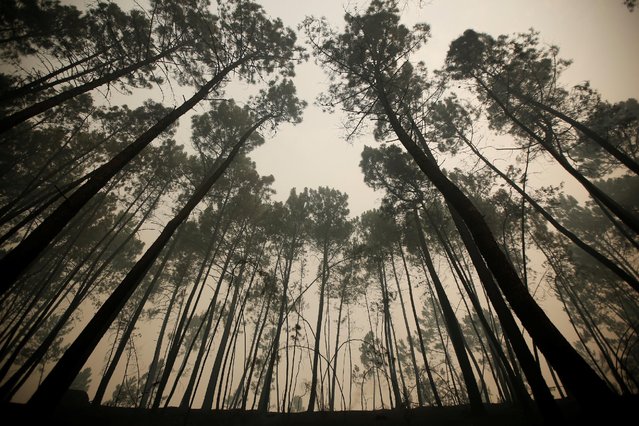
Pine trees are seen after a forest fire near Sao Pedro do Sul, Portugal August 14, 2016. (Photo by Rafael Marchante/Reuters)

Pine trees are seen after a forest fire near Sao Pedro do Sul, Portugal August 14, 2016. Deadly wildfires raging for two weeks in Portugal have destroyed a wooded area the size of 100,000 soccer fields, and the small Iberian nation alone accounts for half of all forests burned in the European Union this year. (Photo by Rafael Marchante/Reuters)
Details
17 Aug 2016 11:07:00
Persepolis, Takht-E-Jamshid Iran

Few people haven’t heard about the ancient city of Persepolis, which lies at the foot of the Mountain of Mercy (Kuh-I-Rahmat). In ancient times, Persepolis was the capital of the Achaemenid Empire. Regretfully, it was burned by the Greeks in 330 BC after they looted the immense treasure of this city. It is said that Greeks needed 5,000 camels and 20,000 mules to carry all the treasures from Persepolis. The only thing of Persepolis that has survived the wear of time is the ginormous stone terrace 530 by 330 meters adorned by elaborate stone sculptures. It is amazing how intricately detailed some of the sculptures are, despite the fact that they were created many centuries ago.
Details
26 Oct 2014 12:30:00
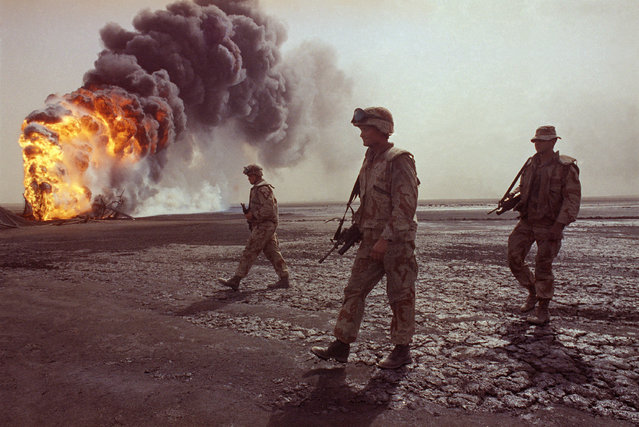
In this March 7, 1991 file photo, a U.S. Marine patrol walks across the charred oil landscape near a burning well during perimeter security patrol near Kuwait City. Twenty five years after the first U.S. Marines swept across the border into Kuwait in the 1991 Gulf War, American forces find themselves battling the extremist Islamic State group, born out of al-Qaida, in the splintered territories of Iraq and Syria. The Arab allies that joined the 1991 coalition are fighting their own conflicts both at home and abroad, as Iran vies for greater regional power following a nuclear deal with world powers. (Photo by John Gaps III/AP Photo)

In this March 7, 1991 file photo, a U.S. Marine patrol walks across the charred oil landscape near a burning well during perimeter security patrol near Kuwait City. Twenty five years after the first U.S. Marines swept across the border into Kuwait in the 1991 Gulf War, American forces find themselves battling the extremist Islamic State group, born out of al-Qaida, in the splintered territories of Iraq and Syria. The Arab allies that joined the 1991 coalition are fighting their own conflicts both at home and abroad, as Iran vies for greater regional power following a nuclear deal with world powers. (Photo by John Gaps III/AP Photo)
Details
23 Feb 2016 11:43:00


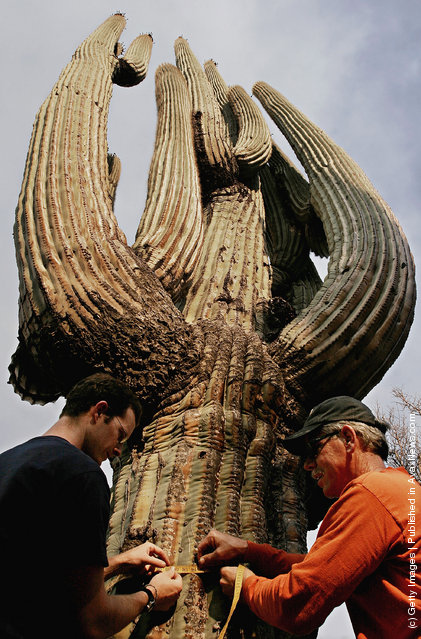
“The saguaro (scientific name Carnegiea gigantea) is a large, tree-sized cactus species in the monotypic genus Carnegiea. It is native to the Sonoran Desert in the U.S. state of Arizona, the Mexican state of Sonora, a small part of Baja California in the San Felipe Desert and an extremely small area of California, U.S. The saguaro blossom is the State Wildflower of Arizona”. – Wikipedia

Photo: Daniel Appel (L), a firefighter with Engine 84 from the Lassen National Forest in California and Mike Hallen, (R), Arizona representative of the National Register of Big Trees, measure the circumference of this Saguaro cactus called the "Grand One," in the Tonto National Forest on July 1, 2005 35 miles north of Phoenix, near Carefree, Arizona. The cactus, estimated to be more than 200 years old, measures a circumference of 7 feet, 10 inches (2.4 meters) and stands 46 feet high (14 meters). The cactus was burned in the Cave Creek Complex fire and may not survive. It was once the largest Saguaro in the world, two others have been found recently that have tied it's measurements. The fire has burned more than 214,000 acres of the Sonoran desert. (Photo by Jeff Topping/Getty Images)

Details
26 Jul 2011 12:27:00
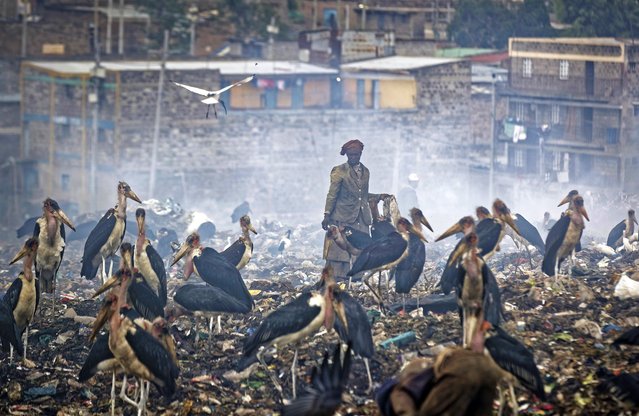
In this photo taken Wednesday, December 5, 2018, a woman who scavenges recyclable materials from garbage for a living is seen through a cloud of smoke from burning trash, surrounded by Marabou storks who feed on the garbage, at the dump in the Dandora slum of Nairobi, Kenya. As the world meets again to tackle the growing threat of climate change, how the continent tackles the growing solid waste produced by its more than 1.2 billion residents, many of them eager consumers in growing economies, is a major question in the fight against climate change. (Photo by Ben Curtis/AP Photo)

In this photo taken Wednesday, December 5, 2018, a woman who scavenges recyclable materials from garbage for a living is seen through a cloud of smoke from burning trash, surrounded by Marabou storks who feed on the garbage, at the dump in the Dandora slum of Nairobi, Kenya. As the world meets again to tackle the growing threat of climate change, how the continent tackles the growing solid waste produced by its more than 1.2 billion residents, many of them eager consumers in growing economies, is a major question in the fight against climate change. (Photo by Ben Curtis/AP Photo)
Details
14 Jan 2019 00:01:00
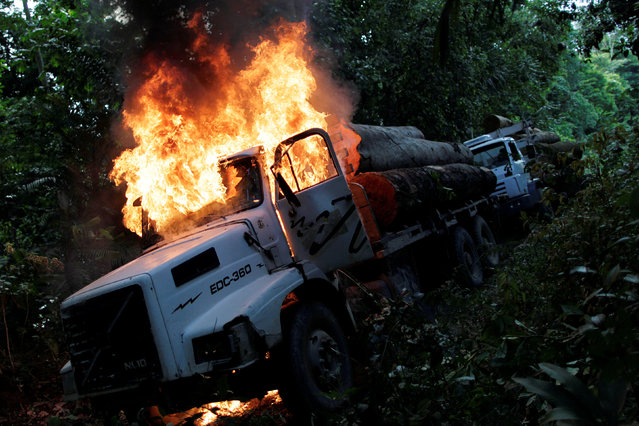
Trucks loaded with tree trunks are burned by agents of the Brazilian Institute for the Environment and Renewable Natural Resources, or Ibama, during an operation to combat illegal mining and logging, in the municipality of Novo Progresso, Para State, northern Brazil, November 11, 2016. When able to do their job, agents of the Brazilian Institute for the Environment and Renewable Natural Resources, or Ibama, are decisive, punishing illegal loggers on the spot. Nearly twice the size of India, the Amazon absorbs an estimated 2 billion tonnes of carbon dioxide per year, making its preservation vital in the fight to halt global warming. Ibama, responsible for preserving Brazil's 65 percent share of the world's largest rainforest, is one of the most important groups in that fight. But after years of surprising success, the rate of deforestation is on the rise again. Over the past four years it has risen 35 percent, as Ibama suffered from a lack of funding amid Brazil's worst recession in a century. (Photo by Ueslei Marcelino/Reuters)

Trucks loaded with tree trunks are burned by agents of the Brazilian Institute for the Environment and Renewable Natural Resources, or Ibama, during an operation to combat illegal mining and logging, in the municipality of Novo Progresso, Para State, northern Brazil, November 11, 2016. When able to do their job, agents of the Brazilian Institute for the Environment and Renewable Natural Resources, or Ibama, are decisive, punishing illegal loggers on the spot. Nearly twice the size of India, the Amazon absorbs an estimated 2 billion tonnes of carbon dioxide per year, making its preservation vital in the fight to halt global warming. (Photo by Ueslei Marcelino/Reuters)
Details
30 Nov 2016 12:36:00
World's Ugliest Dog

It's that time of year again when dogs with unusually large heads, hairless bodies and other oddities compete to be the World's Ugliest Dog. This year's winner? A 2-year-old mutt named Peanut, whose wild white and brown hair, bulging eyes and protruding teeth belie his sweet, energetic personality. Peanut's owner, Holly Chandler of Greenville, North Carolina, says he was seriously burned as a puppy and she wants to use her pet to raise awareness about animal abuse. She plans to use the $1,500 prize to pay for other animals' veterinary bills. The contest, held at the Sonoma-Marin Fairgrounds in Petaluma, California, is in its 26 year. The dogs are scored by a three-judge panel in several categories, including special or unusual attributes, personality and natural ugliness.
Details
24 Jun 2014 10:04:00
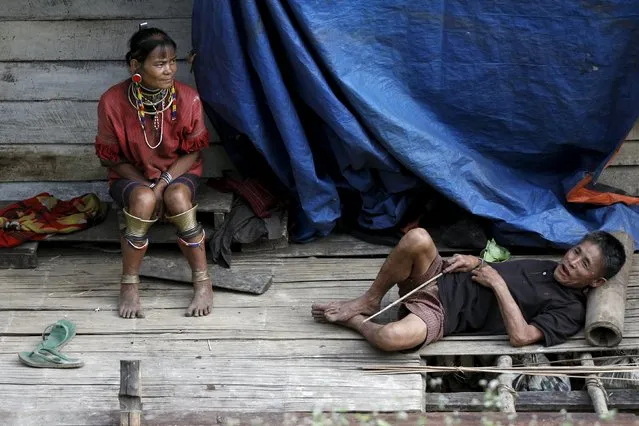
An ethnic Kayaw couple Mu Htoo and her husband Htaw Eili rest at their home at Htaykho village in the Kayah state, Myanmar September 12, 2015. (Photo by Soe Zeya Tun/Reuters)

An ethnic Kayaw couple Mu Htoo and her husband Htaw Eili rest at their home at Htaykho village in the Kayah state, Myanmar September 12, 2015. With about 30,000 members, the Kayaw are one of the smallest ethnic minorities among Myanmar's 135 groups. Their village has for decades been off-limits, as armed rebels fought the military before a recent ceasefire stopped the bloody conflict here. The rebels in the area have put down their guns and taken to the hills to grow rice and corn, but slash-and-burn cultivation methods mean they struggle to find new places to farm. (Photo by Soe Zeya Tun/Reuters)
Details
21 Oct 2015 08:03:00