Loading...
Done
Young women wearing facemasks and traditional costumes of Song dynasty and Tang dynasty are seated on a bench in a park next to the East Lake in Wuhan, in China’s central Hubei province on May 17, 2020. The Guardian picture desk has chosen on December 17, 2020, the AFP photojournalist Hector Retamal as “Agency Photographer of the Year 2020” for his coverage of the novel coronavirus Covid-19 pandemic in Wuhan, China. (Photo by Hector Retamal/AFP Photo)

Young women wearing facemasks and traditional costumes of Song dynasty and Tang dynasty are seated on a bench in a park next to the East Lake in Wuhan, in China’s central Hubei province on May 17, 2020. The Guardian picture desk has chosen on December 17, 2020, the AFP photojournalist Hector Retamal as “Agency Photographer of the Year 2020” for his coverage of the novel coronavirus Covid-19 pandemic in Wuhan, China. (Photo by Hector Retamal/AFP Photo)
Details
12 Jan 2021 00:03:00
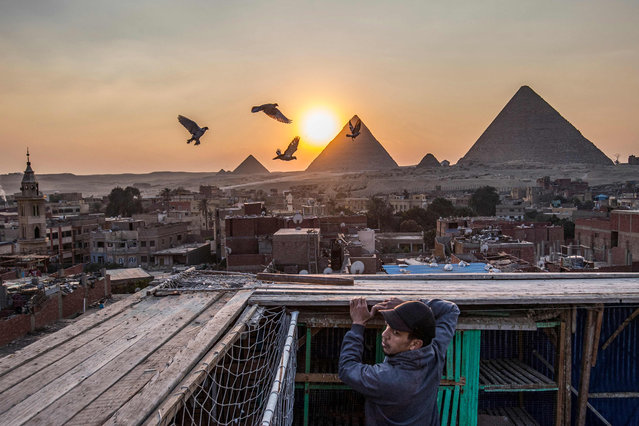
Omar Gamal, a 28-year-old pigeon keeper, stands next to his pigeon coop on his rooftop in the Egyptian capital's twin city of Giza on February 21, 2021, with the Pyramids of (R to L) Khufu (Cheops), Khafre (Chephren), and Menkaure (Menkheres) in the background. An ancient tradition handed down through the generations, the practice of domesticating pigeons stretches across borders from the banks of the Nile to north Africa and beyond, with people not only training birds for competitions, but also serving them up as a dining delicacy. (Photo by Khaled Desouki/AFP Photo)

Omar Gamal, a 28-year-old pigeon keeper, stands next to his pigeon coop on his rooftop in the Egyptian capital's twin city of Giza on February 21, 2021, with the Pyramids of (R to L) Khufu (Cheops), Khafre (Chephren), and Menkaure (Menkheres) in the background. An ancient tradition handed down through the generations, the practice of domesticating pigeons stretches across borders from the banks of the Nile to north Africa and beyond, with people not only training birds for competitions, but also serving them up as a dining delicacy. (Photo by Khaled Desouki/AFP Photo)
Details
27 Mar 2021 09:11:00
People stand next to a ship, containing tonnes of hazardous mercury-mixed oil, as it was allowed to anchor at Gadani ship-breaking yard in Gadani, Pakistan, 28 May 2021. Authorities have launched an investigation into the anchoring of a ship at the Gadani shipbreaking yard despite Interpol's warning that the ship contains dangerous chemicals. (Photo by Rehan Khan/EPA/EFE)

People stand next to a ship, containing tonnes of hazardous mercury-mixed oil, as it was allowed to anchor at Gadani ship-breaking yard in Gadani, Pakistan, 28 May 2021. Authorities have launched an investigation into the anchoring of a ship at the Gadani shipbreaking yard despite Interpol's warning that the ship contains dangerous chemicals. (Photo by Rehan Khan/EPA/EFE)
Details
18 Jun 2021 14:46:00
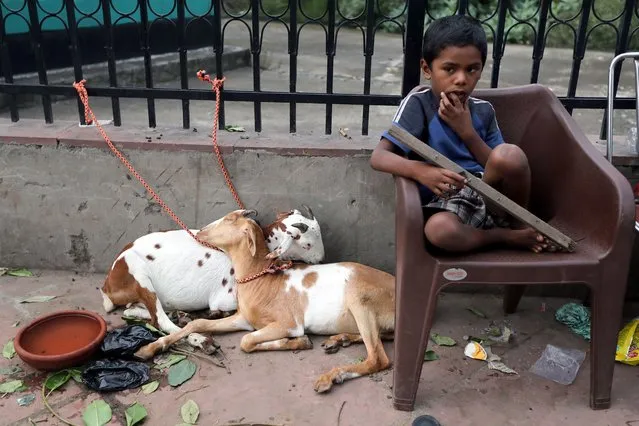
A boy sits next to sacrificial goats resting during Eid al-Adha in New Delhi, India, 29 June 2023. Muslims around the world celebrate Eid al-Adha or feast of sacrifice, by slaughtering sheep, goats and cows to commemorate Prophet Abraham's willingness to sacrifice his son Ismail at God's command. (Photo by Harish Tyagi/EPA)

A boy sits next to sacrificial goats resting during Eid al-Adha in New Delhi, India, 29 June 2023. Muslims around the world celebrate Eid al-Adha or feast of sacrifice, by slaughtering sheep, goats and cows to commemorate Prophet Abraham's willingness to sacrifice his son Ismail at God's command. (Photo by Harish Tyagi/EPA)
Details
07 Jul 2023 02:48:00
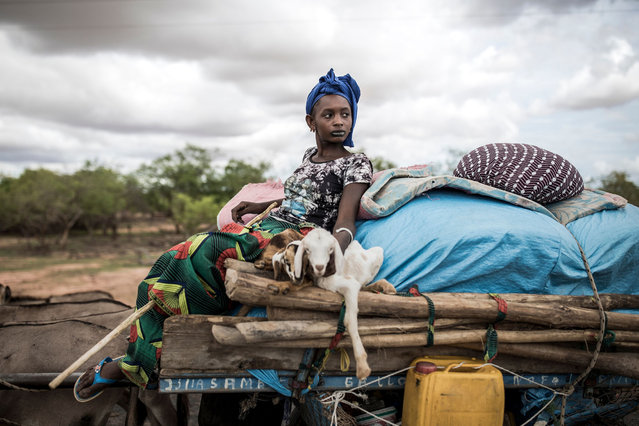
A Fulani Pastoralist carries two baby sheep on her donkey cart as her family move on northwards in Barkedji, Senegal on July 21, 2020. Thousands of Pastoralist families will start the movement north in the next weeks. With the first rains comes fresh grass and water for the Fulani herders' livestock, it also marks the point where most of the Pastoralist will move northwards until the dry season. (Photo by John Wessels/AFP Photo)

A Fulani Pastoralist carries two baby sheep on her donkey cart as her family move on northwards in Barkedji, Senegal on July 21, 2020. Thousands of Pastoralist families will start the movement north in the next weeks. With the first rains comes fresh grass and water for the Fulani herders' livestock, it also marks the point where most of the Pastoralist will move northwards until the dry season. (Photo by John Wessels/AFP Photo)
Details
04 Aug 2020 00:05:00
A woman with a sign that reads in Portuguese “Being woman without Temer”, stands next to a police barricade during a protest against the gang rape of a 16-year-old girl in Sao Paulo, Brazil, Wednesday, June 1, 2016. In response to the assault, Brazil's interim President Michel Temer said that the country will set up a specialized group to fight violence against women. (Photo by Andre Penner/AP Photo)

A woman with a sign that reads in Portuguese “Being woman without Temer”, stands next to a police barricade during a protest against the gang rape of a 16-year-old girl in Sao Paulo, Brazil, Wednesday, June 1, 2016. In response to the assault, Brazil's interim President Michel Temer said that the country will set up a specialized group to fight violence against women. (Photo by Andre Penner/AP Photo)
Details
03 Jun 2016 13:05:00
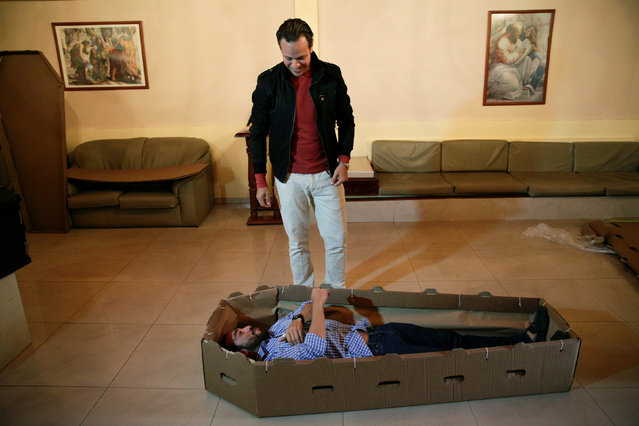
Elio Angulo (bottom C) lies inside a cardboard coffin next to Alejandro Blanchard as they introduce their product to potential customers at a mortuary in Valencia, in the state of Carabobo, Venezuela August 25, 2016. (Photo by Marco Bello/Reuters)

Elio Angulo (bottom C) lies inside a cardboard coffin next to Alejandro Blanchard as they introduce their product to potential customers at a mortuary in Valencia, in the state of Carabobo, Venezuela August 25, 2016. When Venezuelan entrepreneurs Alejandro Blanchard and Elio Angulo decided to create cardboard coffins, they were looking for an ecological selling point to compete against classic wood and brass caskets. Three years on, with the oil-rich country mired in deep economic crisis, their “bio-coffins” are becoming a viable option because of high prices for wooden coffins and shortages of brass ones. (Photo by Marco Bello/Reuters)
Details
27 Aug 2016 11:18:00
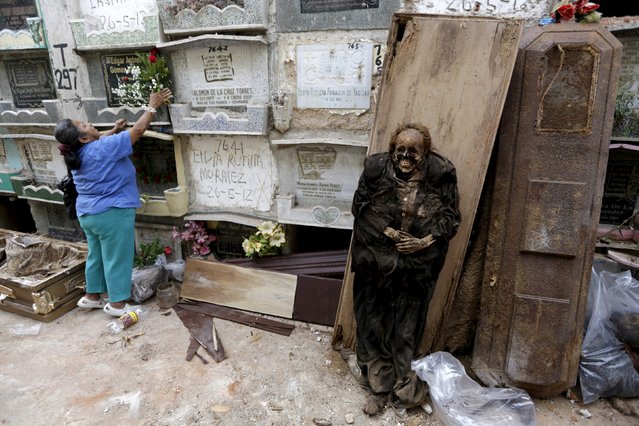
A woman (L) places flowers at a grave next to a mummified body during exhumation works at the General Cemetery in Guatemala City, April 15, 2015. (Photo by Jorge Dan Lopez/Reuters)

A woman (L) places flowers at a grave next to a mummified body during exhumation works at the General Cemetery in Guatemala City, April 15, 2015. If a lease on a grave has expired or not been paid, grave cleaners will break open the crypts to remove and rebury the bodies. Any remains that have not been claimed are packed into plastic bags, labeled and stored in mass graves. Bodies that have been stored in the upper crypt are exposed to dry and sunny conditions which means they do not decompose and instead become mummified. (Photo by Jorge Dan Lopez/Reuters)
Details
16 Apr 2015 13:01:00