Loading...
Done
Ballerina Kira Hilli of the Netherlands National Ballet dances in a tutu with a diameter of 3 meters for a video made for the 1.5 meter society, on the Prinsengracht in Amsterdam, The Netherlands, 04 June 2020 (issued on 12 June 2020). The so-called social distance tutu is made of denim fabric, specially made for the Safe Distance Ballet. (Photo by Remko de Waal/EPA/EFE)

Ballerina Kira Hilli of the Netherlands National Ballet dances in a tutu with a diameter of 3 meters for a video made for the 1.5 meter society, on the Prinsengracht in Amsterdam, The Netherlands, 04 June 2020 (issued on 12 June 2020). The so-called social distance tutu is made of denim fabric, specially made for the Safe Distance Ballet. (Photo by Remko de Waal/EPA/EFE)
Details
15 Jun 2020 00:07:00
Protesters a demonstration of the LGTBI collective in Madrid on November 20, 2021 against the rise of the fascism in the society and in support of the new transgender law in Spain. (Photo by Celestino Arce Lavin/ZUMA Press Wire/Rex Features/Shutterstock)

Protesters a demonstration of the LGTBI collective in Madrid on November 20, 2021 against the rise of the fascism in the society and in support of the new transgender law in Spain. (Photo by Celestino Arce Lavin/ZUMA Press Wire/Rex Features/Shutterstock)
Details
23 Nov 2021 09:16:00
Belgian yoga teacher Dorien Dierckx, 29 from Brussels enjoys a beer while relaxing in a jacuzzi full of hot water and a mixture of ingredients used to make beer, and where customers can serve their own beer from the tap at the Good Beer Spa in Brussels, Belgium on May 12, 2021. (Photo by Yves Herman/Reuters)

Belgian yoga teacher Dorien Dierckx, 29 from Brussels enjoys a beer while relaxing in a jacuzzi full of hot water and a mixture of ingredients used to make beer, and where customers can serve their own beer from the tap at the Good Beer Spa in Brussels, Belgium on May 12, 2021. (Photo by Yves Herman/Reuters)
Details
17 May 2021 07:47:00
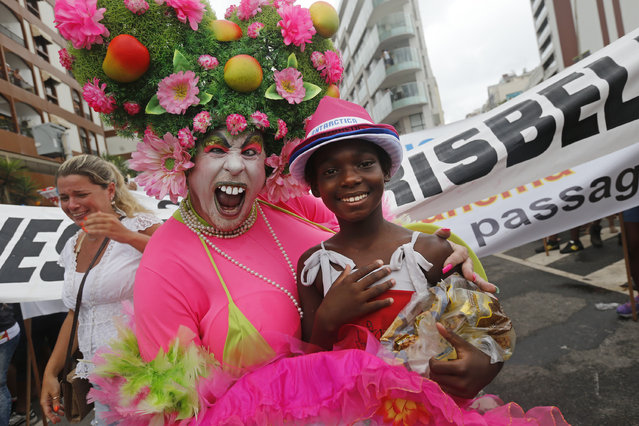
A reveler and a child street vendor pose for a photo during the Banda de Ipanema Carnival parade in Rio de Janeiro, Brazil, Saturday, January 31, 2015. Rio's over-the-top Carnival is the highlight of the year for many local residents. Hundreds of thousands of merrymakers are beginning to take to the streets in open-air “blocos” parties. (Photo by Silvia Izquierdo/AP Photo)

A reveler and a child street vendor pose for a photo during the Banda de Ipanema Carnival parade in Rio de Janeiro, Brazil, Saturday, January 31, 2015. Rio's over-the-top Carnival is the highlight of the year for many local residents. Hundreds of thousands of merrymakers are beginning to take to the streets in open-air “blocos” parties. (Photo by Silvia Izquierdo/AP Photo)
Details
03 Feb 2015 12:56:00
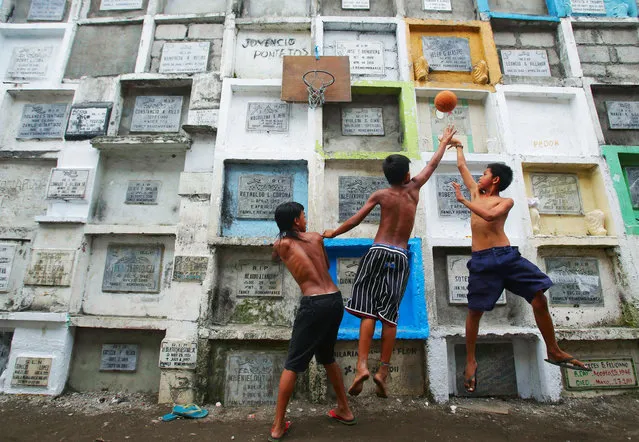
Filipino boys play basketball at an improvised court hooked on multi-layered tombs at a public cemetery in Navotas, north of Manila, Philippines on Thursday Oct. 31, 2013. Filipinos are expected to flock to cemeteries on November 1 to remember their dead as they observe All Saints Day in this predominantly Roman Catholic country. (Photo by Aaron Favila/AP Photo)

Filipino boys play basketball at an improvised court hooked on multi-layered tombs at a public cemetery in Navotas, north of Manila, Philippines on Thursday Oct. 31, 2013. Filipinos are expected to flock to cemeteries on November 1 to remember their dead as they observe All Saints Day in this predominantly Roman Catholic country. (Photo by Aaron Favila/AP Photo)
Details
02 Nov 2013 12:07:00
A reveller from Salgueiro performs during the second night of the Carnival parade at the Sambadrome in Rio de Janeiro, Brazil on February 13, 2018. (Photo by Sergio Moraes/Reuters)

A reveller from Salgueiro performs during the second night of the Carnival parade at the Sambadrome in Rio de Janeiro, Brazil on February 13, 2018. (Photo by Sergio Moraes/Reuters)
Details
15 Feb 2018 00:03:00
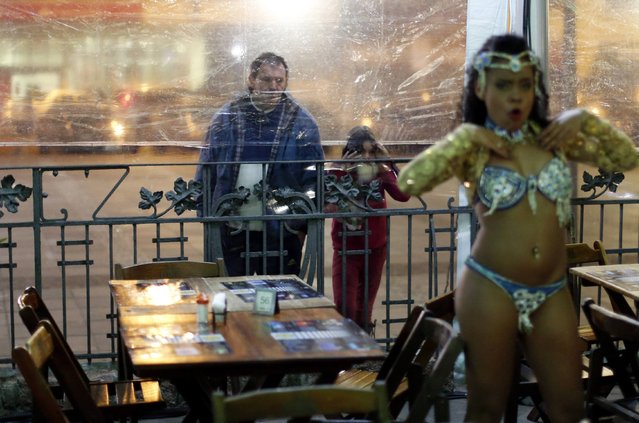
People watch from outside as a dancer performs inside a bar in Porto Alegre June 21, 2014. In a project called “On The Sidelines” Reuters photographers share pictures showing their own quirky and creative view of the 2014 World Cup in Brazil. (Photo by Marko Djurica/Reuters)

As national soccer teams and the photographers who have been covering them start to trickle home from the Brazil World Cup, it’s time to revisit the “On the Sidelines” project. This Reuters Pictures project was billed as a chance for photographers to share “their own quirky and creative view of the World Cup”. Photo: People watch from outside as a dancer performs inside a bar in Porto Alegre June 21, 2014. In a project called “On The Sidelines” Reuters photographers share pictures showing their own quirky and creative view of the 2014 World Cup in Brazil. (Photo by Marko Djurica/Reuters)
Details
09 Jul 2014 13:04:00


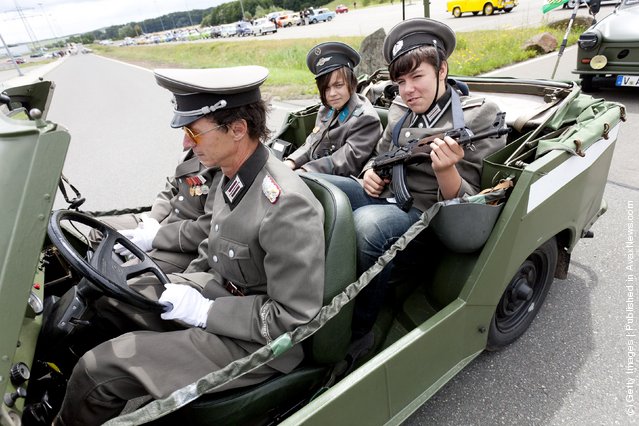
“The Trabant is a car that was produced by former East German auto maker VEB Sachsenring Automobilwerke Zwickau in Zwickau, Sachsen. It was the most common vehicle in East Germany, and was also exported to countries both inside and outside the communist bloc. The main selling points was that it had room for four adults and luggage in a compact, light and durable shell and that it was fast (when introduced) and durable. With its mediocre performance, smoky two-stroke engine, and production shortages, the Trabant is often cited as an example of the disadvantages of centralized planning; on the other hand, it is regarded with derisive affection as a symbol of the failed former East Germany and of the fall of communism (in former West Germany, as many East Germans streamed into West Berlin and West Germany in their Trabants after the opening of the Berlin Wall in 1989). It was in production without any significant changes for nearly 30 years with 3,096,099 Trabants produced in total”. – Wikipedia

Photo: Enthusiasts weared in uniforms of the former eastern german army trive in a military Trabant car as fans and owners of East German-era Trabant cars gather at the 2011 International Trabantfahrer Treffen (International Trabant Drivers Meeting) on June 26, 2011 in Zwickau, Germany. The Trabant, also known as the Trabi, was among the main cars produced in communist East Germany and built by VEB Sachsenring Automobilwerke in Zwickau for 30 years until 1989. Today the car has cult status for many followers and one company, IndiKar, is even seeking to revive the brand in a modern, electric version. (Photo by Carsten Koall/Getty Images)

Details
27 Jun 2011 12:21:00